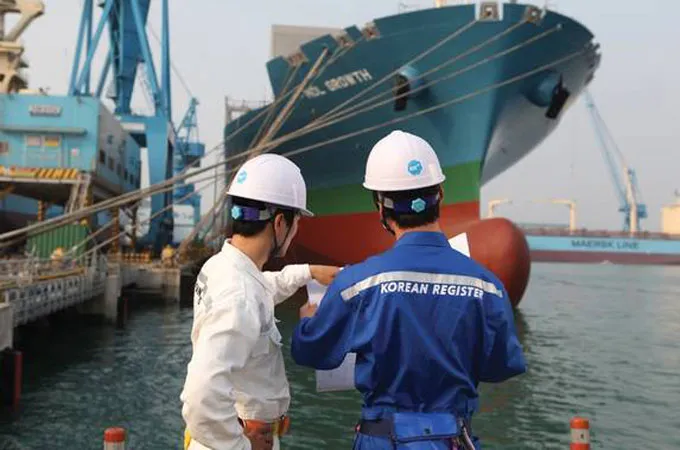
Korean Register (KR) has published the ‘Numerical Calculation Guidelines for the Determination of the Attained EEDI, developed through a joint research initiative with HD Hyundai Heavy Industries (HD HHI) and Samsung Heavy Industries (SHI).
These guidelines establish a standardized methodology for numerical analysis based on Computational Fluid Dynamics (CFD), providing an alternative to the conventional physical model testing previously used to verify vessel energy efficiency.
As the International Maritime Organization (IMO) continues to tighten greenhouse gas reduction regulations, the shipbuilding industry has been actively adopting a range of energy-saving technologies, including air lubrication systems and wind-assisted propulsion systems, to improve energy efficiency and reduce carbon emissions, said KR in a statement.
Historically, demonstrating the energy-saving performance of such technologies required physical model testing using scaled vessel models in large towing tanks or wind tunnels, resulting in significant time and cost burdens.
In contrast, CFD-based numerical analysis, which uses computer simulations to precisely calculate the flow of water and air around a hull, has emerged as a promising alternative. However, differences in analysis conditions and simulation settings can lead to variations in results, highlighting the need for objective and consistent verification standards.
These newly-published guidelines systematise the procedure for determining the EEDI reference speed (Vref) using CFD-based numerical calculations into three stages: qualification; validation and calibration; and main computation.
The guidelines were developed in collaboration with two of Korea's leading shipbuilders, HD HHI and SHI, incorporating practical design experience and validated performance data from actual ship design and engineering practices.
This is expected to enhance the efficiency of the classification approval process and contribute to reducing design and analysis lead times at shipyards.
These guidelines clearly define analysis methodologies and reporting standards to ensure the reliability and reproducibility of results.
Of particular significance is the inclusion of detailed modeling requirements and classification verification criteria for evaluating the performance of air lubrication and wind-assisted propulsion systems, areas not yet fully addressed in the guidelines of either the IMO or the International Association of Classification Societies (IACS), it added.
KR Executive Vice President, Kim Daeheon said: "Through this joint development, we have established an advanced technical standard that enables the maritime industry to proactively respond to international regulatory requirements.'
"We will continue to expand our technical support to strengthen the shipbuilding industry’s digital engineering capabilities and lead the market for environmentally friendly vessels," he added--TradeArabia News Service