In February 2026, total net electricity generation in the Organisation for Economic Co-operation and Development (OECD) reached 920.8 TWh, an increase of 0.8 per cent compared to February 2025.
Of this total, 418.4 TWh (45.4 per cent) was produced from fossil fuels, 347.8 TWh (37.8 per cent) from renewable sources and 144.4 TWh (15.7 per cent) from nuclear power.
Electricity generation from fossil fuels decreased by 4.7 per cent year-on-year in the OECD in February 2026, reported International Energy Agency (IEA).
Electricity generation from natural gas decreased by 3.3 per cent year-on-year (-8.8 TWh), and generation from coal decreased by 8.3 per cent year-on-year (-13.1 TWh).
The shares of natural gas, coal and oil as a percentage of total electricity generation were 28.3 per cent, 15.7 per cent and 1.4 per cent, respectively.
The decrease in electricity generation from natural gas was driven by OECD Europe (-13.6 per cent y-o-y, -8.6 TWh), while the decrease in coal occurred in both OECD Europe (-13.6 per cent y-o-y, -5.2 TWh) and in OECD Americas (-11.5 per cent y-o-y, -8.2 TWh).
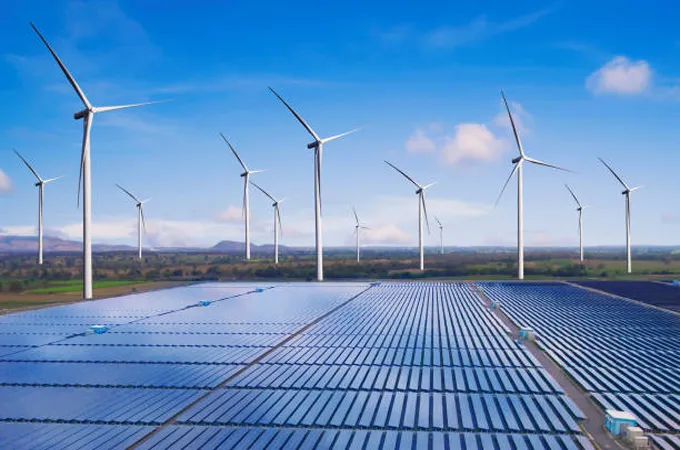
Electricity generation from renewable sources increased by 10.1 per cent year-on-year (+31.8 TWh) in the OECD in February 2026.
The highest absolute increase came from wind power generation (+18.8 per cent y-o-y, +18.5 TWh), bringing total OECD wind generation to 116.8 TWh (12.7 per cent of total generation).
This increase was mainly driven by OECD Europe, where wind power generation increased by 36.9 per cent year-on-year (+17.2 TWh) to 63.7 TWh.
Inside Europe, the increase in wind generation was led by Germany (+5.3 TWh) followed by Spain and France, each with a 2.6 TWh increase compared to the same month in 2025.
The total electricity generation from solar in the OECD also increased by 11.9 per cent year-on-year (+7.2 TWh) to 67.5 TWh (7.3 per cent of total generation).
Nuclear power generation decreased 3.4 per cent year-on-year (-5.1 TWh) in the OECD in February 2026.
This was driven by a 3.9 TWh (-25.6 per cent y-o-y) drop in
Korea and a 1.1 TWh (-44.1 per cent y-o-y) drop in Belgium’s Nuclear
generation. -OGN/ TradeArabia News Service