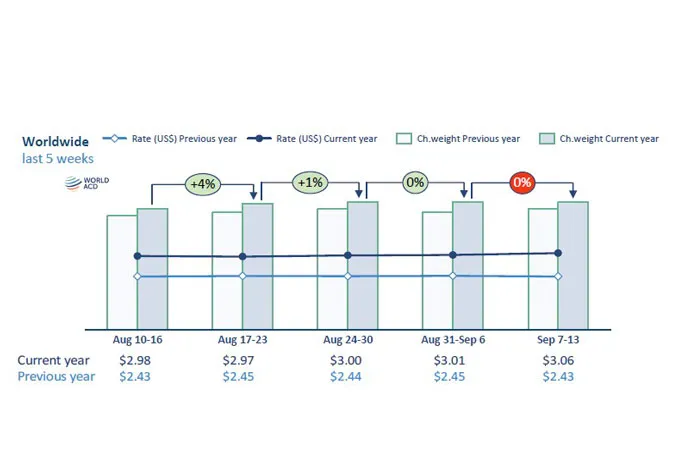
Worldwide air cargo tonnages rebounded in mid-September after the usual annual dip around the US and Canadian Labour Day holiday, with chargeable weight rising for a fourth consecutive week. However volumes from the Middle East and South Asia fell 4%, while Africa also recorded a 4% decline.
Air cargo tonnages, spot rates and capacity from Asia Pacific all rose in the second week of September, although the strong performance was partly a rebound from national holidays the previous week in Vietnam and Malaysia.
Global air cargo rates fell in July as the conflict involving Iran pushed up jet fuel costs and disrupted supply chains, while new European Union import rules further weakened shipments from China and Hong Kong to Europe, according to WorldACD Market Data.

Worldwide air cargo tonnages and rates for the first half of 2026 were well up on last year’s levels with the June’s figures up 9% over the same month last year, and stable compared to May, despite the disruptions to capacity and markets in the Middle East, said a report.
Global air cargo rates extended their decline at the end of June and early July as lower fuel prices and softer demand weighed on the market, although renewed tensions in the Middle East region have raised the risk of fresh supply chain disruption, according to a report.

Total global air cargo demand, measured in cargo tonne-kilometres (CTK), increased by 6.0% in May this year, compared to May 2025 levels (6.5% for international operations), according to International Air Transport Association (IATA) data.

Global air cargo volumes rebounded in the first week of June as airlines restored capacity following disruptions caused by a convergence of public holidays in Europe (Pentecost), US (Memorial Day) and Eid Al Adha festival affecting notably Middle East & South Asia and Africa origin regions.

Global air cargo demand rose 4% year-on-year in April, supported by robust Asia-linked trade flows, despite severe disruption at major Gulf hubs from conflict in the Middle East that reshaped trade routes and constrain capacity on key corridors, said a report.

Even though the rebound in global airfreight traffic slowed, pricing continued to rise further, indicating that the price of jet fuel is replacing capacity constraints as the driver of upward rate momentum, said a report. GCC-based airlines continued to rebuild their capacity but still face constraints from the conflict.

The sharp rise in global air cargo rates following the outbreak of war involving the US, Israel and Iran is showing signs of slowing, as a fragile ceasefire allows capacity to gradually return to Middle East markets. The recovery was led by Gulf markets, where the capacity shortfall narrowed to 46% from 53%.