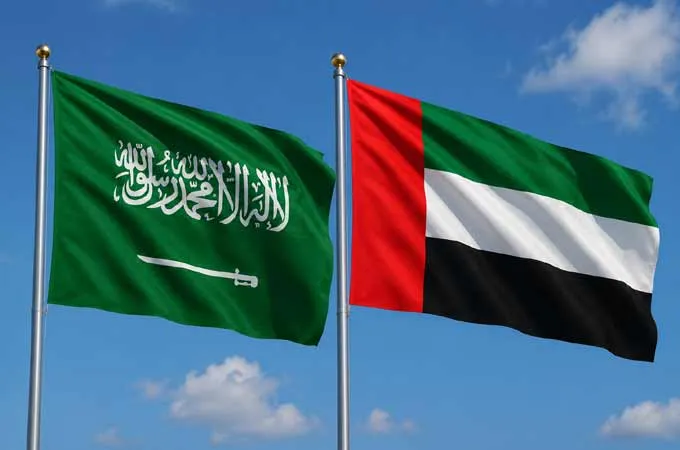
The Middle East conflict entered a new phase over the weekend as the United States paused its bombing campaign against Iran after 13 consecutive nights of strikes, while violence shifted to the Red Sea where Iran-backed Houthi rebels targeted Saudi commercial assets, prompting retaliatory military action by Saudi Arabia.
The apparent halt in US air strikes came amid renewed diplomatic signals from Washington.
US President Donald Trump indicated on Friday that negotiations with Tehran were becoming more serious, suggesting diplomacy remained his preferred option after nearly two weeks of sustained military operations. However, an Iranian official dismissed the remarks, saying the conflict was "one that will not end."
There were also no reports over the weekend of fresh Iranian attacks against neighbouring countries, marking a pause in Tehran's pattern of near-daily responses to US military operations.
Saudi vessel attacked
Saudi Arabia said one of its commercial vessels, NCC MASA, sustained minor hull damage after being targeted while sailing through the Red Sea on Saturday. The Saudi Transport General Authority confirmed that the crew remained safe and that the vessel continued its voyage after inspections verified its seaworthiness.
Saudi officials condemned the attack as a violation of international maritime law, warning that repeated assaults on commercial shipping threatened one of the world's busiest trade corridors.
The attack followed Saudi air strikes against Houthi military positions in Yemen on Friday after the Iran-backed group launched a series of attacks against commercial shipping.
Officials from Yemen's internationally recognised, Saudi-backed government said coalition aircraft struck Houthi targets in Marib and Al Jawf provinces, while both sides were reported to be mobilising forces along frontlines, raising fears of a broader escalation in Yemen's long-running civil war.
The Houthis claimed responsibility on Saturday for attacks against Saudi installations along the Red Sea coast, opening what analysts describe as another active front in the broader confrontation between Iran and its regional adversaries.
Coalition spokesman Major General Turki Al-Malki said the Houthis had committed a "reckless and cowardly" terrorist act by attacking commercial vessels in the Red Sea, describing the assault as part of a long pattern of maritime attacks threatening international shipping.
He said coalition forces had carried out a "firm, resolute and proportionate" military response directed exclusively at legitimate military targets used by the Houthis to threaten commercial navigation.
Ports stay open
Al-Malki also rejected Houthi claims regarding humanitarian restrictions, saying Hodeidah, Ras Isa and Salif ports remained open to commercial shipping carrying food, fuel and other essential supplies, while accusing the Houthis of preventing flights to Sana'a International Airport.
He warned that any further attacks against Saudi interests or international shipping would be met with an "unrelenting, resolute response."
Pressure to continue
Despite the pause in US air strikes, the US military stressed that pressure on Iran continues unabated.
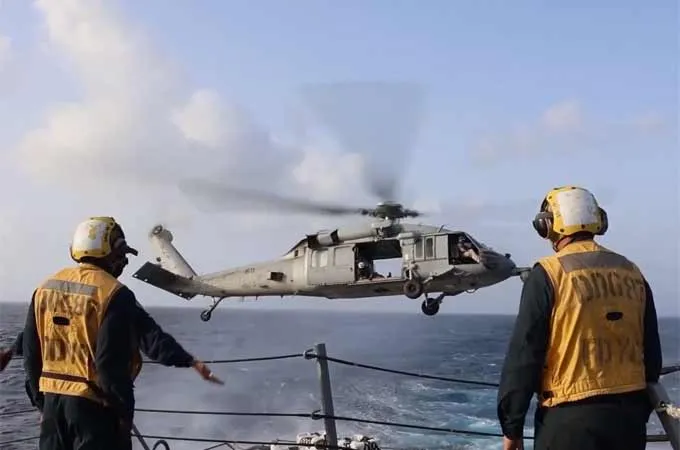
US Central Command (CENTCOM) said its naval blockade against Iran "remains in full effect," announcing that US forces boarded another commercial tanker in the Arabian Sea to verify compliance with the blockade. The Comoros-flagged M/T Charminar was allowed to continue its voyage after inspection.
CENTCOM also disclosed additional details about another tanker intercepted a day earlier, saying the Mozambique-flagged M/T Lavine in the Gulf of Oman had violated the blockade, ignored repeated warnings and was subsequently disabled before being prevented from sailing to Iran.
According to the US military, since reimposing the naval blockade earlier this month, American forces have redirected 12 commercial vessels, boarded two ships for inspections and disabled two vessels that failed to comply.
The Pentagon has not officially explained why it suspended the bombing campaign after 13 straight nights of escalating attacks on Iranian targets.
Push for diplomacy
A senior Trump administration official said the president had always preferred diplomacy but had demonstrated the consequences if Tehran refused serious negotiations.
"Combined with successful sanctions that have crippled Iran's economy and 13 straight days of strikes against military targets in response to their repeated aggression, it would be wise for Iran to work towards a negotiated deal. Otherwise, they know what will happen," White House Communications Director Steven Cheung said.
Behind the scenes, however, senior military leaders reportedly urged caution.
According to sources familiar with White House discussions, Vice President JD Vance and Chairman of the Joint Chiefs of Staff Gen Dan Caine expressed concerns during a meeting with Trump over the risks of further escalation and the strain prolonged operations could place on US precision-guided munitions stockpiles, said a CNN report.
A Department of Defense source said operations were currently "on hold," although it remained unclear whether the pause would prove temporary.
While US-Iran hostilities eased slightly, attention shifted to the Red Sea, where the conflict intensified dramatically.
Caspian Sea incident
Meanwhile, Iran accused Ukraine of carrying out what it described as a "hostile and criminal" attack against one of its vessels in the Caspian Sea. Iran's Foreign Ministry summoned Ukraine's chargé d'affaires in Tehran to protest the alleged incident, according to state news agency IRNA.