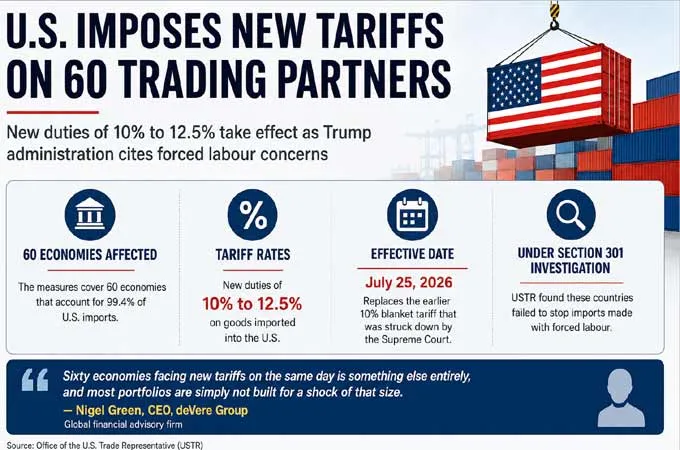
The United States has imposed fresh tariffs ranging from 10% to 12.5% on imports from 60 major trading partners, including several Middle Eastern countries, after concluding that they had failed to take sufficient action to prevent goods produced with forced labour from entering their markets.
The measures took effect on Friday.
The action replaces a temporary 10% across-the-board tariff that had been introduced earlier this year but was subsequently struck down by the US Supreme Court. The new duties have instead been imposed under Section 301 of the Trade Act following an investigation by the Office of the US Trade Representative (USTR).
According to the USTR, the tariffs cover 60 economies that together account for 99.4% of US imports. The agency said the investigation found the countries had failed to adequately prohibit or enforce bans on imports made using forced labour. Certain products, including oil, natural gas, fertilisers and some food items, are exempt from the measures.
The affected economies include major US trading partners such as the European Union, China, Japan, India, Canada and Mexico, as well as Gulf countries including Bahrain, Saudi Arabia, the United Arab Emirates, Qatar, Kuwait and Oman.
Senior White House officials said President Donald Trump remained committed to pursuing his trade agenda despite the Supreme Court ruling against the earlier tariff framework.
The move has drawn criticism from several governments. European Union foreign policy chief Kaja Kallas described the tariffs as a "negative surprise" and rejected the US allegations. Switzerland also objected to the findings, while Norway said it had no plans to retaliate with tariffs on American goods.
Market impact
Nigel Green, chief executive of global financial advisory firm deVere Group, said the simultaneous imposition of tariffs on 60 economies represented a significant shock for global markets.
"One country facing new tariffs is a single-sector concern for that country's exporters. Sixty economies facing new tariffs on the same day is something else entirely, and most portfolios are simply not built for a shock of that size," he said.
Green warned that many investment portfolios may be more exposed than investors realise because they rely on the same manufacturing hubs and shipping routes.
"Tariffs are a tax, plain and simple, and a tax this broad has inflation consequences central banks cannot ignore, even before you factor in what is happening with oil right now on top of it," he said.
He advised investors to treat trade policy as a permanent investment risk rather than a temporary disruption, arguing that currency markets, bond yields and sector performance could see increased volatility in the coming weeks as businesses adjust to the new tariff regime.
"Investors who sit on their hands until this settles are still making a decision, just a passive one," Green said, adding that investors would be better served by reviewing their exposure to supply chains and international trade risks now rather than waiting for corporate earnings to reflect the impact. - TradeArabia News Service