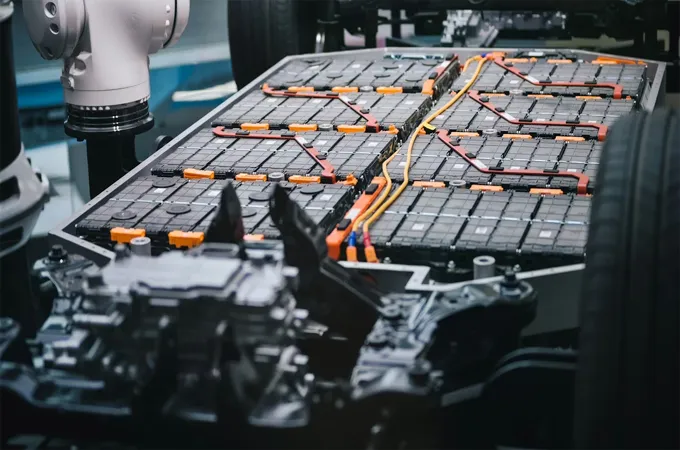
The number of lithium-ion and similar batteries reaching end-of-life is expected to rise sharply from the mid-2030s onwards, making managing battery waste safely and efficiently a key challenge.
Companies,
universities and public research centres are responding by accelerating innovation to
recycle critical raw materials and reduce reliance on primary mining, while
mitigating the environmental impact.
According to a new
study published by the European Patent Office (EPO) and the International
Energy Agency (IEA), international patent families (IPFs) related to
battery circularity recorded an average annual growth rate of 42 per cent from
2017 to 2023.
This figure compares
with 16 per cent for rechargeable battery manufacturing overall and 2 per cent
for all technical fields during the same period.
“Innovation in battery
circularity technologies is key to securing resources, strengthening
competitiveness and reducing environmental impact,” said António Campinos, EPO President. “As
this field becomes increasingly important in global resource systems, regions
that combine strong industrial ecosystems, supportive policy frameworks and
access to recycling feedstock will be well positioned to lead the circular
battery economy. Europe brings many of these elements together, with a diverse
innovation ecosystem and policy initiatives that provide a solid foundation for
the development of circular battery value chains.”
“In the age of
electricity, batteries have become a cornerstone of energy security and
industrial competitiveness, but their full value will only be realised if
countries build strong circular systems around them,” said Fatih Birol, IEA Executive
Director . “Accelerating innovation in recycling and reuse can ease
pressure on critical mineral supply chains, reduce environmental impacts and
create new economic opportunities. Europe has important strengths to build on,
and this report highlights how targeted innovation and policy support can help
position it at the forefront of a sustainable battery economy.”
More than one in four
cars sold globally in 2025 was an electric vehicle, reliant on lithium-ion or
other modern batteries.
But around 1.2 million
electric vehicle batteries could reach the end of their lives in 2030 and 14
million in 2040, and today’s supply chains for battery minerals and components
are highly concentrated.
Battery circularity
technologies - including recycling, reuse of batteries in vehicles and
repurposing of batteries for new applications – can help solve these
challenges.
The EPO-IEA report
draws on resources including the EPO’s patent databases and IEA expert analysis
to identify the main locations of patenting, the leading patent applicants and
the key technology categories.
Energy storage,
including batteries, now accounts for around 40 per cent of all energy‑related
patenting and continues to grow rapidly.
Patenting related to
battery circularity is growing even faster than battery patenting in general,
thanks to the rapid uptake of electric vehicles worldwide as well as
legislation in Europe and China that makes companies responsible for
end-of-life electric vehicle batteries.
Patent applicants from
Asia accounted for 63 per cent of IPFs in battery circularity in 2023.
Until 2019, Japanese
and Korean companies such as Toyota, LG and Sumitomo were the leading patent
applicants in battery circularity, but they have been overtaken by Brunp of
China.
Brunp’s growth has
helped lift China’s share of IPFs in battery circularity from 5 per cent in
2013 to 29 per cent in 2023.
Chinese applicants are
increasingly seeking patent protection outside of China in response to a bigger
international market for battery circularity, adding to China’s strong presence
across different stages of the battery value chain.
European companies and
research institutes account for roughly 20 per cent of IPFs in battery
circularity, with strong activity in technologies for the collection of used
batteries and for chemical transformation to provide the raw materials for new
batteries.
This focus reflects
Europe’s current role more as a battery user than a producer.
While growth in
battery circularity has been faster in Asia, the report shows that innovation
in Europe is also expanding.
With targeted EU‑level policy support, this activity could form the basis of a robust European battery circularity ecosystem. -OGN/TradeArabia News Service