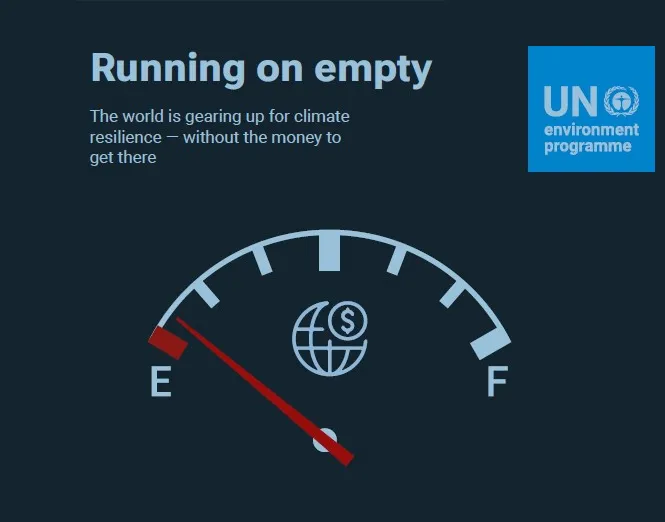
The world is running out of time to
prepare for worsening climate impacts, as global adaptation efforts continue to
lag dangerously behind the growing scale of the crisis, warns the United
Nations Environment Programme (UNEP) in its Adaptation Gap Report 2025: Running
on Empty.
The report, released ahead of COP30 in
Belem, Brazil, paints a stark picture, warning that developing countries alone
will require over $310 billion annually for climate adaptation by 2035, an
amount 12 times higher than current public financing levels.
The report underscores that the gap
between what is needed and what is being delivered is not just financial, but
also systemic.
While progress in adaptation planning
and implementation has been made, the pace and scale of action remain far below
what is required to protect lives, livelihoods, and economies from escalating
climate shocks.
Inger Andersen, Executive Director, UNEP,
cautioned that “every person on this planet is living with the impacts of
climate change, including wildfires, heatwaves, desertification, floods, rising
costs and more”.
He warns that that without urgent action
to scale up adaptation funding, “we will face escalating” costs every year.”
A WIDENING ADAPTATION GAP
There is a caveat to the $310-billion gap for developing countries. Based on UNEP’s modelled estimates, when calculations are expanded to include the needs outlined in Nationally Determined Contributions (NDCs) and National Adaptation Plans, that figure climbs to $365 billion, and even higher when adjusted for inflation.
In stark contrast, international public
adaptation finance flows dropped from $28 billion in 2022 to $26 billion in
2023, reversing recent gains.
This leaves an estimated finance gap of $284-$339
billion per year, or up to 14 times current levels.
The report warns that if these trends
continue, the Glasgow Climate Pact goal of doubling international public
adaptation finance from 2019 levels, to approximately $40 billion by 2025, will
not be achieved.
When accounting for inflation, if the
past decade’s inflation rate continues, the estimated adaptation costs for
developing nations could reach $440-$520 billion per year by 2035, far
outpacing the new global climate finance target.
Even the New Collective Quantified Goal
(NCQG) adopted at COP29, which calls for, at least, $300 billion per year for
climate action in developing countries by 2035, will fall short, since this
amount covers both mitigation and adaptation combined.
UNEP also warns of growing debt risks
for vulnerable nations. It said many countries are already struggling with high
external debt and economic instability, making it difficult to finance
adaptation without incurring additional borrowing.
The report urges the use of grants,
concessional loans, and non-debt-creating instruments to prevent adaptation
finance from exacerbating financial vulnerabilities.
While many countries have developed
national adaptation plans, 36 out of 172 have not updated their strategies for
more than a decade.
Such outdated instruments heighten the
risk of maladaptation.
Moreover, although more than 1,600
adaptation actions have been reported under the Paris Agreement’s Biennial
Transparency Reports, few countries are assessing their actual outcomes or
effectiveness, leaving large gaps in measuring progress.
GLIMMERS OF PROGRESS AMID MOUNTING
CHALLENGES
Despite the daunting figures, the report
also highlights encouraging signs of momentum. Nearly all countries (172 in
total) now have, at least, one national adaptation policy, strategy, or plan in
place, reflecting a growing global consensus that adaptation is no longer
optional but essential.
Only four countries have yet to initiate
formal adaptation planning.
Financially, there has been a notable
uptick in project support through international climate funds.
In 2024, new project commitments under
the Adaptation Fund, the Global Environment Facility (GEF), and the Green
Climate Fund (GCF) collectively rose to $920 million, representing an 86 per
cent increase over the five-year moving average of $494 million (2019–2023).
Although UNEP cautions that this may be
a temporary spike, it demonstrates that scaling up support is possible when
political will aligns with financial mechanisms.
Encouragingly, the report points to new
international frameworks designed to mobilise larger financial flows.
The Baku-to-Belem Roadmap, unveiled as
part of the run-up to COP30, aims to raise $1.3 trillion by 2035 to help
developing nations adapt to climate change.
Meanwhile, UNEP identifies substantial private
sector potential, estimating that targeted policy actions and blended finance
could expand private investment in national adaptation priorities to $50
billion per year, compared to just $5 billion currently.
To unlock that potential, UNEP calls for
public and private finance to work in tandem, using concessional public funds
to de-risk private investments and integrate climate resilience into mainstream
financial decision-making.
This approach, the report argues, is
essential to closing the adaptation finance gap without deepening debt burdens.
— OGN / Trade Arabia News Service