Tourism leaders at WTM London’s inaugural Leaders’ Summit have highlighted the importance of public-private partnerships, government commitment and community engagement in driving sustainable tourism growth.
Representatives from
destinations including Ras Al Khaimah, Egypt and Mexico outlined major
infrastructure investments, marketing initiatives and strategies to attract
investors, while emphasising the need to involve local communities in tourism
development.
Phillipa Harrison,
Chief Executive of Ras Al Khaimah Tourism Development Authority, said tourism
currently contributes 5% of the emirate’s GDP, with ambitions to increase this
to 20-30% over the next five to 10 years.
She identified
community engagement and public-private partnerships as essential to achieving
this target, alongside attracting talent and creating opportunities for
residents.
“We need to attract
more talent… and make sure locals have opportunities – a win-win, to create a
sustained cultural offering will resonate well with visitors”, she said.
Harrison said the
emirate’s head of state is “very invested in tourism”, with a long-term
masterplan extending to 2040.
Addressing concerns
about regional instability, she highlighted Ras Al Khaimah’s economic and
infrastructure resilience despite its proximity to the Strait of Hormuz.
“There is a huge gap
between perception and reality in the Middle East…the Middle East is confident
and looking to the long-term,” she told delegates.
Ahmed Youssef, Chief
Executive of the Egyptian Tourism Authority, said tourism remains at the
“heart” of Egypt’s economy. He noted that 20% of GDP has been invested in
infrastructure development in recent years, including improved airports and
clean energy projects such as solar and hydro-electric power.
Egypt is recording
visitor growth of around 5% in 2026, despite regional conflict and wider
economic pressures, including inflation and the energy crisis.
Youssef also
highlighted efforts to diversify source markets and engage residents through
the We Are Egypt campaign, which promotes awareness of tourism’s contribution
to the national economy.
In Mexico, Michelle
Fridman, Secretary of Tourism for the state of Jalisco, identified
opportunities for investment across the region’s mountains, cities, beaches and
traditional towns. Jalisco recently co-hosted the FIFA World Cup.
“We need to give
certainty to investors… and convince investors of the demand, infrastructure
and investment in promotion,” she commented.
Fridman also stressed
the importance of addressing safety perceptions and involving local
communities, whose participation brings “authenticity and sustainability” to
tourism.
Gloria Guevara,
President and Chief Executive of the World Travel & Tourism Council (WTTC),
described destinations as “the heart of our industry”, underlining the
importance of public-private sector collaboration.
She outlined seven
investment priorities, including legal certainty, regulatory stability,
stakeholder involvement, fiscal incentives, strong government commitment,
long-term masterplans with visible project pipelines, and sustained demand
growth.
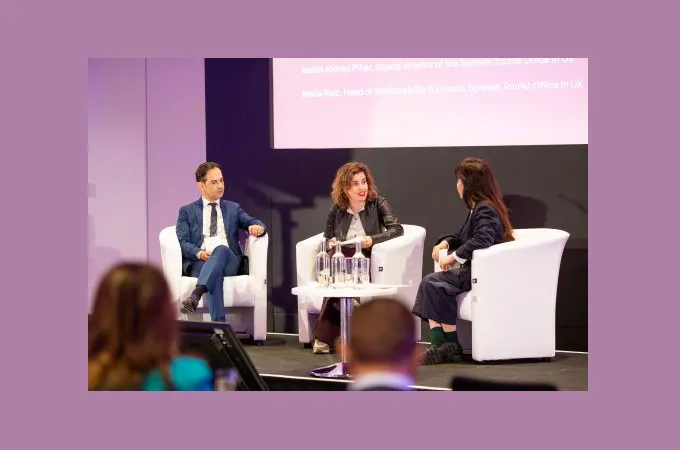
The summit also
showcased Spain’s approach to accessible tourism through its Spain For All
campaign, launched in 2024.
Barbara Couto, Chief
Marketing Officer at Turespana, highlighted the role of content creators and
influencers, including violinist Matthew Castle and his blind husband, visual
artist and author Paul Castle, in showcasing Spain’s sensory experiences.
Jesus Ruiz, Head of
Sustainability and Impact at the Spanish Tourist Office in the UK, said the
campaign’s advisory board had demonstrated how seemingly minor barriers, such
as steps or inadequate signage, could cause anxiety and frustration for
visitors.
“Spain For All can
help develop a roadmap for the whole industry and share good ideas, good
examples and models that can be replicated,” he said.
“Spain can be a
benchmark destination and a catalyst to transform the way that the global
travel and tourism industry can deliver inclusion.”
WTM London Event
Director Chris Carter-Chapman confirmed that the Spanish Tourist Office is the
event’s inaugural official accessibility partner for 2026.
A new campaign, Spain, a Country for All, expanding on the existing Spain For All initiative, was also unveiled on the first day of WTM London. -TradeArabia News Service