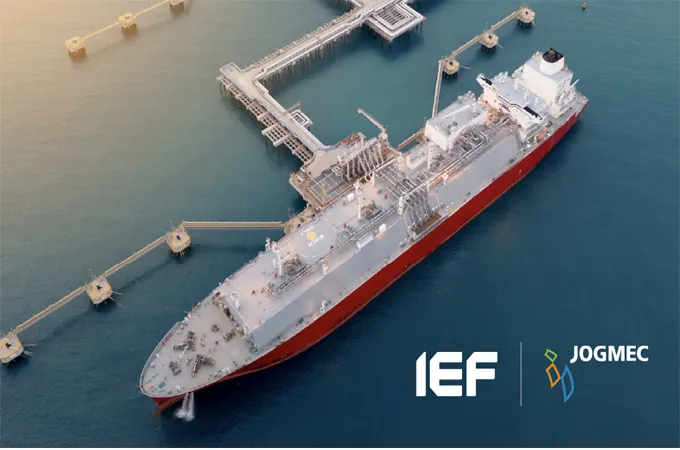
The International Energy Forum (IEF) and the Japan Organisation for Metals and Energy Security (JOGMEC) have released a new report examining the changing structure of global liquefied natural gas (LNG) markets and the implications for energy security, affordability and resilience.
The report, Global LNG Market Security, finds that
global LNG trade could reach around 800 billion cubic metres (bcm) by 2031, up
from more than 600 bcm expected in 2026.
However, it warns that rising trade volumes alone will not
guarantee greater energy security, as supply remains concentrated and
infrastructure constraints and maritime chokepoints continue to expose markets
to disruption.
LNG trade has expanded more than fourfold since 2000, rising
from 133 bcm to more than 600 bcm expected in 2026.
The report said future growth will depend on economic
conditions, energy prices, infrastructure development and government policies.
Jassim Alshirawi, Secretary General of the IEF, said: "LNG
has moved from the margins of the gas market to the center of the global energy
security agenda. Its share of global primary energy demand has nearly tripled,
while global LNG trade has expanded more than fourfold over the same
period."
Alshirawi added: "The lesson from recent energy shocks
is clear; LNG market Resilience is built through investment, spare capacity,
diversified relationships, transparent markets and sustained dialogue between
producers and consumers."
The study found that LNG supply remains highly concentrated
despite growing diversity among importing countries.
The US, Australia and Qatar accounted for nearly 64 per cent
of global LNG exports in 2024, while the number of importing countries has
increased substantially.
The report identifies the Strait of Hormuz as a critical
chokepoint, with nearly 20 per cent of global LNG trade passing through the
waterway.
Available spare liquefaction capacity elsewhere has not
consistently been sufficient to replace those volumes, with the estimated
replacement gap reaching around 14 bcm in 2025.
Importing countries face different levels of exposure.
Around 75 per cent of India’s LNG imports, 87 per cent of Pakistan’s and 71 per
cent of Bangladesh’s were sourced through Hormuz in 2024.
China had a lower proportional exposure of 22 per cent, but
the scale of its imports means disruptions could still increase competition for
replacement cargoes.
Harada Daisuke, Director General of Energy Business Unit and
Leader of the LNG Information Team at JOGMEC, said: "LNG remains
critically important to the energy security of Japan and many other importing
economies, while the market itself is becoming larger, more interconnected and
increasingly exposed to geopolitical and supply-chain risks."
Daisuke added: "This report demonstrates the value of
combining detailed market analysis with international dialogue. Strengthening
LNG security will require an appropriate balance between stable long-term
procurement and greater flexibility, supported by diversified supply, adequate
infrastructure and effective trading capabilities. JOGMEC welcomes its
collaboration with the IEF in contributing to a deeper shared understanding of
these evolving global market dynamics."
The report also stresses that diversification does not
necessarily mean substitutability.
The ability to replace disrupted LNG supplies depends on
spare liquefaction capacity, feed-gas availability, contractual commitments,
shipping, storage and regasification infrastructure.
Investment across the entire LNG value chain will therefore
be critical.
The report said future security will depend not only on new
liquefaction projects, but also on upstream supply, storage, shipping, ports,
regasification terminals and pipeline networks.
The study includes the first harmonised global bilateral LNG
trade dataset covering 144 countries from 2000 to 2024, combining national and
international statistical sources.
The dataset provides a consistent historical picture of LNG
trade flows and supports projections through 2031.
Ali Alsamawi, Senior Energy Analyst at the IEF and principal
author of the report, said: "We have brought together more than two
decades of bilateral LNG trade across 144 countries, giving governments,
industry and other stakeholders a clearer picture of how the global LNG market
has evolved and where it is heading."
Alsamawi added: "The LNG market is becoming more
global, but not less vulnerable. Demand is diversifying rapidly while supply
remains concentrated, an imbalance that will shape the market’s resilience to
future disruptions."
Alsamawi concluded: “Not every energy chokepoint appears on
a map. Feed-gas shortages, domestic supply obligations, regulatory decisions
and investment conditions can create virtual bottlenecks just as constraining
as physical ones."
The report highlights these “virtual chokepoints” as an
increasingly important source of risk. Feed-gas shortages, domestic supply
requirements, regulatory conditions and commercial constraints can limit LNG
exports even when liquefaction capacity is available.
Supply growth is also expected to remain concentrated.
The US is projected to remain the world’s largest LNG
exporter through 2031, followed by Qatar and Australia.
Together, the three countries are expected to account for
approximately two-thirds of global supply.
On the demand side, growth is expected to be more widely
distributed. Türkiye is projected to record the strongest relative increase
among major importers, with LNG imports expected to rise by approximately 85
per cent above 2025 levels by 2031.
India, Pakistan and China are each projected to increase
imports by roughly 50 per cent.
Christof van Agt Ross, Director of Energy Dialogue at the
IEF, said: "The LNG market is global, but disruptions affect regions
differently. The 2026 Hormuz disruption creates strong price responses in
Europe and Asia, while developing economies are often priced out of the market,
underscoring the market’s growing sensitivity to the duration of disruptions
and tightening global LNG balances."
"LNG market security and resilience will depend on the
strength of international cooperation to stimulate trade and investment, more
diversified partnerships and greater regional market integration to cover risk,
strengthen reliability, and improve affordability."
The report also points to rising electricity demand from
data centres and AI-enabled services, advanced manufacturing and
energy-intensive industries as factors that could further influence LNG demand
and energy security.
It concludes that resilient LNG markets will require
sustained investment, diversified supply relationships, flexible contracts and
shipping arrangements, sufficient storage and regasification capacity,
transparent market information and stronger international coordination.
Regional cooperation, including cross-border investment, market integration and coordinated approaches to storage and emergency procurement, will also be important to strengthen reliability and affordability. -OGN/TradeArabia News Service