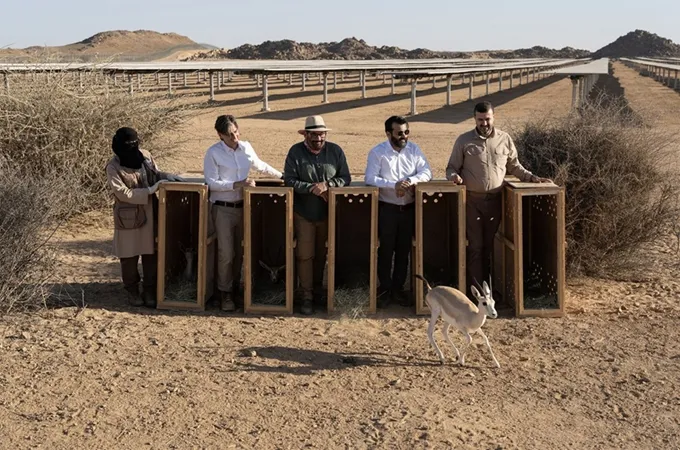
Prince Mohammed bin Salman Royal Reserve is pioneering a conservation initiative that combines renewable energy generation with wildlife restoration, breeding threatened Sand gazelles within an operational solar park in Saudi Arabia.
The 505-hectare facility, built and managed by Amaala
Sustainable Company for Energy (ASCE), a joint venture involving EDF Group and
Masdar, alongside SUEZ and Korea East-West Power (EWP), supplies Red Sea
Global’s AMAALA destination with 100 per cent renewable energy.
The solar park also provides a protected environment for
Sand gazelles to breed and establish viable populations for eventual
reintroduction into the wild.
The initiative, known as ReWildingVoltaics, aims to
demonstrate how renewable energy infrastructure can support biodiversity
conservation alongside decarbonised electricity generation.
Following a seven-month proof-of-concept programme launched
in October 2025 involving Sand gazelles, Mountain gazelles and Arabian hares,
the initiative entered its breeding phase in May 2026.
A total of 33 female and five male Vulnerable Sand gazelles
were introduced into the solar facility, with the first offspring expected in
December 2026.
Population modelling by the Reserve’s Scientific Services
Division projects that the herd could grow to approximately 600 animals by
2031.
A minimum founder population of 500 is required to support
successful reintroduction into the 24,500-square-kilometre reserve.
Andrew Zaloumis, CEO of Prince Mohammed bin Salman Royal
Reserve, said: “Our rewilding goal is to build self-sustaining wildlife
populations that can survive in the wild without ongoing human intervention.
This collaborative innovation not only accelerates that work but also
introduces a novel 'double-green' framework with global scalability. We are
calling it 'ReWildingVoltaics.'”
The initiative supports the Saudi Green Initiative’s
objectives of protecting 30 per cent of the Kingdom’s land and sea and
generating 50 per cent of its electricity from renewable sources by 2030,
alongside its target of achieving net-zero emissions by 2060.
Saudi Arabia’s protected-area coverage has increased from
4.2 per cent to 18.3 per cent over the past decade.
Omar AlDaweesh, CEO Saudi Arabia and Bahrain, EDF Group,
said: “This initiative demonstrates how renewable energy infrastructure can
create value beyond the clean electricity it generates. By bringing
biodiversity conservation into an operational solar facility, we are showing
how energy infrastructure and nature can coexist. Through ASCE, EDF is proud to
contribute to an innovative model that supports Saudi Arabia’s renewable energy
and conservation ambitions, with the potential to inspire similar approaches
beyond the Kingdom.”
The proof-of-concept programme demonstrated the site’s
suitability for wildlife breeding. Its predator-proof perimeter provides a
controlled environment, while solar panels reduce ground temperatures by
approximately 5 deg C to 10 deg C through shading.
Around 73 per cent of the site is considered usable habitat,
including shaded areas beneath panels and open spaces featuring natural
elements such as rocky outcrops.
The facility has increased the Reserve’s wildlife husbandry
capacity 15-fold, enabling specialist rangers to continuously monitor animal
behaviour, health and reproductive performance.
Sand gazelles were selected for their ecological importance
and ability to move beneath the panels without affecting infrastructure.
As grazers and
browsers, they also help manage vegetation, disperse seeds and restore the
natural food chain.
Aligned with the Kunming-Montreal Global Biodiversity
Framework, ReWildingVoltaics aims to establish founder populations for future
release into wider landscapes.
Findings from the initiative could inform similar projects in other regions where renewable energy infrastructure and wildlife conservation programmes operate alongside one another. -TradeArabia News Service