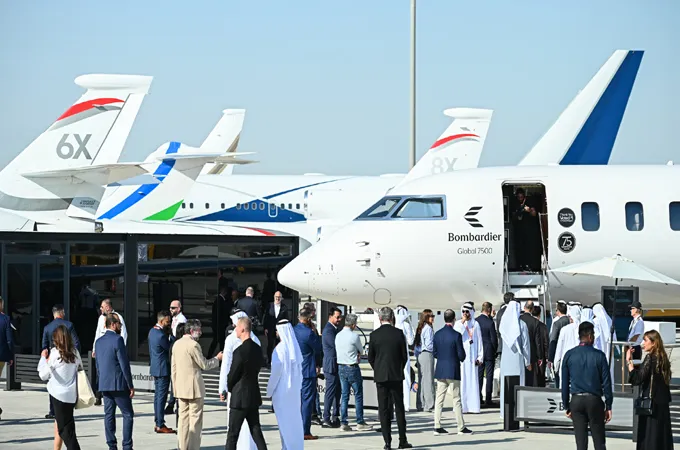
The GCC aviation industry is expected to maintain strong growth momentum over the medium to long term, supported by infrastructure investments, rising tourism demand, fleet expansion and technological advancements, according to Alpen Capital’s GCC Aviation Industry Report 2026.
The report provides an overview of the region’s aviation
sector, examining key market segments, growth drivers, challenges and emerging
trends.
It also profiles the six GCC countries and major aviation
players, covering commercial airlines, air cargo and maintenance, repair and
overhaul (MRO) services.
“The GCC has established itself as a global aviation hub,
capitalising on its strategic location and robust infrastructure. While the
region’s aviation sector continues to be led by full-service carriers, low-cost
carriers have gained significant market share. The region’s MRO market has also
expanded over the years, owing to increasing connectivity and a heightened
focus on capacity expansion and technology integration. However, recent
geopolitical tensions have disrupted flight paths, as well as cargo and
passenger operations, resulting in higher costs and reduced load factors for
airlines and airports. We expect these challenges to be offset by economic
recovery, favourable demographics, ambitious diversification agendas and
continued investment in aviation infrastructure, supporting the sector’s growth
momentum,” says Lakshmanan TM, Chief Executive Officer of Alpen Capital.
The report identifies government-led infrastructure
development, greater private-sector participation, growth in travel and
tourism, and technological innovation as key factors underpinning the sector’s
expansion. Investments are expected to support both full-service carriers
(FSCs) and low-cost carriers (LCCs), while strengthening regional air cargo and
logistics capabilities.
Alpen Capital also expects ancillary revenues to play an
increasingly important role in improving airline profitability amid
intensifying competition. Meanwhile, the MRO segment is expected to benefit
from investments in local maintenance capabilities, technical expertise and
strategic partnerships.
Sustainability is another emerging priority, with aviation
stakeholders expected to increase investments in sustainable aviation fuel
(SAF), electric ground equipment and carbon-reduction initiatives to meet
international environmental standards.
“We see significant growth opportunities emerging across the
aviation industry, driven by advances in air mobility, an increased focus on
sustainability, and continued fleet expansion. For GCC carriers, enhancing
customer experience and developing strategic partnerships will remain important
to maintain healthy margins over the long term. We also expect continued
investment in mega-hubs to expand passenger capacity and strengthen
cargo-handling capabilities. Meanwhile, M&A activity, which has picked up
across the region in recent years, is expected to focus on cargo and logistics
integration, airport infrastructure modernisation, MRO facilities, sustainable
fuel and digital transformation initiatives,” says Rajan Gupta, Managing
Director of Alpen Capital.
Airline fleet and passenger growth
The GCC commercial aviation fleet stood at approximately
1,556 aircraft in 2025, with the UAE and Saudi Arabia accounting for 71% of the
total. UAE-based airlines had the largest fleet at 624 aircraft, followed by
Saudi Arabia with 483 and Qatar with 275.
Government-owned FSCs accounted for around 62% of the
region’s total fleet. Emirates was the largest operator, representing 30.2% of
the combined fleet of GCC full-service carriers.
The six largest regional FSCs — Emirates, Qatar Airways,
Etihad Airways, Saudia, Gulf Air and Oman Air — have a combined order book of
486 aircraft scheduled for delivery by the end of 2029. Emirates accounts for
41.2% of these orders, followed by Qatar Airways at 23% and Etihad Airways at
20.6%.
LCCs have also strengthened their market position as demand
for affordable air travel increases. Flydubai holds the largest share of the
GCC low-cost carrier fleet at 32.3%, while Air Arabia serves the highest number
of destinations among its regional peers.
The four largest LCCs ,Air Arabia, Flydubai, Flynas and
Flyadeal, have collectively ordered 295 aircraft for delivery by 2029. Air
Arabia accounts for 38.6% of the orders, marginally ahead of Flydubai at 38.3%.
Passenger traffic across GCC airlines increased from 318.1
million in 2019 to 373 million in 2024, representing a compound annual growth
rate (CAGR) of 3.2%. The UAE and Saudi Arabia accounted for more than 75% of
regional passenger traffic in 2024.
The region handled 392.5 million passengers in 2025,
representing a 5.2% increase from the previous year.
Revenue passenger-kilometres (RPKs) reached 822.7 billion in
2024, growing at a CAGR of 2.4% between 2019 and 2024 and exceeding
pre-pandemic levels. Saudi Arabia recorded the strongest growth at 6.4%,
followed by Qatar at 5.3%. The UAE remained the region’s largest market, with
429.2 billion RPKs.
Cargo and MRO expansion
The GCC air cargo sector also recorded growth, with freight
tonne-kilometres (FTKs) increasing from 29.8 billion in 2019 to 34 billion in
2024.
Hamad International Airport and Dubai International Airport
together handled approximately 65% of Middle East air cargo volumes, processing
around 2.6 million and 2.2 million metric tonnes, respectively.
The GCC ranked third globally in air cargo activity, behind
the US and China, handling more cargo than Germany, Japan, the UK and India.
Regional revenue tonne-kilometres (RTKs) increased from
100.1 billion in 2019 to 110.7 billion in 2024. The UAE accounted for the
largest share at 51.8%, equivalent to 57.3 billion RTKs, followed by Qatar with
35 billion and Saudi Arabia with 11.5 billion.
The MRO market is another significant growth area. Middle
East MRO revenues increased at a CAGR of 6.8% between 2019 and 2024 to reach $12.5 billion. The market expanded further to $16.2 billion in 2025, a
29.6% year-on-year increase, primarily driven by engine maintenance, which grew
34.1% to $11.4 billion.
The UAE led the regional MRO market with an estimated 45%
share, valued at $5.6 billion, followed by Qatar at $2.4 billion and Saudi
Arabia at $2 billion. GCC countries collectively accounted for approximately
88% of the Middle East MRO market in 2024.
Geopolitical risks and emerging trends
Despite the positive outlook, Alpen Capital identifies
geopolitical tensions as a major near-term risk. Restrictions on neighbouring
airspace can disrupt flight routes, cargo movements and passenger operations,
increasing fuel consumption and operating costs while putting pressure on
airline load factors.
Other challenges include intensifying competition, potential
overcapacity arising from fleet expansion and new market entrants, and
shortages of skilled professionals, particularly pilots and technical
engineers. A projected narrowing of the GCC fiscal surplus in 2026 could also
affect the pace of public infrastructure investment.
Nevertheless, favourable demographics, rising incomes,
population growth and increasing numbers of high-net-worth individuals are
expected to sustain demand. International tourist arrivals in the GCC are
forecast to grow at a CAGR of 4% between 2025 and 2030, reaching approximately
95.2 million.
The report also highlights growing adoption of codeshare
agreements, public-private partnerships, digitalisation and sustainable
aviation initiatives. Saudi Arabia, in particular, is witnessing increased
public-private participation in airport development and modernisation.
Alpen Capital concludes that the region’s aviation expansion will depend on continued investment in airports, manufacturing, MRO services, technology, digitalisation and professional training. However, the medium-term outlook will remain closely linked to the duration and intensity of geopolitical tensions and their impact on international passenger confidence. -TradeArabia News Service