Saudi Arabia has shut down its East-West pipeline after the vital oil conduit came under aerial attack in the widening Middle East war, threatening to send energy prices even higher.
An official source at Saudi Arabia's Ministry of Energy stated that the East–West Pipeline in Riyadh and Madinah regions was subjected to multiple attacks on the morning of Thursday, September 10, 2026. The pipeline was shut down as a precautionary measure. The attacks resulted in a number of injuries, and medical care was provided to those affected, it said.
The source said emergency and specialised technical teams responded immediately following the attacks, taking the necessary measures to secure the pipeline and assess its safety in line with approved safety procedures and emergency response plans, in coordination with the relevant authorities. Any further developments will be announced in due course, said the statement, published by Saudi Press Agency.
Both Baghdad and Riyadh said the drone attacks had originated in Iraq, where Iranian-backed militias operate. Iraq dismissed a military commander on Saturday in response to the attack.
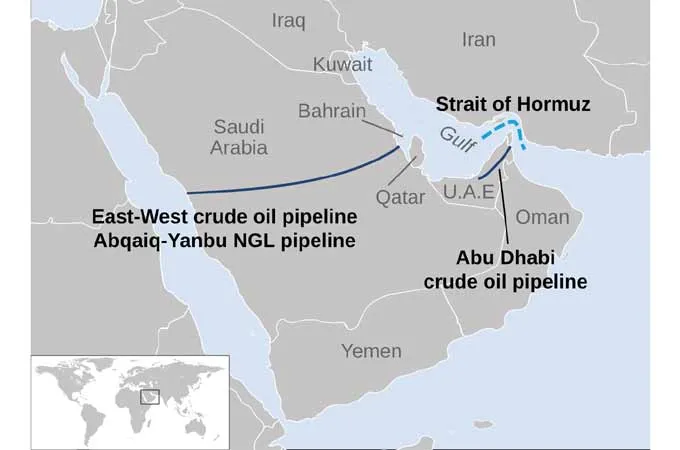
The 1,200-km pipeline running across the Arabian Peninsula had helped Saudi Arabia to bypass a shipping logjam in the Strait of Hormuz, where tanker traffic has slowed to a trickle due to the six-month war between the US and Iran. The line has been moving 4 million to 5 million barrels per day in recent months, amounting to 4% to 5% of global supply, according to ship tracking companies and analysts.
An early analysis found that pump stations, which are located next to the pipeline itself, were hit, reported CNN citing senior US officials. A satellite image taken on Friday appears to show extensive fire damage at one pumping station, and an image of a different pumping station, taken Thursday, showed a small fire sending up plumes of thick, black smoke.
It was not immediately clear who was responsible for the strikes or if sections of the pipeline itself were damaged but one of the officials said it was struck by drones originating from Iraq.
The Saudi Ministry of Foreign Affairs later released a statement condemning “the attack on the East-West Pipeline in the Riyadh and Madinah regions by several drones coming from Iraq, which resulted in injuries and some damage that is currently being addressed.”
It was not immediately clear how long it would take to repair the damage to the pipeline system, sources said.
The attack came as Iran-aligned Houthi rebels in Yemen tightened their grip in the Red Sea, which combined with the Strait of Hormuz disruptions has put an energy squeeze on both sides of the Arabian Peninsula and sent global oil prices back above $100 per barrel.
Four Yemeni government sources told Reuters that Houthis had seized the strategic island of Perim on Friday at the mouth of the Red Sea, in the Bab el-Mandeb strait.
The Houthis' lightning advance across the southern reaches of the Tihamah – Yemen's arid coastal plain – appears to have taken most observers by surprise.
Until recently, the anti-Houthi coalition known as the National Resistance held significant territory along Yemen's Red Sea coast. In a matter of days, much of this has fallen to the Houthis, stated the BBC report.
According to some estimates, the Iranian-backed rebels have captured as much as 130km (81 miles) of the country's strategically important coastline.
Reuters reported on Thursday that the dramatic Houthi advance down Yemen's Red Sea coast came with direct guidance from Iran's Revolutionary Guards.
Iran told the Houthis last week to escalate their attacks on Saudi Arabia and promised more funding, weapons and senior officers to help them do so, two Iranian sources said.
The dual attacks reported on Friday — on the pipeline and Perim Island — could represent a dangerous escalation while diplomatic efforts to end the war have stalled.
In a post on X on Saturday, Ebrahim Azizi, head of the Iranian parliament's national security committee, said: "As long as the American side does not accept all of Iran's conditions, dialogue and negotiation are of no use."
Saudi crude supply fell to the lowest levels in more than three decades, the International Energy Agency said on Friday, partly due to attacks on ships transiting Bab el-Mandeb by Houthi-linked groups.
Iraq responded by ordering the closure of the Shalamcheh border crossing between Iraq and Iran as a precautionary measure, two security sources told Reuters. The crossing serves as one of the main routes for the import to Iraq of vegetables and other food supplies from Iran.
The two sources said a wide-scale operation was under way to find those responsible for the pipeline attack.