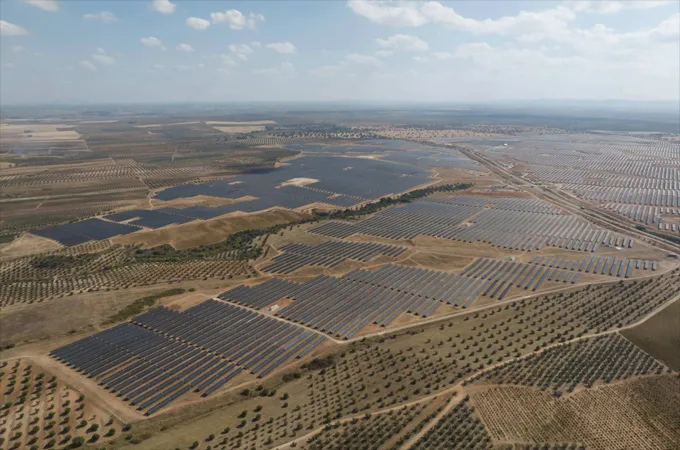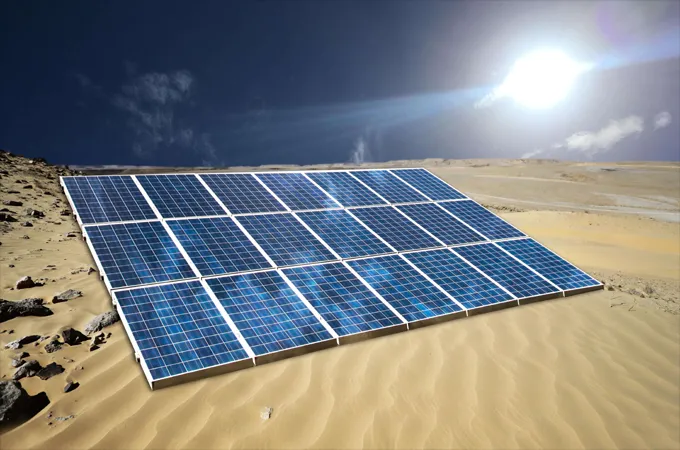
Researchers at King Abdullah University of Science and Technology (KAUST) have developed a solar panel coating that helps maintain performance in dusty conditions while capturing moisture from the air, offering a practical approach for solar systems operating in arid environments.
The coating was tested outdoors at KAUST
for six months, during which treated panels showed only minimal
performance loss, whereas uncoated panels exposed to the same
conditions showed significant declines.
At the same time, the surface captured moisture from the air
at night, which was then successfully used for plant irrigation in a
controlled demonstration.
Dust accumulation is a well-known challenge for solar energy
systems, particularly in regions with high temperatures and limited
rainfall.
Cleaning panels often requires water and regular
maintenance, both of which can increase operational costs.
The KAUST team set out to address this by developing a
surface that could clean itself using natural environmental conditions.
The result is a transparent, nanostructured coating made
from a food-grade silicone material.
It combines three properties in a single layer: it allows
sunlight to pass through, repels water and dust, and cools slightly below the
surrounding air at night.
This cooling effect causes moisture in the air to condense
into droplets, which then roll off the surface, removing accumulated dust in
the process.
“This work focuses on a practical challenge for solar energy
systems — how to maintain performance in environments where dust and heat are
unavoidable,” said Qiaoqiang Gan, professor of material science
and engineering at KAUST, who led the research. “By using naturally
occurring temperature changes between day and night, we can enable passive
cleaning without additional water or energy input.”
Alongside self-cleaning, the process also enables the
surface to collect moisture from the air.
In field tests, coated panels produced more than twice as
much condensed water as uncoated surfaces under similar conditions.
While modest in volume, this was sufficient to support
small-scale irrigation in the study, suggesting potential use in localized
agricultural settings.
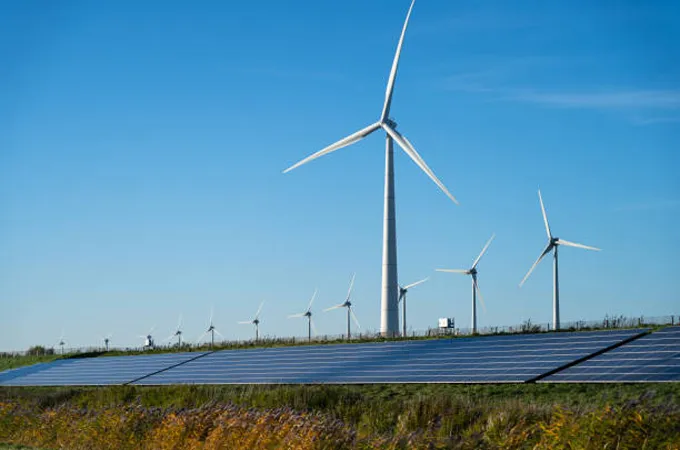
The research also explored how this approach could be
applied in agrivoltaic systems, where solar panels and agriculture
are co-located.
By maintaining cleaner panel surfaces and
providing a supplementary source of water, the coating could support more
efficient use of land and resources in environments where both energy and water
management are closely linked.
The coating is produced through a simple thermal process and
can be applied to standard glass surfaces, supporting its potential for
scaling.
The team is now working to further assess durability and performance over longer time periods and in different environmental conditions. -OGN/TradeArabia News Service