The 2026 FIFA World Cup kicks off tomorrow (June 11) in Mexico City, marking the start of the largest edition of the tournament since its inception in 1930.
Jointly hosted by the US, Canada and Mexico, the tournament will feature a record 48 national teams, making it the first World Cup to be staged across three countries.
The opening match will see hosts Mexico take on South Africa in Group A at the Estadio Azteca, which becomes the first stadium to host FIFA World Cup matches in three different editions, having previously staged games in 1970 and 1986.
The 2026 tournament marks the first expansion from 32 to 48 teams, increasing the number of matches from 64 to 104 and extending the competition to nearly six weeks.
Matches will be played across 16 host cities, including 11 in the US, three in Mexico and two in Canada.
Record Arab representation
The tournament will also feature a record Arab representation, with eight teams qualifying for the finals for the first time. Morocco, Egypt, Tunisia, Algeria, Saudi Arabia, Qatar, Jordan and Iraq will represent the Arab world, marking the largest Arab presence in World Cup history.
The expanded format includes nine Asian teams, 10 African teams, 16 European teams, six teams from the Confederation of North, Central America and Caribbean Association Football (Concacaf), six South American teams and one team from Oceania.
According to experts, attending a World Cup has become considerably more expensive.
In 1994, tickets for first-round matches ranged from $25 to $75, while seats for the final at the Rose Bowl in Pasadena cost between $180 and $475.
For the 2026 tournament, FIFA has introduced dynamic pricing, meaning ticket costs fluctuate based on demand. First-round tickets have been sold for as much as $2,735, while final tickets have reached nearly $11,000.

Mexican teen youngest player at World Cup 2026
Mexico feature an exciting storyline at the 2026 World Cup with the inclusion of Gilberto Mora, who enters the tournament as the youngest player across all 48 teams.
As El Tri prepare to face South Africa on June 11 in another historic inaugural match, the teenage prodigy will be just 17 years and 240 days old.
While Mora is the youngest in this edition, he does not hold the all-time tournament record. That milestone still belongs to Northern Ireland’s Norman Whiteside, who was just 17 years and 41 days old when he faced Yugoslavia at the 1982 World Cup.

For Mexican fans, the future looks incredibly bright with Mora in the squad. The midfielder has been a standout performer for Xolos de Tijuana since bursting onto the scene in 2024 at just 15 years old, when he provided an assist in a 3-1 victory over Santos Laguna.
11 new rules, one goal: fewer mistakes, faster football
The 2026 World Cup is going to be unprecedented for a variety of reasons - and that includes the sheer number of law changes. Fifa has introduced 11 measures specifically for the tournament, reported BBC.
Pierluigi Collina, the head of referees, is determined to speed up the matches and to reduce the potential for match-changing mistakes.
But get used to them, because you will see most applied in the Premier League, English Football League and Scottish Premiership next season.
There are new powers for the video assistant referee (VAR), a whole host of measures to protect the tempo of the game and a couple of adjustments around player behaviour.
Here is what you need to look out for and how the new laws will work.
Time-saving measures for goal-kicks, throw-ins and substitutions
Fixing timewasting has been one of Collina's top issues for quite a few years.
At the Qatar World Cup in 2022, the Italian told his officials to be precise and add everything on to stoppage time.
The opening matches all exceeded 100 minutes, with 24 minutes added on across both halves for England's 6-2 win over Iran.
For this World Cup, the plan is to make sure players get on with the game and save lost time this way.
The idea is not strict enforcement, but deterrent measures to alter player behaviour.
Countdowns for goal-kicks and throw-ins (five seconds): Under the new rule, if a player deliberately delays the restart of play, a goal-kick could become a corner or the throw given to the opposition.
Cooling breaks and player welfare
The summer heat remains a challenge for World Cup organisers.
While players in 1994 competed through hot and humid conditions without interruption, the 2026 tournament will include mandatory three-minute cooling breaks in each half when conditions require them.
According to the official FIFA website, each of these stoppages lasts three minutes, with the aim of prioritising player welfare throughout the summer tournament.
The 2025 FIFA Club World Cup served as one of the final tests for this new implementation. The break takes place in the 22nd minute of each half.
The breaks are expected to provide players with valuable recovery time and allow coaches brief opportunities to adjust tactics.
"For every game, no matter where the games are played, no matter if there’s a roof, (or) temperature-wise, there will be a three-minute hydration break. It will be three minutes from whistle to whistle in both halves," said Manolo Zubiria, Chief Tournament Officer.
The count will not begin when the ball goes out of play. A referee will choose to activate it if a player is taking too long.
Like the eight-second countdown after a goalkeeper has caught the ball, the referee will visibly make a count by moving an arm up and down.
Deterrent to goalkeepers
This law change should be a deterrent to goalkeepers who take a long time over their kicks towards the end of games.
Previously, the only tool a referee would really have is to show one yellow card. And the keeper might just keep on doing it knowing an official is not likely to book them twice and be forced to send them off.
It is hoped that conceding a corner which could lead to conceding a goal is a more effective deterrent.
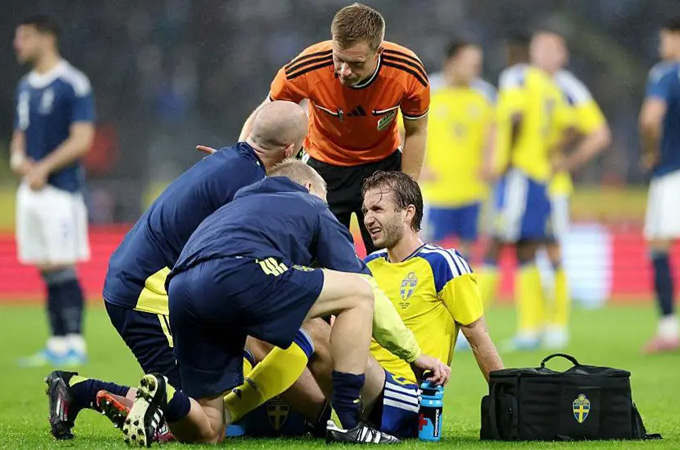
Time-limited substitutions (10 seconds): Substituted players have 10 seconds to leave the field at the nearest point. If they fail to do so, the substitute cannot enter the field for at least one minute and the team must play with 10 players.
There are a couple of exemptions - if a player is injured or there are security concerns about where they can go off, though the latter should not be an issue at the World Cup.
The new law says that the substitute will not be able to come on until play next stops. That means a team could in theory be left with 10 players for several minutes.
Take the international friendly between Japan and Iceland on May 31.
An Iceland player took too long to leave the field, so the team had to play with 10 men for more than two minutes. The first time play stopped was when Koki Ogawa scored the only goal of the game for Japan.
The idea is not to make teams play with 10 men, but to make it such a clear deterrent that players do not waste time on substitutions.
The tournament is expected to generate record revenues for FIFA through increased ticket sales, broadcasting rights, sponsorship agreements and commercial partnerships.
FIFA expects around seven million spectators to attend matches during the tournament, while global viewership is projected to reach nearly six billion across multiple broadcasting platforms.