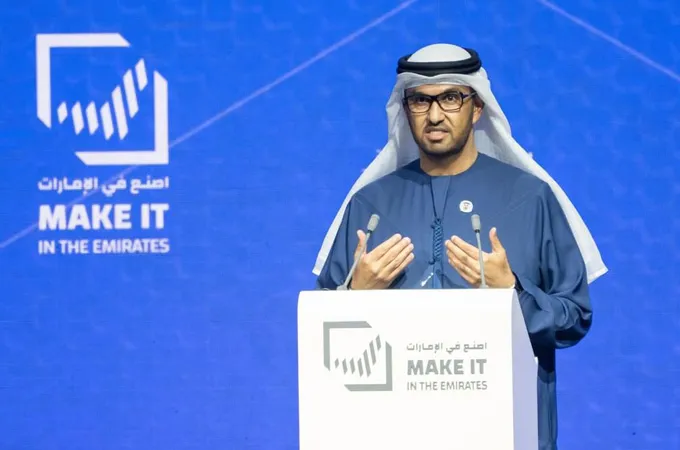
The UAE’s industrial strategy continues to deliver structural transformation across the national economy with the industrial sector alone contributing AED200 billion ($54.4 billion), up 70% since 2021, stated Dr Sultan bin Ahmed Al Jaber, Minister of Industry and Advanced Technology, at the Make it in the Emirates, the UAE’s flagship industrial platform, in Abu Dhabi.
The industrial exports climbed to AED262 billion ($71 billion), including AED92 billion ($25 billion) in advanced industrial exports, he stated.
Dr Al Jaber was addressing the gathering after opening the fifth and largest edition of Make it in the Emirates, the UAE’s flagship industrial platform, where he announced AED180 billion in new industrial procurement opportunities in a national drive to localise more than 5,000 products across sectors critical to economic, food, and healthcare security.
"These figures are not merely growth," stated Dr Al Jaber. "They are proof that our industrial economic model works, produces, and continues to accelerate,' he added.
He highlighted the National In-Country Value (ICV) Program as a key driver of this progress, helping turn spending into investment “in our economy, our factories, our talent, and our future.”
Today, with the support of the UAE leadership and endorsement of the cabinet, the value of industrial procurement opportunities will increase from AED168 billion to AED180 billion over the next decade.
Resilience, sovereignty, industrial capability vital
Opening the forum following a three-month period that has tested the region deeply, Dr Al Jaber said the UAE continues to transform challenges into opportunities, emphasising that resilience, sovereignty and industrial capability are central pillars of the country’s long-term economic strategy.
"History remembers the challenges nations face. But it also remembers how nations respond to them and what they build next," stated Dr Al Jaber.
"There is a great difference between those who focus only on surviving crises, and those who seize them as opportunities and turn them into new beginnings. In the UAE, we do not simply endure hardships. We emerge from them stronger," he stated.
"We do not wait for transformation; we drive it. We do not simply adapt to the future; we help shape it," he added.
Make it in the Emirates follows the Make it with ADNOC forum held on Sunday with the support of Sheikh Khaled bin Mohamed bin Zayed Al Nahyan, Crown Prince of Abu Dhabi and Chairman of the Abu Dhabi Executive Council.
The forum unveiled procurement opportunities and planned projects worth more than AED 200 billion over the next two years, reinforcing ADNOC’s role as a catalyst for UAE industrial growth.
The Local+ initiative was also announced at the forum, which connects engineering, procurement, construction, and services contractors with 70 qualified Emirati manufacturers.
Dr Al Jaber emphasized that industry is not simply an economic choice, but “a necessity” that strengthens resilience, protects the national economy from global volatility, and enhances the country’s ability to withstand disruption.
Referring to the importance of safeguarding international trade routes, he warned that disruptions to strategic maritime corridors affect not only one region, but the global economy.
“Economic security cannot be imported – it must be built and protected,” Dr. Al Jaber said. “The security of vital trade routes is not a regional matter alone, but a shared global responsibility,” he added.
Addressing the crisis around the Strait of Hormuz, Dr. Al Jaber reaffirmed the UAE’s position on freedom of navigation and the legal status of international waterways.
“Freedom of international navigation is non-negotiable and cannot be compromised,” he said. “Any change to these principles would constitute a dangerous and unacceptable precedent and a direct threat to global economic security.”
Dr Al Jaber pointed out that the UAE was entering “a new chapter” in which it is reshaping its place in the global economy with “confidence, clarity, and ambition.”
Exit from Opec a strategic move
He described the UAE’s decision to reposition itself within the global energy landscape, including its exit from Opec and Opec+, as “a carefully considered strategic decision” that “is not directed against anyone, any country, or institution” and is aligned with the country’s long-term national interests and economic ambitions.
“[The decision] serves our national interests and long-term strategic objectives, aligns with our industrial, economic, and developmental ambitions, and gives us greater ability to accelerate investment, expand, and create value,” Dr. Al Jaber said.
“Real strength is not measured by the abundance of resources, but by how they are harnessed to create value and serve the nation,” he added.
In line with the UAE government’s direction to deploy AI agents and advanced AI models across services and operations, the country is launching what Dr. Al Jaber described as an unprecedented technological and digital transformation across its industrial ecosystem.
“Artificial intelligence will no longer be just a tool in our factories,” he said. “It will become an industrial brain and a partner in decision-making – redefining efficiency, productivity, and the decision-making process.”
The transformation reflects an integrated economic model through which the UAE is shaping and anticipating the future, he added.-TradeArabia News Service