Destinations that act before disruption hits recover up to 1.5 times faster than those that wait, according to a new research.
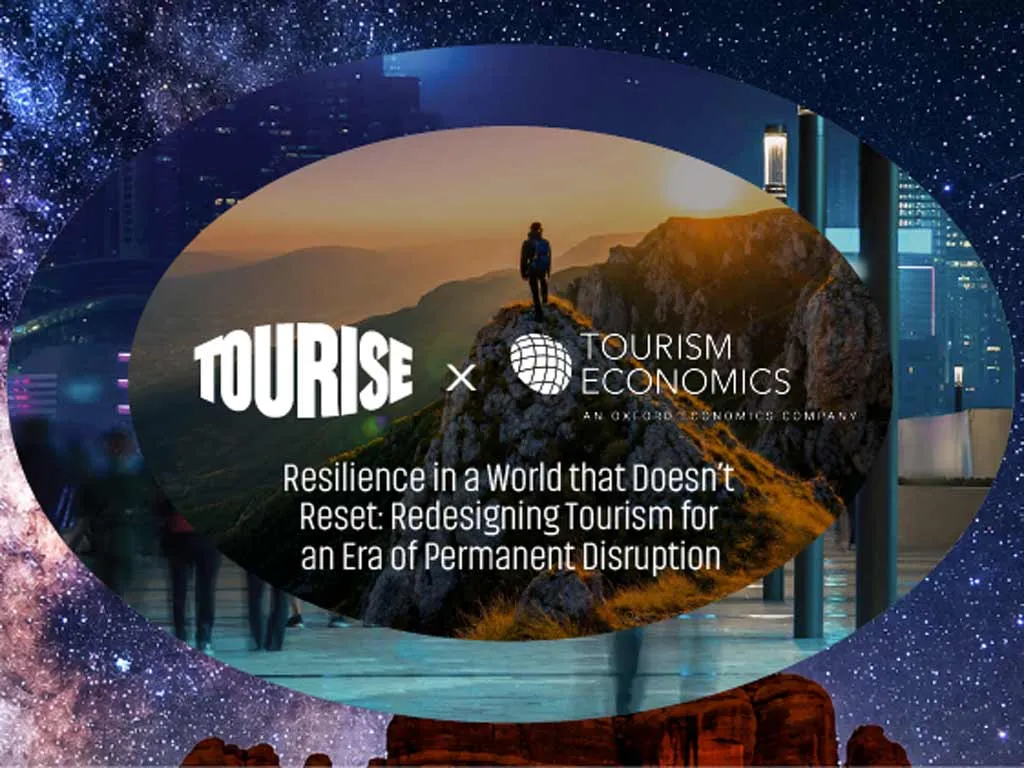
TOURISE, premier platform for redefining and shaping the future of tourism, in collaboration with Oxford Economics, today released the new report, “Resilience in a World that Doesn’t Reset: Redesigning Tourism for an Era of Permanent Disruption.”
The analysis of 85 major crises over two decades shows a clear pattern: in a world defined by continuous shocks, destinations that act before disruption recover faster, says the study.
“In a world that does not reset between crises, disruption is a constant feature of the global tourism landscape,” said Ahmed Al-Khateeb, Minister of Tourism of Saudi Arabia and Chairman of TOURISE. “The real test for destinations measures how they prepare for volatility, protect traveller confidence, and maintain continuity ahead of such events.”
Using the current Middle East crisis as a lens, where Gulf hubs carry roughly 14 percent of global transit traffic, the report provides investors and policymakers with practical guidance for navigating a system in which disruption is now the norm.
Key findings include:
*Three scenarios, one conclusion: recovery depends on confidence, connectivity, and affordability. The report models three pathways for the current Middle East crisis. If the ceasefire holds, global travel grows about 6 percent in 2026; if hostilities resume, it falls about 1 percent; and under sustained disruption, it declines about 3 percent and remains weak into 2027.
Across every scenario, the report concludes that recovery is determined less by the crisis itself than by how quickly confidence, connectivity, and affordability can be restored.
* Confidence now travels faster than people. In 2025, viral rumours of a megaquake drove booking declines of up to 50 percent from some East Asian markets despite no scientific basis, showing how misinformation can depress demand before any physical disruption.
* Tourism is recovering faster, but systemic crises are the new test. Average recovery times fell from about 24 months in the early 2000s to 10 to 12 months today. However, increasingly complex, multi-country disruptions are beginning to slow this trend.
* Preparation is becoming a competitive advantage. Saudi Arabia, which welcomed 37.2 million tourists in the first quarter of 2026, an 8 percent year-on-year increase despite regional volatility, and reached its 100 million annual-visitor target seven years early, illustrates how diversification under Saudi Vision 2030 translates into measurable resilience.
"Global tourism has proven remarkably resilient, reaching a record 1.52 billion international arrivals in 2025 despite a decade defined by natural and man-made disasters,” said Adam Sacks, President of Tourism Economics.
“The lesson learned is that resilience can be built before disruption occurs, in the actions destinations take to prepare. In a world that no longer resets between crises, preparedness is becoming a core measure of competitiveness." - TradeArabia News Service