Iran launched renewed attacks on US Gulf allies on Saturday after the United States completed a seventh consecutive night of strikes targeting Iranian military infrastructure, marking a sharp escalation one week after a fragile ceasefire collapsed, reported Reuters.
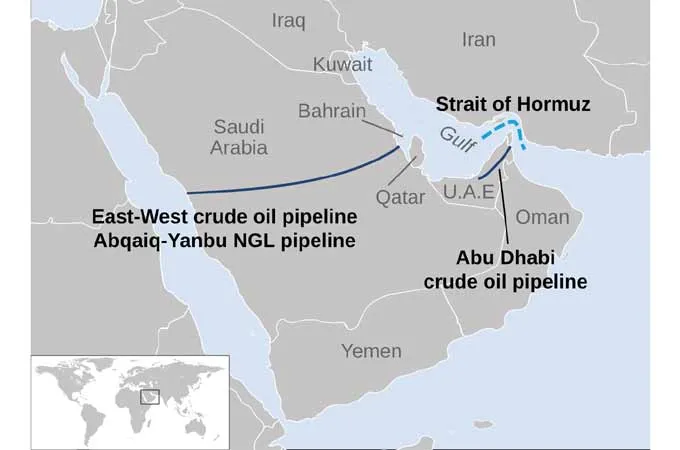
Both sides also took aim at shipping traffic, with the US saying it was enforcing a naval blockade while Iran said it targeted vessels that violated its rules on navigating the Strait of Hormuz, the vital waterway for one-fifth of the world's oil supply.
Armed men seized another vessel off Yemen, raising concern over security in the Middle East's other big choke point for oil shipments at the mouth of the Red Sea.
Iran's state television quoted the Revolutionary Guards as saying that until US "aggression" comes to an end, it will not be possible to export chemical fertilizers or even a "single drop of oil and gas" from the region.
The Revolutionary Guards later said four "violating" vessels that attempted to pass through the strait in recent hours were stopped through a combined missile and drone operation.
Washington and Tehran have been testing the limits of escalation since their ceasefire agreement collapsed last week, raising the prospect of a return to all-out war.
The US military said its latest campaign targeted surveillance sites, military logistics infrastructure, underground weapons storage facilities and maritime capabilities used to threaten shipping through the Strait of Hormuz, reported BBC. President Donald Trump warned Tehran it "better behave" and threatened further strikes on bridges and power plants if Iran failed to return to negotiations.
Iran responded by claiming it had struck US military targets across the region, including in Bahrain and Kuwait, while also launching attacks against other US allies.
Bahrain’s military said it had intercepted multiple Iranian attacks overnight into Saturday. “The Bahrain Defence Force’s air defence systems intercepted and destroyed several” Iranian aerial attacks on Saturday, the BDF posted on X.
Bahrain is home to the headquarters of the US 5th Fleet. Its interior ministry previously reported that air alert sirens had been activated multiple times into Saturday morning local time.
Meanwhile, Tehran's top negotiator, Mohammad Bagher Ghalibaf, said Iran had "no reason" to uphold the ceasefire agreement if it no longer served the country's interests.
The conflict has increasingly spread to the Gulf's vital shipping lanes. Washington said it was enforcing a naval blockade, while Iran said it targeted vessels that violated its navigation rules in the Strait of Hormuz, the strategic waterway through which around one-fifth of global oil supplies pass.
Iran also warned of a possible "full-scale offensive" if US strikes continue and threatened key Gulf ports after the US destroyed a surveillance tower near the Strait of Hormuz. Iranian state media also reported strikes on bridges and highways linking key coastal cities to the country's interior.
At sea, where the renewed conflict has again cut off energy supplies from the Gulf, US Marines boarded a tanker near the Strait of Hormuz. Armed men seized another vessel off Yemen, raising concern over security in the Middle East’s other big choke point for oil shipments at the mouth of the Red Sea, said a Reuters report.
Iranian media reported, citing Iran's Revolutionary Guards, that two oil tankers exploded and caught fire after passing through a mined route south of the strait, but the US military labeled the report as false.
In the latest strikes, the US Central Command included “military logistics infrastructure” in the list of targets it said it had hit, the first time it has mentioned infrastructure in more than a week.
Regional allies remained on high alert. Besides Bahrain, Kuwait too issued repeated missile and drone warnings over a 12-hour period, reported CNN. Following the renewed escalation, Kuwait International Airport has temporarily suspended operations, forcing Kuwait Airways to reschedule most Saturday flights.
The renewed hostilities have heightened fears of a return to full-scale war as Washington and Tehran continue testing the limits of escalation following the breakdown of last week's ceasefire.
The growing conflict has also unsettled global energy markets, with oil prices jumping more than 4% to their highest level in over a month, adding political pressure on President Trump as Republicans seek to retain control of Congress in the November elections.