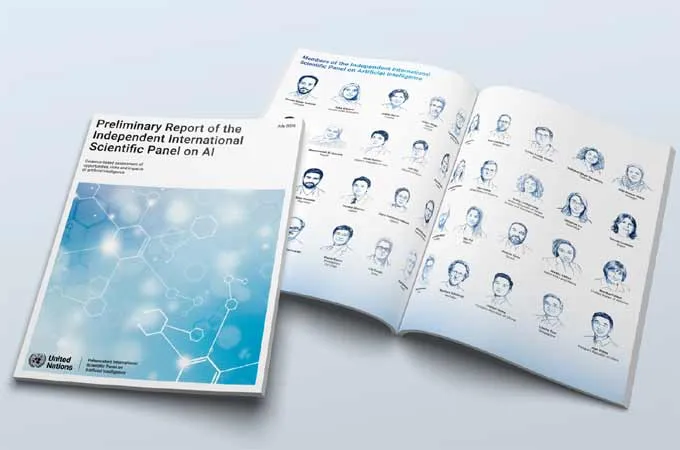
Artificial intelligence is evolving faster than scientific understanding and governments' ability to regulate it, creating growing risks that require urgent global action based on a shared scientific evidence base, a landmark United Nations report warned.
The preliminary report of the Independent International Scientific Panel on AI: Evidence-based Assessment of Opportunities, Risks and Impacts of AI is the first independent global scientific review of AI's opportunities, risks and societal impacts. It is intended to guide governments as they develop AI governance frameworks and will serve as the foundation for a comprehensive report due in 2027.
The report identifies a critical challenge for policymakers: scientific evidence is essential for governing AI effectively, but by the time evidence becomes conclusive, it may already be too late to respond to rapidly evolving technologies. It says whether AI ultimately benefits humanity equitably will depend on informed decisions taken collectively by nations based on a shared scientific understanding.
The assessment comes at a time when governments worldwide are making far-reaching decisions on artificial intelligence amid rapidly changing technologies and often conflicting evidence. The report examines AI across seven major domains, including technological advances, healthcare, education, agriculture, economic impacts, security, environmental implications, human rights, democracy, child safety, culture, governance and system reliability.
Warning over widening risks
The report was prepared by the Independent International Scientific Panel on Artificial Intelligence, a body of 40 leading scientists and experts from every region of the world serving in their personal capacities, independent of governments, companies or institutions. Its findings will be presented to governments at the inaugural UN Global Dialogue on AI Governance in Geneva on July 6-7.
"AI capabilities are outpacing both scientific understanding and governments' ability to adapt. With growing evidence of deceptive AI behaviour, science currently cannot guarantee that as capabilities continue to increase, AI will not cause catastrophic harm, either on its own or due to malicious users. To act effectively, global policymakers must understand these systems. This Panel provides exactly that: a rigorous, shared scientific foundation to guide our collective way forward," said Yoshua Bengio, Co-Chair, Independent International Scientific Panel on Artificial Intelligence.
"The technology is transformative, but if the world keeps moving along this trajectory, humanity will fail to realize the gains it promises. The risks — to societies, to security, and to our species — are too high, and the forces driving AI forward are not the forces that will deliver its benefits," said Maria Ressa, Co-Chair, Independent International Scientific Panel on Artificial Intelligence.
Call for urgent global cooperation
"The world cannot govern what it cannot understand. The panel's report provides independent science, drawn from every region, and available to every government. Its message is clear: the potential is great, but the risks are real, and the cost of waiting is rising. I urge all leaders to use this shared evidence to act together, and without delay," said United Nations Secretary-General António Guterres.
"AI will not close divides by itself. The benefits land where institutions, skills and data already exist. Where they do not, the same technology can displace workers, widen inequality and leave communities dependent on systems built without them in mind. This report puts that into a shared scientific language for the first time. Those realities are now on the record, independently verified, and impossible to set aside," said Amandeep Singh Gill, Under-Secretary-General and Special Envoy for Digital and Emerging Technologies.
Established by the UN General Assembly, the Independent International Scientific Panel on Artificial Intelligence is the first global scientific body dedicated to assessing AI. Selected through an open call that attracted more than 2,600 applications from over 140 countries, the panel has been mandated to provide independent scientific assessments rather than prescribe policy, issuing regular reports and thematic briefs as AI technologies continue to evolve.