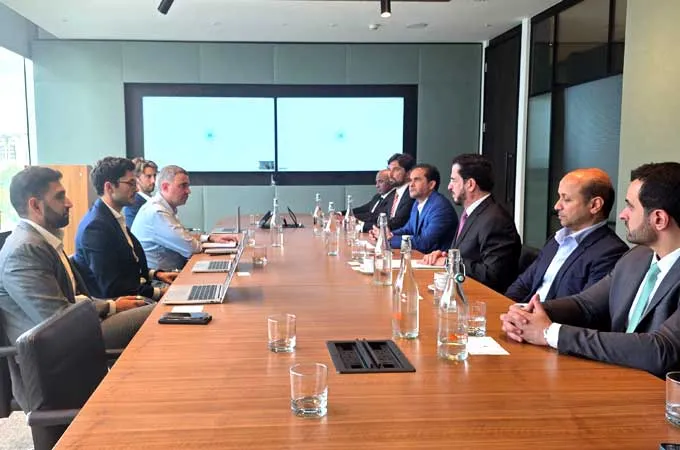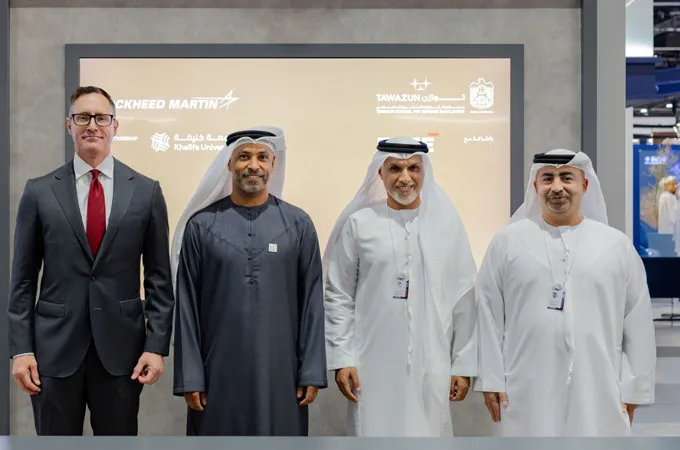
The Tawazun Council for Defence Enablement today (May 7) signed an agreement with top global security and aerospace contractor Lockheed Martin to establish an advanced microelectronics design and assembly facility in the UAE, on the sidelines of the Make it in the Emirates 2026.
The project will be executed in partnership with EDGE, one of the world’s leading advanced technologies and defence groups, and Khalifa University of Science and Technology, the country’s top-ranked research and enterprise-oriented institution.
The agreement establishes the UAE’s capability to design and assemble advanced chiplet-based technologies and advances its ambitions to localise manufacturing, strengthen industrial value chains, and position the country as a globally competitive hub for next-generation technologies.
As part of the programme, Halcon, an Edge Group Company, will integrate chiplet-based processors into advanced targeting and guidance systems, enabling more sophisticated onboard computation and enhancing target acquisition, tracking, and precision engagement.
The collaboration includes the establishment of a dedicated R&D centre at Khalifa University focused on microelectronics design, talent development, and industry-led research.
On the strategic deal, Shareef Hashim Al Hashmi, General-Director of Industry Development Directorate, said Tawazun plays a key role in enabling this national project by bringing together strategic partners, driving efforts for impact, supporting capability development, and establishing the foundations for a sustainable, locally anchored chiplet ecosystem.
This enablement reflects the Council’s approach to supporting and activating national priority projects, contributing to the acceleration of advanced industrial capabilities and strengthening the integration of the national ecosystem within critical technology sectors, he stated.
The chiplet technologies are a key enabler across advanced industries, including defence, aerospace, telecommunications, artificial intelligence, autonomous systems and advanced manufacturing.
The initiative aligns with the objectives of “Make it in the Emirates” and reflects a broader national drive to accelerate industrial growth, enable future industries, and create high-value opportunities for investment and innovation, he added.
Al Hashmi said the initiative strengthens the UAE–US technology partnership through a co-development model, by linking national capabilities in design, research, and assembly with Lockheed Martin’s expertise and its network of US partners, thereby enhancing supply chain resilience, supporting high-value jobs, and enabling innovation in both countries.
Daniel Mouton, Chief Executive, Lockheed Martin Middle East, said for more than 50 years, it has partnered with the UAE to bring advanced capabilities from ambition to reality.
"This agreement moves farther. It establishes the design and assembly capacity needed to place the emirates inside the global microelectronics value chain. Chiplets are foundational to the next generation of aerospace, defence, AI and autonomous systems, and this initiative brings together UAE vision, Emirati talent and US technology partners to build capability that can serve both national priorities and wider industrial growth," he added.
Prof. Ebrahim Al Hajri, President, Khalifa University, said: "Khalifa University is leading in the knowledge-based economy as a catalyst for economic development for the UAE. The dedicated R&D centre at the University that will be established with our partners will train UAE nationals in chiplet design and advanced microelectronics, and connect our research directly to industrial application. This is precisely the model the UAE needs to secure its position in the global technology value chain."
Saif Al Dahbashi, the President – Missiles & Weapons, EDGE, pointed out that this initiative marks a decisive step in advancing the UAE’s sovereign microelectronics capability.
"In partnership with the Tawazun, Lockheed Martin, and Khalifa University, we are combining global expertise with national ambition to accelerate capability transfer, develop a highly specialised talent base, and embed resilient, secure supply chains within the UAE. By anchoring these capabilities locally, we are not only strengthening operational sovereignty, but also positioning the UAE as a regional hub for advanced microelectronics innovation," he added.-TradeArabia News Service