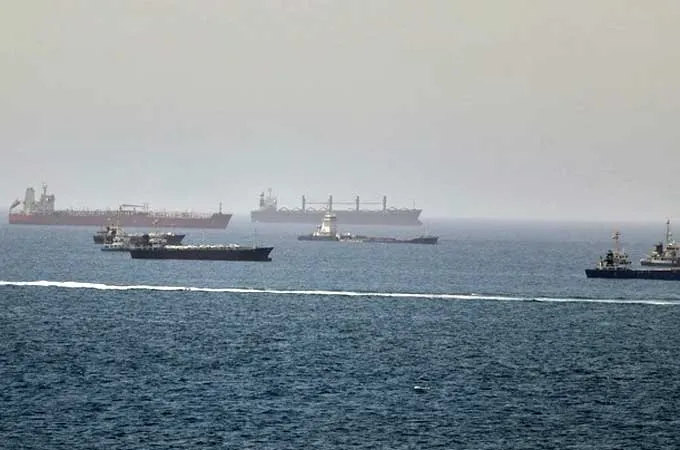
US President Donald Trump spoke to Indian Prime Minister Narendra Modi on Tuesday about the West Asia situation, including the need to secure the key energy waterway, Strait of Hormuz, that remains under an Iranian blockade. Modi reiterated India’s support for de-escalation and restoration of peace at the earliest.
Trump dialled the Indian PM a day after he announced postponement of military strikes on Iranian plants for 5 days, raising hopes of an early cessation of military hostilities, and amid reports that Washington was considering sending Vice President JD Vance to Pakistan for talks with Iranian officials, reported ToI.
The news of Trump calling Modi was broken on social media by US ambassador Sergio Gor, who also told a news channel the president was keeping Modi “in the loop”.
“Received a call from President Trump and had a useful exchange of views on the situation in West Asia. India supports de-escalation and restoration of peace at the earliest. Ensuring that the Strait of Hormuz remains open, secure and accessible is essential for the whole world,” said Modi in a post on X, adding that they agreed to stay in touch regarding efforts towards peace and stability.
This was the first call between the two leaders since the US and Israel launched co-ordinated attacks against Iran on February 28, reported Reuters.
The conflict has disrupted sectors from air travel to shipping and gas supplies, including by the near-closure of the Strait of Hormuz, which serves as a conduit for 40% of India's crude oil imports.
Modi told parliament on Monday that the crisis had triggered unprecedented challenges for India and added that the fundamentals of the Indian economy were strong and the country had adequate availability of petroleum, fertilisers and coal to weather trade and energy disruptions.
According to an Indian readout, Modi noted that safe passage of ships through the Strait is vital for global peace, stability and economic well-being.
This comes amid reports in Iranian media that officials and commentators are increasingly portraying control of the Strait of Hormuz not just as a strategic advantage but as a financial asset that could help offset the costs of war.
According to international media reports, including Bloomberg and Lloyd’s List Intelligence, Iran has begun charging oil tankers for safe passage through the Strait of Hormuz.
Iranian outlets such as the state-owned Mehr News Agency and Tabnak—affiliated with Mohsen Rezaei, senior military adviser to Iran’s new leader—had previously reported that Tehran was considering the strait as a potential source of revenue for the Islamic Republic.
News reports say Iran is charging around $2 million per tanker. However, because US sanctions prevent Iran from conducting international banking, it remains unclear what currency is being used and who ultimately receives the payments, reported Iran International.
Earlier, Iran’s Foreign Ministry announced that various countries and oil companies should contact Tehran directly to coordinate safe passage.
External affairs minister S Jaishankar had spoken to his counterpart Marco Rubio on Monday about the conflict, its likely impact on the international economy and India’s energy security concerns.
While Iran has allowed several Indian ships to sail through the Strait in the past 2 weeks, many Indian vessels remain stuck at the chokepoint. Government sources said India remains engaged diplomatically with Tehran to facilitate the movement of these ships.
Jaishankar met Iran’s ambassador to India Mohammad Fathali on Tuesday and shared India’s concerns about the situation, while thanking Iran for its support to Indian nationals in the country.
Modi on Tuesday also spoke to Sri Lankan President Anura Kumara Dissanayake and discussed the evolving situation in West Asia, with particular focus, as he said, on disruptions affecting global energy security. “We reviewed progress on key initiatives aimed at strengthening India-Sri Lanka energy cooperation and enhancing regional security. As close and trusted partners, we reaffirmed our commitment to work closely together in addressing shared challenges,” said Modi in a social media post.
India has not officially responded to Trump’s delaying of military action on Iranian energy installations with the MEA only saying the government is closely monitoring developments related to the conflict.
Trump and Modi also spoke on a day the former seemed to have endorsed Pakistan’s efforts to play the role of a mediator in the conflict. While Pakistan PM Shehbaz Sharif publicly offered to host talks between the US and Iran for a “comprehensive settlement” of the war that began on February 28, Trump shared a screenshot of Shehbaz’s post on his Truth Social platform.
Spokesperson Randhir Jaiswal, meanwhile said both Modi and Jaishankar are stressing in their engagements that peace can be restored only through dialogue and diplomacy. Like many of US’ European allies, India had shown little interest in joining a US-led naval coalition to keep Strait of Hormuz open.