Global economy shows signs of steady but subdued growth: UN
NEW YORK
SHARE
The global economy has shown resilience amid turbulence during the past year, including shifting trade policies – yet growth remains subdued and far below pre-pandemic levels, the UN said in a landmark report.
The World Economic Situation and Prospects 2026 predicts that global economic output will grow by 2.7% this year, or slightly below the 2.8% estimated for 2025 and well below the pre-pandemic average of 3.2%.
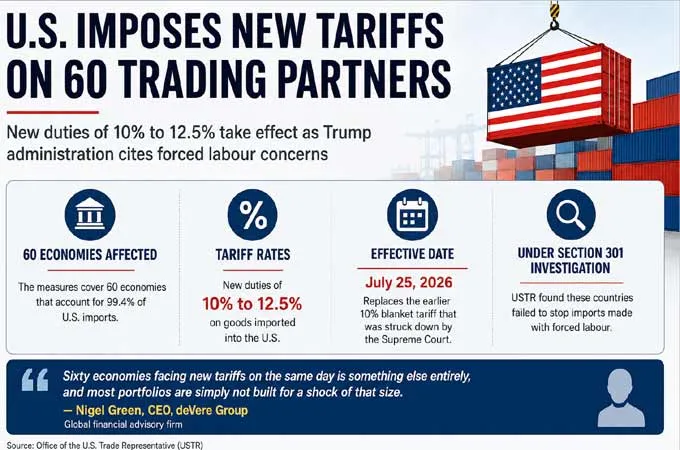
The report noted that a sharp increase in US tariffs “created new trade frictions, though the absence of broader escalation helped limit immediate disruptions to international commerce.”
Unexpected resilience to the tariffs shock, supported by solid consumer spending and easing inflation, helped sustain growth but underlying weaknesses persist.
Subdued investment and limited fiscal space are weighing on economic activity, meaning that the world economy could settle into a persistently slower growth path than in the pre-pandemic era.
A partial easing of trade tensions has helped limit disruptions to international commerce but the impact of higher tariffs, coupled with elevated macroeconomic uncertainties, is expected to become more evident this year.
The financial conditions have eased amid monetary loosening and improved consumer sentiment, but risks remain high, given elevated asset valuations especially in sectors linked to rapid advances in artificial intelligence (AI), stated the report.
Meanwhile, high debt levels and borrowing costs are constraining policy space, particularly for many developing economies," it stated.
UN Secretary-General António Guterres said a combination of economic, geopolitical and technological tensions is reshaping the global landscape, generating new economic uncertainty and social vulnerabilities.
However, he cautioned that “many developing economies continue to struggle” which is putting progress towards achieving the Sustainable Development Goals (SDGs) at risk.
According to the UN report, the economic growth in the US is projected at 2% in 2026 – compared to 1.9% in 2025 – supported by monetary and fiscal easing, though a softening labour market will likely influence momentum.
In the European Union, economic growth is forecast at 1.3%, down from 1.5% in 2025, as higher US tariffs and ongoing geopolitical uncertainty dampen exports.
Meanwhile, in East Asia, growth is projected at 4.4% down from 4.9% the previous year, as the boost from front-loaded exports fades. The region’s largest economy, China, is expected to grow by 4.6% – slightly lower than in 2025 – supported by targeted policy measures.
Growth in South Asia is forecast at 5.6% in 2026, easing from 5.9% last year. This is being led by India’s 6.6% expansion which the experts said is driven by resilient consumption and substantial public investment.
In Africa, output is projected to grow by 4% – a slight uptick from 3.9% in 2025, but high debt and climate-related shocks pose significant risks.
The report found that global trade proved resilient in 2025, expanding by a faster-than-expected 3.8% despite elevated policy uncertainty and rising tariffs.
This expansion was driven by the front-loading of shipments early in the year and robust growth in services trade, however momentum is expected to ease and trade growth is projected to slow to 2.2%.
At the same time, investment growth has remained subdued in most regions due to geopolitical tensions and tight fiscal conditions.
Headline inflation declined from 4% in 2024, to an estimated 3.4% in 2025 and is projected to slow further to 3.1% this year.
“Even as inflation recedes, high and still rising prices continue to erode the purchasing power of the most vulnerable,” said Junhua Li, UN Under-Secretary-General for Economic and Social Affairs.
The report calls for deeper global coordination and decisive collective action amid the current era of trade realignments, persistent price pressures and climate-related shocks.