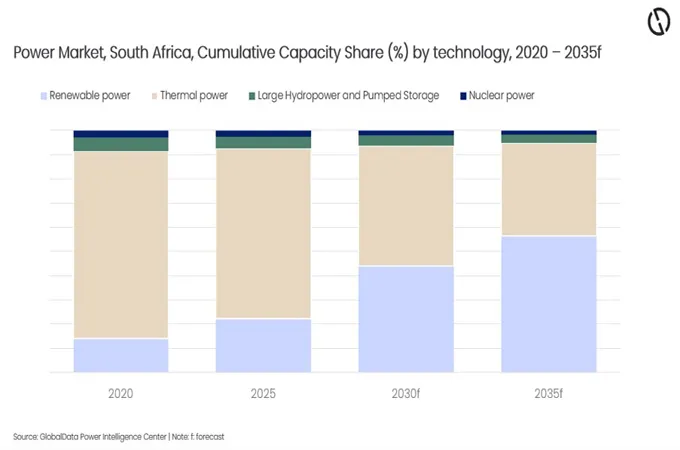
South Africa’s renewable energy capacity is expected to overtake thermal generation by 2035, driven by expanding solar and wind projects, private investment and the retirement of ageing coal plants, according to GlobalData.
The company’s latest report, South Africa Power Market
Trends and Analysis by Capacity, Generation, Transmission, Distribution,
Regulations, Key Players and Forecast to 2035, projects installed power
capacity will grow at a compound annual growth rate of 3.5 per cent between
2025 and 2035.
Attaurrahman Ojindaram Saibasan, Power Analyst at
GlobalData, said: “South Africa’s transition is no longer defined solely by
public procurement. The removal of generation licensing thresholds has enabled
mines, manufacturers, retailers, and other large consumers to secure power
directly from independent producers. This is expanding the role of corporate
power purchase agreements and wheeling, while creating a more diverse market
alongside Eskom’s legacy generation fleet.”
Coal will remain an important source of electricity during
the transition, but planned plant retirements are increasing the need for
replacement capacity, flexible generation and reliable grid connections.
Saibasan said: “The central constraint is increasingly the
grid, rather than the availability of projects or investor interest. South
Africa has a substantial renewable project pipeline, particularly in
high-resource provinces, but transmission capacity in key wind and solar
corridors is already heavily allocated. The delivery of new transmission
infrastructure will determine how rapidly contracted and privately developed
projects can reach commercial operation.”
The Electricity Regulation Amendment Act, which took effect
in 2025, provides a framework for a competitive wholesale electricity market.
Eskom’s unbundling, the establishment of the National
Transmission Company South Africa and independent transmission projects are
also intended to improve governance and attract investment in grid expansion.
Investment is expected to focus on solar PV, onshore wind,
battery storage and transmission infrastructure.
Private electricity trading is expanding through bilateral
contracts and licensed traders as the market prepares for broader competition.
The pace of the transition will depend on coordinating
renewable energy procurement, transmission development, municipal financial
reform and improvements to Eskom’s existing generation fleet.
Saibasan concluded: “South Africa has moved beyond the question of whether private capital will participate in its power sector. The key issue is whether market reform and transmission expansion can proceed quickly enough to replace retiring coal capacity, improve supply reliability, and connect renewable projects where resource quality is strongest.” -OGN/TradeArabia News Service