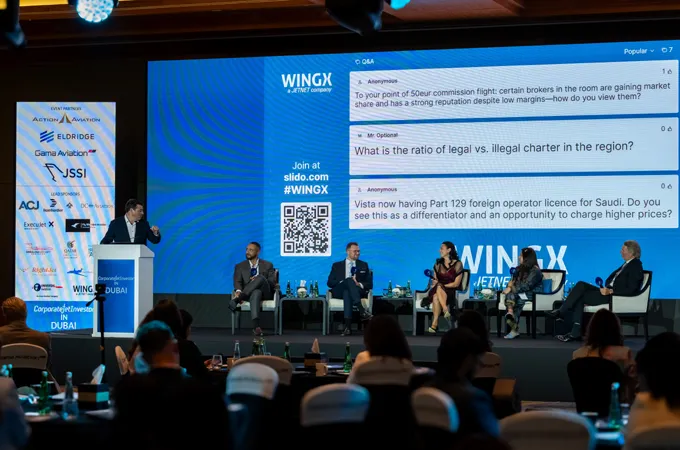
Private aviation brokers face growing pressure to compete on price as digital tools improve access to aircraft availability and charter rates, increasing the importance of operational expertise, safety compliance and accountability, according to industry leaders speaking at Corporate Jet Investor Dubai 2026.
The
discussion highlighted how greater price transparency and increasingly
cost-conscious customers are challenging traditional brokerage models,
particularly in the Middle East, where competition can place significant
pressure on margins.
Steffen
Fries, special advisor to the group CEO at Chapman Freeborn, said the focus on
price can sometimes overshadow the operational and regulatory requirements
needed to deliver a successful charter.
“In
many markets, someone can begin selling a USD 100,000 flight without first
demonstrating that they understand the operational and regulatory requirements
behind it,” Fries said.
He
stressed that the issue was not the size or age of a brokerage, but whether it
possessed the expertise and resources to fulfil its commitments. Experienced
brokers, he said, play an important role in ensuring customers understand what
is operationally possible before a flight is confirmed.
Price
competition raises operational risks
According
to Fries, customers in the Middle East may negotiate over the final $500 or
$1,000 of a charter quotation without fully understanding the differences
between competing offers.
Aircraft
availability and an attractive price do not necessarily guarantee that an
itinerary can be completed as planned. Permits, airport operating hours,
customs availability, crew duty limits, runway conditions and fuel requirements
can all affect operational feasibility.
Unrealistic
promises can damage the reputations of both brokers and aircraft operators when
a flight cannot proceed as expected.
Fries
said professional brokers must manage expectations on both sides, identifying
potential constraints and ensuring the proposed itinerary is workable before
making commitments to customers.
Price-driven
competition can also increase exposure to grey-market charter operations, in
which privately operated aircraft are offered for commercial passenger
transport without the required authorisation.
Because
such aircraft may appear identical to compliant charter aircraft, passengers
cannot reliably identify unauthorised operations by visual inspection alone.
Fries
said brokers have a responsibility to verify aircraft and operators rather than
recommending an option simply because it is cheaper. The concern is
particularly relevant in the Middle East, where privately owned aircraft are
widely used. An aircraft owner operating privately may face different
regulatory requirements when accepting payment to transport passengers.
Unauthorised
commercial flights risk being delayed or grounded if regulatory irregularities
are identified, potentially undermining the time savings and reliability
customers expect from private aviation.
The
UK Civil Aviation Authority advises passengers to check an operator's
certificates, licences and insurance, while the US Federal Aviation
Administration recommends verifying the operator's Air Carrier or Operating
Certificate.
Industry
standards could strengthen accountability
Fries
argued that improving accountability does not necessarily require additional
government regulation. Instead, established brokers, operators and industry
organisations could work together to develop common professional standards.
Potential
requirements could cover operational expertise, operator due diligence,
insurance verification, contractual transparency and customer care.
Such
standards could help customers distinguish between brokers providing
comprehensive professional oversight and those competing primarily on price.
“This
is not about protecting larger brokers from competition,” Fries said, adding
that competition encourages established companies to improve. The problem
arises when brokers make commitments without the knowledge or resources to
deliver them, damaging confidence in the wider industry.
AI
shifts the broker's role
Artificial
intelligence is expected to intensify competition by making charter pricing and
aircraft availability easier to compare. As customers gain faster access to
market information, brokers whose primary function is sourcing an aircraft and
forwarding a quotation may find it harder to justify their fees.
“If
the broker’s only role is to find an aircraft and a price, technology may
eventually make that role obsolete,” Fries said.
However,
he argued that complex charter arrangements require more than matching aircraft
with customers. Brokers must coordinate permits, airport requirements, customs
procedures, crew considerations, ground transportation and contingency
planning.
AI
could help identify potential operational bottlenecks earlier, including
constraints involving fuel services, customs availability and airport capacity.
Better data analysis could make planning faster and more predictable, allowing
experienced brokers to concentrate on risk management, operational judgement
and customer support.
Fries
expects technology to change the brokerage profession rather than eliminate it.
“As
information becomes easier to access, judgement and accountability become more
important,” he said. “Customers are not only paying for an aircraft. They are
paying for someone to anticipate what could go wrong and make sure the journey
works as promised.”
Expertise
becomes a competitive advantage
The
discussion points to a changing business model for private charter brokers,
with transparent pricing increasingly becoming a baseline expectation rather
than a sufficient competitive advantage.
As
digital tools simplify aircraft sourcing and price comparisons, brokers may
need to demonstrate greater value through regulatory compliance, operational
planning and the ability to manage disruption.
For
Chapman Freeborn, which provides private passenger and cargo charter services
and is part of Avia Solutions Group, the future of brokerage will depend on
combining technology with experienced human oversight.
The
central challenge for the sector will be maintaining competitive pricing
without compromising the expertise, safety checks and accountability required
to deliver reliable charter operations. -TradeArabia News Service