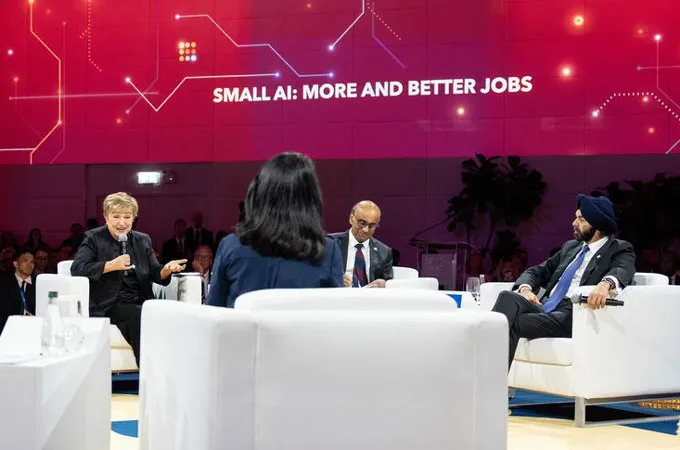
International Monetary Fund (IMF) Managing Director Kristalina Georgieva has warned that artificial intelligence (AI) was hitting the global labour market like a "slow-moving tsunami," with young graduates first in line to be knocked down while the World Bank called for governments to make 'crisis-era' support measures a permanent tool for getting young people into work.
"People to worry about, first and foremost, [are] young people that are coming into the labour market," Georgieva said at a panels on Monday.
"Normally, they would get into these routine, repetitive jobs and then grow up the ranks. But if they're gone, I don't think any young person wants to be a barista in a coffee shop as ... professional future."
The IMF head on Monday warned of the disruptive threat from AI to the labour market and taxation, urging policymakers to rethink education and act now to help society adapt, reported Bloomberg.
"It is a slow-moving tsunami, but tsunami none the less," Georgieva said Monday during her first appearance at the annual meetings of the IMF and World Bank in Bangkok.
An initial study showed that 10% of jobs in the US already required AI skills. While routine, repetitive jobs were shrinking, low-paying jobs were increasing in two lower-paying sectors, construction and data centres, reported Reuters.
The US, China and India are the most important producers in the AI supply chain, but many of the firms supplying hardware for the needed infrastructure are in Asia, Georgieva said, referencing Thailand, host of this year's annual meetings.

Speaking on the same panel, Singapore President Tharman Shanmugaratnam, who co-chairs the World Bank's Jobs Council, called for governments to make "crisis-era" support measures a permanent tool for getting young people into work.
What governments did during the Covid-19 pandemic and, in some cases, the global financial crisis "now has to be thought of not as a crisis measure, but as part of the structural, the menu of structural policies," he said.
That means working with the private sector, and incentivising firms to hire fresh graduates, because "the first rung in employment, your first job upon graduation, is now seeing less demand," Shanmugaratnam said.
The remarks show that policymakers are moving from debating whether AI will disrupt jobs to issuing stark warnings about AI-led disruption and recommending measures on how to cushion the fallout, at a time when rapidly aging populations, particularly in Asia, already threaten to shrink workforces, reported CNBC.
World Bank President Ajay Banga, estimates 1.2 billion young people will turn 18 over the next 15 years, and the private sector, which already generates 75% to 85% of jobs in any country, will have to absorb most of them.
The IMF estimates that about 40% of jobs worldwide will eventually be "augmented, downgraded or eliminated." Exposure is about 60% in advanced economies and 23% in low-income countries, said Georgieva, but poorer nations are not better off: that is "just because AI is further away."
"It is a transformative technology. It so completely changes how we work, how we live," said Georgieva, noting that an AI assistant now gave her a 30-second message about her schedule each morning.
The squeeze is clearest in tech, Shanmugaratnam said, adding that in the US “for the first time in a century, demand for graduates has gone down,” with the wage premium for a college degree also shrinking.
"Without action, a cohort of graduates loses more than a year of skills: “you lose trust in the future," he added.