Oil prices fell about 1% on Friday, extending losses for a third consecutive session, even as Saudi Arabia and Yemen's Iran-backed Houthis exchanged fresh strikes and a tanker was hit in the Strait of Hormuz, with markets focusing instead on efforts to restore Saudi oil flows and alternative routes for Gulf exports.
Brent crude futures fell $1.01, or about 1%, to $103.77 a barrel by 0020 GMT, while US West Texas Intermediate (WTI) declined $1.03, or 1%, to $100.88. Both benchmarks had fallen by around 1% on Thursday.
The decline came despite a further escalation in the conflict around Saudi Arabia's southern border and the Red Sea, underlining the market's growing focus on whether the latest attacks will translate into sustained physical supply losses.
Saudi Arabia and the Houthis exchanged fresh strikes on Thursday as the wider Middle East war spread into Yemen. Houthi-controlled television reported Saudi airstrikes in Hajjah province near the Saudi border and the Red Sea coast, as well as around Taiz further south.
The fighting has also triggered a new movement of civilians. Yemenis were reported to have taken to boats in the Red Sea to escape the intensifying fighting, adding a humanitarian dimension to an escalation that is simultaneously raising concerns over one of the world's key energy corridors.
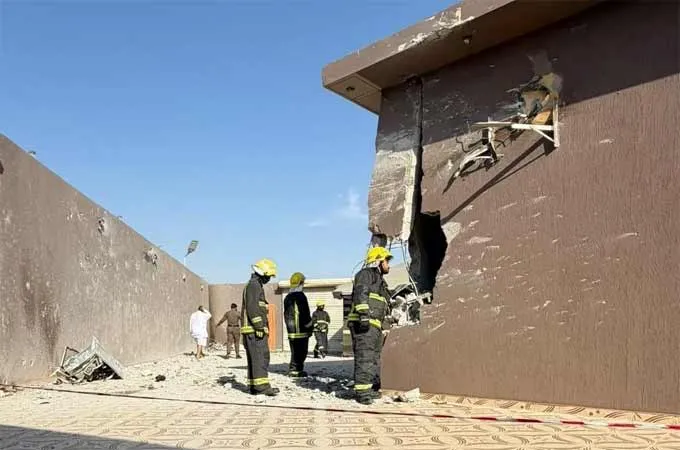
Saudi authorities said a Houthi-launched drone was intercepted and destroyed over Taif Governorate, but falling debris killed a Yemeni resident and injured a Saudi woman and a Pakistani resident, whose condition was described as critical.
The General Directorate of Civil Defense said the debris also caused material damage to civilian buildings and vehicles and that emergency procedures had been activated.
The conflict has particular significance for oil markets because the Houthis now threaten the Red Sea route that Saudi Arabia has been using as an alternative outlet for crude while shipping through the Strait of Hormuz remains severely constrained.
Pipeline damage remains central to oil outlook
The market's immediate concern, however, is whether Saudi Arabia can restore oil flows disrupted by attacks on its East-West pipeline.
The pipeline carries crude from Saudi Arabia's eastern oil fields towards the Red Sea, allowing the kingdom to bypass the Strait of Hormuz and ship oil from Yanbu. Damage to pumping stations had forced Saudi Arabia to suspend some crude loadings at Yanbu and redirect or cancel some cargoes.
But supply fears have eased after reports that Saudi Arabia is working to restore roughly half of the pipeline's capacity within days and is arranging additional crude shipments to Asian buyers through Oman, including ship-to-ship transfers. US Energy Secretary Chris Wright has also said crude should begin flowing through the pipeline within days.
That prospect of alternative supply is helping explain why crude has retreated from the week's highs despite the deteriorating security situation.
The East-West pipeline episode nevertheless illustrates how quickly Saudi Arabia's export flexibility can become critical to the global market. A prolonged shutdown would remove one of the principal alternatives to the Hormuz route at precisely the time that traffic through the strategic waterway remains restricted.
New tanker incident raises Hormuz risk
The pressure on the supply outlook was highlighted by a separate incident in the Strait of Hormuz.
Iran's Revolutionary Guards Navy said a Togo-flagged oil tanker caught fire after being hit while attempting what it described as an “illegal passage” through the strait, according to Iranian state media. The vessel subsequently came to a halt after the fire.
The incident adds to a series of disruptions affecting shipping through the waterway, through which a significant share of global oil and gas normally passes.
Oil traders are therefore watching two potential chokepoints simultaneously: Hormuz, where Iranian restrictions have sharply reduced shipping, and Bab al-Mandeb and the Red Sea, where the expanding Houthi-Saudi conflict threatens an alternative route.
Goldman warns of $120 oil scenario
The longer-term risk is considerably more bullish than Friday's price action suggests.
Goldman Sachs raised its December 2026 Brent forecast by $5 to $85 a barrel, with its WTI forecast also increased by $5 to $80. For 2027, it now sees Brent at $80 and WTI at $75. The bank said it expects Middle East shipping disruptions to persist into next year.
More importantly, Goldman has outlined a much more severe scenario. It said Brent could rise above $120 a barrel if average Gulf oil production in 2027 remains about 4 million barrels per day below pre-war levels, compared with its base-case assumption of a 500,000-bpd shortfall.
Goldman has also said oil could fall towards $80 if regional exports return to normal levels, highlighting how heavily the market is now dependent on the duration and physical consequences of the conflict.
Physical market remains tighter than futures suggest
Recent trading also suggests that the apparent retreat in headline futures prices should not be interpreted as a return to normal conditions.
Asian oil traders remain concerned about prolonged disruption, with spot premiums for Dubai and Oman crude rising sharply and refiners seeking alternative supplies from the United States and other producers. Reuters reported that ship-to-ship transfers outside Hormuz are continuing as buyers adapt to restricted Gulf flows.
The market is therefore being supported by a combination of alternative supply, strategic inventories and weaker demand expectations, even as the physical market remains tight.
China's large inventories and reduced crude imports have also helped cushion the impact, while increased output from non-OPEC producers, particularly the United States, Canada and Guyana, offers some additional supply relief. Reuters has estimated that around 9 million barrels per day of crude and refined products were still being exported from the Middle East despite the disruptions.
Saudi-Qatar security coordination
The widening conflict is also prompting closer security coordination among Gulf states.
Saudi Interior Minister Prince Abdulaziz bin Saud bin Naif met in Riyadh with Qatar's Interior Minister and Commander of the Internal Security Force Sheikh Khalifa bin Hamad Al Thani, with the two officials subsequently co-chairing the fourth meeting of the Security and Military Committee under the Saudi-Qatari Coordination Council.
The meeting reviewed security and military cooperation and coordination between the two countries, including responses to regional and international challenges.