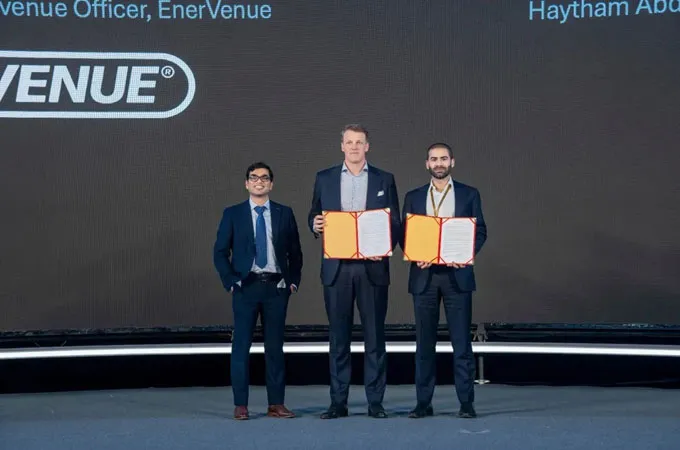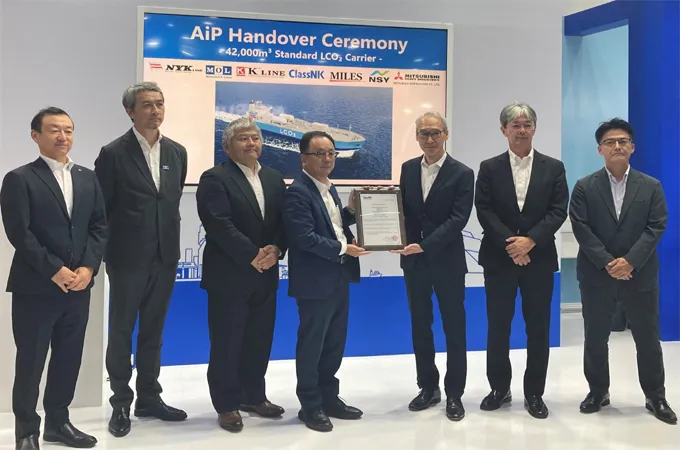
Six Japanese companies have secured Approval in Principle (AiP) from Nippon Kaiji Kyokai (ClassNK) for a low-pressure liquefied CO₂ (LCO₂) carrier, following a risk assessment of CO₂ handling operations.
The AiP ceremony was held at Gastech
2026 in Bangkok.
The companies involved are Kawasaki Kisen Kaisha
(“K” LINE), Mitsui O.S.K. Lines (MOL), Nippon Yusen Kabushiki Kaisha (NYK
Line), Nihon Shipyard, Mitsubishi Shipbuilding, part of the
Mitsubishi Heavy Industries Group, and MILES, a joint venture
focused on LCO₂ carrier and low-carbon-fuelled ship design.
The approval is the first concrete achievement
under a framework established through a 2025 Memorandum of
Understanding, which aims to standardise LCO₂ carrier designs,
support stable domestic construction and strengthen Japan’s carbon
capture and storage (CCS) value chain.
The companies conducted a Hazard
Identification Study (HAZID) covering LCO₂ handling
operations on a standardised 42,000-cubic-metre-class low-pressure
carrier.
The assessment drew on the experience of “K”
LINE, MOL and NYK Line will be incorporated into the
standard carrier design.
A common design platform is expected
to reduce workloads and improve efficiency during future vessel
design and construction, in low-pressure gas carrier operations,
helping identify risks specific to LCO₂ transportation.
Based on the findings, the companies developed a
safety-focused design policy that will be incorporated into
the standard carrier design.
A common design platform
is expected to reduce workloads and improve efficiency during
future vessel design and construction, while strengthening
Japan’s ability to build and supply LCO₂ carriers as
demand increases.
Demand for LCO₂ transportation is expected to rise
as CCS projects begin operations in Japan, creating a need to
transport captured CO₂ to offshore or other storage sites.
“K” LINE is also advancing initiatives supporting
decarbonisation under its long-term environmental policy, ““K”
LINE Environmental Vision 2050”. The company has developed
expertise in LCO₂ transportation through projects including the
provision of three LCO₂ carriers to Northern Lights, which is
developing a full-scale CCS value chain, as well as the
construction and charter agreement of two additional vessels.
The company said it will continue supporting development of the CCS value chain through LCO₂ transportation and emerging technologies, including Floating Storage and Injection Units (FSIU). -OGN/TradeArabia News Service