Germany’s electricity sector is entering a period of major transformation as rising power demand, renewable expansion, policy reforms and the phase-out of coal reshape the country’s energy system, according to GlobalData.
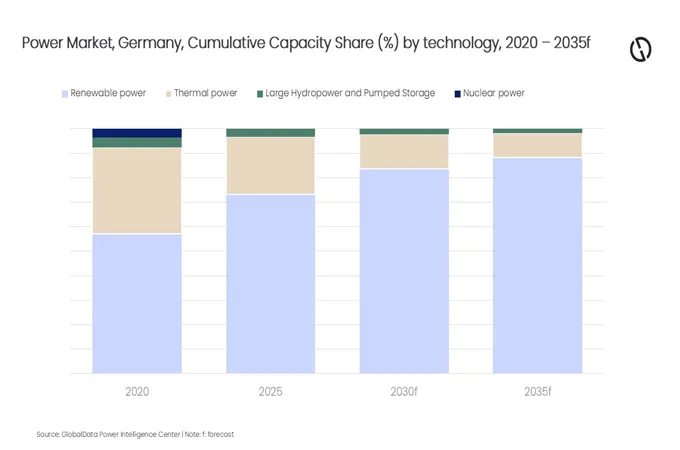
GlobalData’s latest report forecasts installed renewable
capacity to increase from around 73 per cent of Germany’s total capacity in
2025 to nearly 88 per cent by 2035, while renewables could account for almost
80 per cent of electricity generation.
Offshore wind, solar PV and onshore wind are expected to
drive growth, while thermal generation declines and gas-fired power takes on a
greater role in providing system flexibility.
A new capacity market, expected to be fully operational by
the end of 2027, is set to become a key tool for maintaining electricity supply
reliability.
With nuclear power already offline and coal scheduled to be
phased out by 2038, the mechanism is intended to ensure sufficient dispatchable
capacity as renewable generation grows.
At the same time, the EEG-2027 reform is shifting renewable
energy support away from traditional fixed feed-in tariffs towards competitive
auctions and direct marketing.
Attaurrahman Saibasan, Power Analyst at GlobalData, said:
“New projects will typically enter the market via competitive auctions or
direct marketing arrangements, with smaller-scale installations receiving
transitional support or bonuses during the switch. Larger projects must now
optimise their generation, location, and operational profile, rather than
merely depend on guaranteed compensation, thereby pushing the sector toward
market-oriented performance.”
Electricity demand is also expected to rise sharply,
increasing from approximately 466TWh in 2025 to more than 576TWh by 2035.
The growth will be driven by electrification across
transport, heating and industry, creating additional pressure for investment in
transmission infrastructure.
Germany will need stronger high-voltage networks to
transport electricity from offshore wind farms in the North Sea and Baltic Sea
to industrial centres in the south.
Delays in transmission construction and permitting could
increase renewable curtailment and create supply constraints.
Saibasan said: “Alongside these macro shifts, market
dynamics are growing more complex. Negative wholesale prices are already a
concern in periods of high wind or solar output when demand is low and they
create revenue volatility. As fixed support mechanisms fade, every project must
factor in such risks, including exposure to price swings, grid access
limitations, and project execution delays. Investors increasingly scrutinise
auction rules, the transparency of capacity payments, regulatory certainty, and
the timeline for permitting approvals.”
Investment is increasingly targeting solar PV and offshore
wind, alongside hydrogen infrastructure, energy storage, flexible thermal
generation and long-distance transmission.
Power-sector investment is expected to rise through the late
2020s as Germany works towards its targets of at least 80 per cent renewable
electricity by 2030, a coal exit by 2038 and climate neutrality by 2045.
Saibasan concluded: “Ultimately, the success of EEG-2027 and the capacity market reform will be judged by Germany’s ability to deliver across four interlinked dimensions: reliability, affordability, market-driven flexibility, and system integration. Regulatory clarity, investment certainty, and infrastructure delivery are critical. If executed in synchrony, these changes promise not only to accelerate the Energiewende but also to position Germany as a benchmark for energy transitions in large industrial economies, proving that moving beyond fixed subsidies toward performance-based, resilient systems is both possible and necessary.” -OGN/TradeArabia News Service