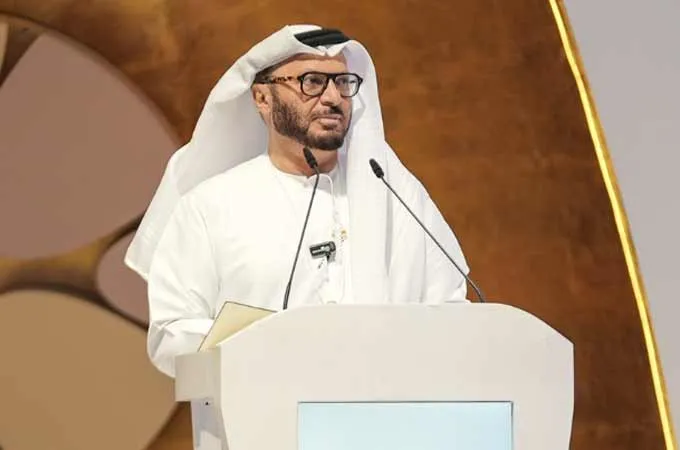
The Gulf region cannot afford to remain trapped in a prolonged state of “neither war nor peace”, with its stability and future dependent on fragile arrangements and repeated efforts to contain crises after they erupt, Dr Anwar Mohammed Gargash, Diplomatic Advisor to His Highness the UAE President, said at a key forum on Monday.
During his special address at the third edition of Hili Forum 2026 opened today in Abu Dhabi, Dr Gargash said: “Our region's stability, and the future of its people, require clarity of vision and of path. What comes next cannot rest on fragile arrangements that are detached from or that undermine international law.
"The objective must be sustainable stability, governed by clear and common rules. Getting there requires serious de-escalation, a long-term diplomatic approach to regional stability, and a clear path on Iran’s nuclear programme - clear in its terms, clear in its verification, and clear in its consequences.”
The theme of the forum this year is: “Gulf at Crossroads: Conflict, Consequences and Course Correction.” Co-organised by the Emirates Center for Strategic Studies and Research (ECSSR) and the Anwar Gargash Diplomatic Academy (AGDA), the forum brings together leading decision-makers, senior officials, diplomats, academics and international experts.
This year’s edition takes place at a pivotal moment as rapid transformations reshape regional security and the international order. The Gulf has emerged as a strategic crossroads where security, energy, trade, technology and critical corridors intersect, while Gulf states play an increasingly influential role in shaping regional and global dynamics. The Forum’s agenda is structured around three core pillars: geopolitics, geoeconomics and geotechnology.
Dr Sultan Mohammed Al-Nuaimi, Director General of ECSSR, said: “The essence of the crossroads lies in moving the international response beyond managing the consequences of crises towards a vision that reflects the Gulf’s importance to the stability of the international order. From this perspective, the Hili Forum highlights the Gulf’s role in reinforcing international stability and the deep interconnection between its security and the smooth functioning of the economy and trade. It also provides a platform to explore how this interdependence can be translated into more sustainable political, legal and economic cooperation, strengthening risk assessment and enabling responses commensurate with those risks.”
Nickolay E Mladenov, Director General of AGDA, said: “We are living through a clear paradox: the world has never been more connected, yet it is becoming increasingly fragmented, while its capacity to resolve conflicts is declining. Amid these transformations, the Gulf is increasingly one of the places where the future international order is being negotiated, contested and tested. The challenge for the region is therefore not only whether it can withstand an age of fragmentation, but whether it can remain a source of connection, continue building relationships and institutions, and strengthen trust across divides.”
Day One featured a plenary titled “Gulf Regional Security Complexes,” featuring Dr Majed Al-Ansari, Advisor to the Prime Minister and Spokesperson for the Ministry of Foreign Affairs of the State of Qatar, and Vice Admiral John W “Fozzie” Miller, US Navy, President and CEO of The Fozzie Miller Group, USA. The session was moderated by Dr Mohammed Ibrahim Al Dhaheri, Deputy Director General of the Anwar Gargash Diplomatic Academy.
The first day also featured fireside chats with Nickolay Mladenov, High Representative for Gaza Board of Peace and Director General of AGDA, and Jasem Mohamed Albudaiwi, Secretary-General of the Gulf Cooperation Council. Two rounds of concurrent sessions also brought members of the public and young people together with leading experts to examine regional and international issues from multiple perspectives.
Day One was attended by Dr Ali Rashid Al Nuaimi, Chairman of the Defence, Interior and Foreign Affairs Committee at the UAE Federal National Council; Khalifa bin Shaheen Al Marar, Minister of State at the Ministry of Foreign Affairs; Dr Sultan bin Saif Al Neyadi, Minister of State for Youth Affairs; and Sheikh Abdulla bin Mohammed Al Hamed, Chairman of the UAE National Media Authority.
Hili Forum 2026 continues tomorrow with sessions exploring competition for influence as a new geotechnology order emerges, the convergence of data, drones and digital transformation, and the growing role of middle powers amid the shifts and divisions reshaping the global order. -TradeArabia News Service