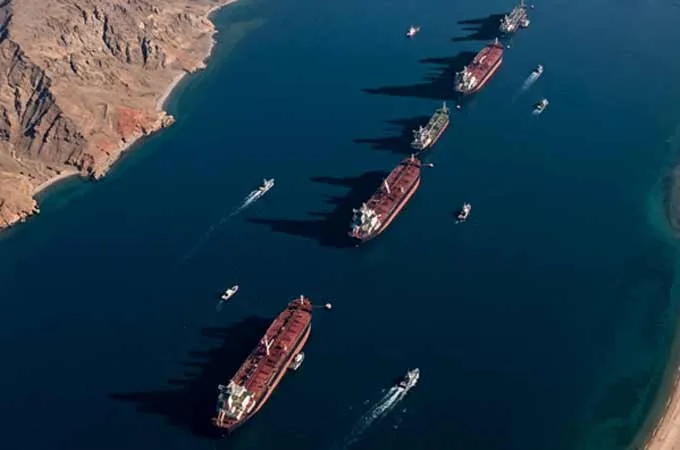
Oil prices surged above $100 a barrel on Thursday as the escalating US-Iran conflict intensified fears of a prolonged disruption to crude supplies, with attacks on tankers and a sharp decline in shipping through the Strait of Hormuz adding to market anxiety.
Brent crude futures rose to $101.34 a barrel, while US West Texas Intermediate (WTI) climbed to $96.55, as traders assessed the growing threat to one of the world's most important energy corridors.
The latest surge came after US President Donald Trump said high oil prices caused by the war with Iran were unlikely to ease until after the US midterm elections in November, effectively acknowledging that the disruption could persist for months.
Trump has also suggested that Iran was prolonging the conflict to influence the US election outcome and said he expected the war to end after the midterms.
Tanker attacks raise supply fears
The maritime situation has deteriorated sharply in recent days.
Iran said it had attacked 10 vessels near the Strait of Hormuz in retaliation for US strikes that destroyed five Iranian oil tankers. Tehran said the targets included two US vessels and eight oil tankers it regarded as non-compliant.
The US has denied that its warships were hit, while US Central Command said American forces had destroyed Iranian tankers linked to what Washington described as an oil-smuggling network financing the Islamic Revolutionary Guard Corps.
The attacks have heightened concerns among shipowners and insurers about the safety of vessels using the waterway. Two supertankers carrying Saudi crude were also struck by unidentified projectiles while transiting the Strait of Hormuz earlier this month.
The latest attacks come against the backdrop of a much wider disruption to Gulf oil flows. Industry data indicates that Gulf oil exports remain substantially below pre-war levels despite some vessels continuing to make so-called “dark crossings” with their tracking systems switched off.
According to Reuters, Gulf exports are currently running at around 15-16 million barrels per day, roughly two-thirds of pre-war levels.
Hormuz traffic plunges
The impact is particularly visible in shipping traffic through the Strait of Hormuz.
Only six commodity vessels passed through the waterway on Tuesday, according to preliminary Kpler data, down from nine the previous day and well below the 10-day average of 12 vessels a day. Five of Tuesday's vessels were inbound and only one was outbound.
The decline is significant given the strategic importance of Hormuz. Before the conflict, the strait carried around 20% of global oil and LNG supplies, with roughly 125 commercial vessels passing through it each day.
The sharp reduction in traffic reflects not only direct attacks but also the growing reluctance of shipowners to expose vessels and crews to missile, drone and mine threats, as well as sharply higher insurance costs.
The Red Sea is also coming under renewed pressure, with Iran-aligned Houthi militants stepping up attacks on Saudi Arabia and threatening shipping through the Bab el-Mandeb, creating the prospect of disruption at both ends of the Gulf's main export routes.
Trump claims control, markets see disruption
Trump has maintained that the US has control of the Strait of Hormuz, but the continuing decline in commercial traffic presents a starkly different picture of conditions on the waterway.
The gap between Washington's assurances and shipping data has become increasingly important for oil markets. Even if the strait is not formally closed, a sustained reduction in tanker movements can have much the same effect on global supplies by delaying cargoes, increasing freight and insurance costs and forcing producers and traders to rely on alternative routes or clandestine shipments.
The latest escalation therefore represents a shift from fears of a temporary disruption towards concerns about a prolonged supply squeeze.
The US Energy Information Administration has already raised its oil-price outlook amid declining global inventories and lower Middle Eastern production.
For Gulf economies, the developments present a complex picture. Higher crude prices could provide a substantial revenue boost for oil exporters, but prolonged disruption to shipping threatens refinery feedstock, LNG flows, petrochemical supply chains, freight costs and the wider regional economy.