Iran has warned that any further US attack will trigger a “faster, heavier and more painful” response, as Tehran said it will impose tighter control over shipping around the Strait of Hormuz following the latest US strikes on Iranian oil tankers.
Iranian Parliament Speaker Mohammad Baqer Qalibaf said on Sunday that Washington should understand that the “rules of the game have changed” following the US attacks on three Iranian tankers.
“From now on, any attack against Iran’s interests and security will receive a faster, heavier and more painful response,” Qalibaf said in remarks carried on his Telegram channel.
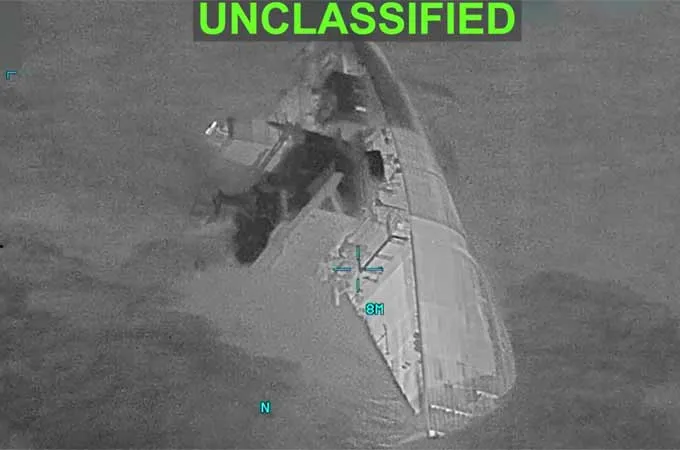
The warning came a day after US Central Command said its forces had struck three Iranian crude carriers after Iran's Islamic Revolutionary Guard Corps launched ballistic missiles towards two US Navy ships.
The US said two of the tankers were disabled and a third, the M/T Kylo, was sunk in the Gulf of Oman after its crew was ordered to abandon the vessel.
Mohsen Rezaei, secretary of Iran's Supreme National Security Council, said Tehran would establish a new “restricted” or “prohibited” maritime zone outside the Strait of Hormuz in the coming days.
The zone would begin at the US naval blockade line and extend into parts of the Gulf, Rezaei said. Any vessel entering the area would be placed on an Iranian sanctions list.
Rezaei also indicated that Iran and Oman were working on an agreement covering a new shipping corridor through the Strait, with its entry and exit points under Iranian control.
The proposed zone adds another layer of uncertainty for commercial shipping already facing sharply reduced traffic through Hormuz.
Kpler data showed that traffic through the strategic waterway had fallen to its lowest level since May, averaging about 10 commodity vessels a day over the past 10 days. The decline followed the latest US and Iranian attacks on ships in and around the strait.
The escalation is also feeding directly into oil markets. Brent crude rose above $97 a barrel on Monday, extending last week's gains as traders assessed the risk of further disruption to Middle East supplies.
Hormuz is one of the world's most important energy chokepoints, carrying a substantial share of global oil and gas exports. Prolonged restrictions or attacks on commercial shipping could therefore affect not only regional producers but refiners, consumers and energy markets worldwide.
Iran faces growing economic pressure
The military confrontation is unfolding alongside mounting economic pressure on Tehran.
Qalibaf said Iran's battle was now being fought not only on the military front but also over production and people's livelihoods, citing inflation, currency volatility, unemployment and difficulties in managing the domestic market.
Economy Minister Ali Madanizadeh said the government would pursue economic reforms to counter US sanctions and rejected the argument that economic pressure would force Tehran to change its political course.
Iran's economy has come under increasing pressure as Washington seeks to restrict its oil exports and financial links, while the conflict has disrupted the country's access to international markets.
The latest confrontation has also deepened uncertainty over the prospects for diplomacy. A preliminary ceasefire reached in June has unravelled, while efforts to revive negotiations have made little progress.
Gulf faces wider environmental risk
The continuing attacks on oil tankers are also raising concerns about the potential environmental consequences for the Gulf region, although there is no confirmed evidence at present of a major oil spill from the tanker sunk by the US or of pollution reaching the coastline of Oman or other Gulf states.
The concern is nevertheless significant because the Gulf and Gulf of Oman are environmentally vulnerable and heavily dependent on marine resources.
The sinking of an oil tanker creates the possibility of crude or fuel escaping from the vessel, with the eventual impact depending on the amount of oil aboard, the condition of the tanker, currents and weather.
The Gulf of Oman has experienced major oil pollution incidents before. A 1994 tanker collision released thousands of tonnes of crude and contaminated part of the UAE coastline, affecting fishing and coastal areas.
The Arabian Gulf itself is particularly vulnerable because it is shallow and semi-enclosed, with relatively limited water exchange with the wider Indian Ocean. Pollution can therefore persist longer than in open waters.
The environmental risk is especially sensitive for the Gulf states because millions of people depend on desalinated seawater. A major spill close to desalination plants or their intake systems could potentially disrupt water production, while coastal ecosystems, fisheries, mangroves and coral habitats could also be affected.