Nvidia is teaming up with some of Wall Street's biggest financial firms to mobilise more than $500 billion for artificial intelligence (AI) infrastructure, as part of its ambitious plan to turn AI chips and computing capacity into a new asset class that investors can finance much like real estate, power plants or other critical infrastructure, said media reports.
The global chip giant has signed agreements with Apollo Global Management, Blackstone, BlackRock, Brookfield Asset Management, Goldman Sachs and KKR to create financing platforms for Nvidia customers, the company said.
The initiative could reshape how the enormous buildout of AI infrastructure is funded.
Rather than forcing hyperscalers, AI labs and other companies to finance increasingly expensive data centres and graphics processing units entirely from their own balance sheets, the platforms would tap institutional credit, insurance capital and private investment.
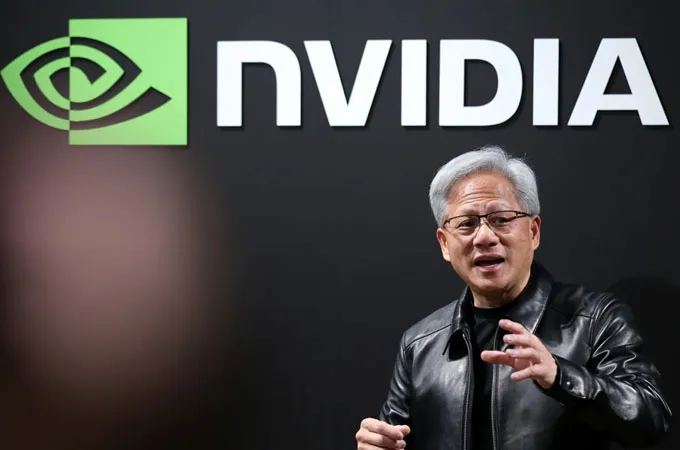
"This is really the first time that technology chips have become an investable asset class," Nvidia founder and CEO Jensen Huang told CNBC. "These are revenue-generating assets now. They're productive, they're long-lived, they're fungible, they're flexible."
Huang's argument represents a major departure from the traditional way investors have viewed computing hardware. GPUs and other chips have typically been treated as rapidly depreciating technology, particularly because newer and more powerful generations can arrive within just a few years.
"Nvidia boss Jensen Huang is like a car salesman hawking a popular model. He sees eager customers for computing power, but knows that fewer of them can afford it. The solution: assemble deep pockets from across Wall Street to pony up some $500 billion of funding for buyers. It's a crafty deal, that also conspicuously reflects concerns about the ever-growing cost of artificial intelligence," said a Reuters analyst.
Prime data-center builders are approaching their financial limits. Alphabet, Amazon.com, Meta Platforms, Microsoft and Oracle will spend roughly $750 billion this year, equal to 38% of revenue, S&P Global Ratings has projected. Some of them are already burning cash.
New spending promises are also making shareholders twitchy. Debt issued by tech goliaths keeps getting pricier. The cost of insuring against its default is rising, he stated.
It's an awkward situation for Huang. Hyperscalers are big consumers of Nvidia's silicon, and their credit ratings ultimately secure purchases by other server farmers, too, he added.
To help fill the gap, Nvidia will now steer buyers, including unrated AI labs like OpenAI and neoclouds such as CoreWeave to blue-chip suppliers of capital.
Their loans will be customized, but secured by Nvidia’s products. This will extend beyond its ubiquitous graphics processors to other server-rack equipment. Depending on the project, the $5.3 trillion chipmaker may guarantee up to 25% of collateral based on residual value. Most of the funds would come from insurers, or credit and infrastructure investors; money managers foresee equity or hybrid elements, too.
The entire plan hinges on Nvidia products retaining their widespread acceptance as the industry standard, with value sufficiently understood to be safely financed and even resold if a customer defaults. In a sense, it channels the $130 billion market for securitized car loans. Vehicles can be repossessed easily, after all, and flogged to other drivers.
Nvidia is betting that the economics of AI have changed that calculation. With its GPUs deployed widely across data centers and capable of generating revenue through AI workloads, Huang argues the chips can increasingly be treated as productive infrastructure that lenders can underwrite, reported International Business Times.
"Fundamentally, what's different about this industry and this way of doing computing is that the computer is now part of the infrastructure, like electricity, like the internet, and so you have to think about it like it's infrastructure," Huang said.
The concept could prove particularly attractive as technology companies face growing scrutiny over the hundreds of billions of dollars they are spending on AI. Rating agencies including Moody's have warned that soaring capital expenditures are putting pressure on free cash flow and pushing some technology giants toward greater reliance on debt, it stated.
The financing platforms could provide another source of capital while allowing Nvidia customers to continue expanding AI capacity without carrying the entire cost themselves. Wall Street's largest alternative asset managers have already been pouring money into digital infrastructure. Apollo and Blackstone, for example, have participated in debt and equity financing involving AI developer Anthropic.
Goldman Sachs CEO David Solomon described the current environment as a "pivotal moment of a historic AI investment cycle."
"Our investment and distribution roles reflect our confidence in NVIDIA's leadership, and we're excited for the new opportunity to create a market for credit backed by NVIDIA compute," Solomon said in Nvidia's announcement.
Solomon told CNBC that Huang approached the Wall Street firms with the idea behind the financing initiative. Blackstone President Jon Gray compared the emerging market for AI compute financing to the way mortgage lenders view homes as financeable assets. He also pointed to soaring demand, saying AI usage among Blackstone portfolio companies has increased sevenfold this year.
BlackRock CEO Larry Fink went even further, describing the initiative as potentially the beginning of the "next future for financial engineering" and comparing its development to the emergence of mortgage-backed securities in the 1970s.
Some capital has already been raised, Fink said, but BlackRock expects to seek substantially more. "We need to raise this money as fast as possible and put this to work, because I think it's really imperative that the United States is the leader in AI in the world," Fink told the outlet.