The United States launched a heavy wave of airstrikes against Iran late on Wednesday, marking the most significant direct attack on Iranian territory in days and sharply escalating a conflict that is increasingly threatening regional security, global energy supplies and international shipping.
The strikes came less than 24 hours after Iran launched what the US military described as a "surprise attack" against American forces in the region, firing multiple ballistic missiles towards US military positions in Jordan. The missiles were intercepted before causing damage, prompting President Donald Trump to vow swift retaliation.
"We're going to be hitting them very hard because it's our turn to hit them. They know it's coming," Trump told reporters in the Oval Office earlier on Wednesday.
Hours later, US Central Command (CENTCOM) announced that it had completed a "heavy wave of strikes" against dozens of Islamic Revolutionary Guard Corps (IRGC) targets across Iran.
"CENTCOM assets struck dozens of Islamic Revolutionary Guard Corps (IRGC) targets in Iran, including military command centres, missile and drone facilities, coastal surveillance and defence sites, and maritime capabilities," the command said in a statement posted on X. The operation concluded around 10 p.m. ET, although the military did not disclose the total number of targets hit or the extent of the damage.
Iranian state media reported multiple explosions across southern Iran, including in the strategic port city of Bandar Abbas overlooking the Strait of Hormuz and on Kish Island in the Persian Gulf. The attacks represented the first direct US strikes on Iranian territory in several days.
State broadcaster IRIB reported that search and rescue teams were deployed to Qeshm Island after US missiles struck a residential building in the Chah Tangu neighbourhood. Photos and videos aired by the broadcaster showed rescue workers searching through damaged structures. Iranian news agency IRNA said explosions were also heard around Kish Island but reported no damage to residential or urban areas there.
The latest exchange ended several days of relative calm following earlier efforts by both sides to limit direct confrontation, signalling that the conflict has entered a more dangerous phase with increasingly frequent direct military exchanges between Washington and Tehran.
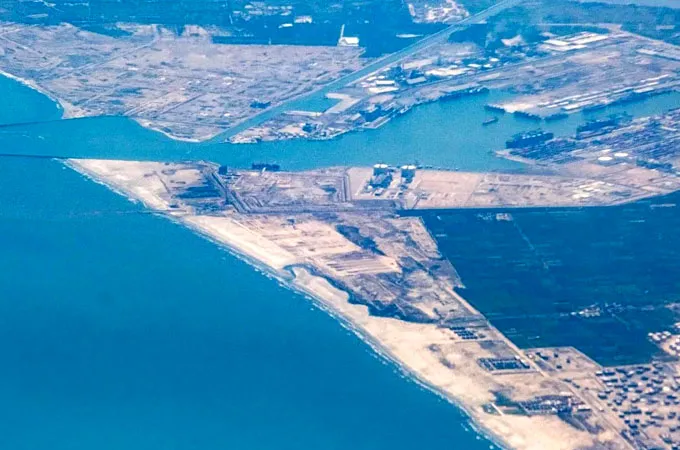
The regional conflict widened further on Wednesday after a drone struck a US-owned gas storage tanker at Egypt's Mediterranean port of Damietta, according to British maritime security firm Ambrey. Egypt's Petroleum Ministry confirmed a fire at the port but did not identify the cause or mention a drone attack. Responsibility for the incident has not been established.
Earlier, US and Saudi forces reportedly carried out strikes against Iran-aligned groups in eastern Iraq, underscoring the expanding geographical scope of the conflict.
The maritime security situation has also deteriorated after Yemen's Iran-backed Houthi movement declared that Saudi vessels attempting to reach the Indian Ocean would be treated as military targets, prompting shipping companies to reassess routes through one of the world's busiest energy corridors.
Commercial vessel movements through the Strait of Hormuz remain sharply below normal levels. MarineTraffic data showed that only 14 commercial ships transited the strategic waterway over the past 24 hours, with eight vessels entering the Persian Gulf and six departing towards the Gulf of Oman, reflecting growing caution among ship operators amid fears of further military escalation.
Saudi Arabia is meanwhile seeking to establish an international coalition to safeguard commercial shipping in the Red Sea against Houthi attacks, according to a Reuters report citing two sources familiar with the discussions. The proposed coalition is still under negotiation, with consultations reportedly involving dozens of countries.
The renewed fighting initially sent oil prices sharply higher as traders priced in the increased risk of supply disruptions across the Middle East. Brent crude surged nearly 8% on Wednesday while US West Texas Intermediate gained more than 6%, reversing the previous day's sharp decline after hopes briefly emerged of a pause in hostilities.
However, prices eased during early Asian trading on Thursday as oil tankers continued moving out of the region despite the heightened tensions. Brent crude futures fell $1 or 1.1%, to $89.74 a barrel, while WTI crude slipped 69 cents, or 0.82%, to $83.77 a barrel. Analysts said the pullback reflected cautious optimism that energy exports had not yet suffered major disruptions, although markets remain highly sensitive to developments around the Strait of Hormuz and Red Sea shipping lanes.