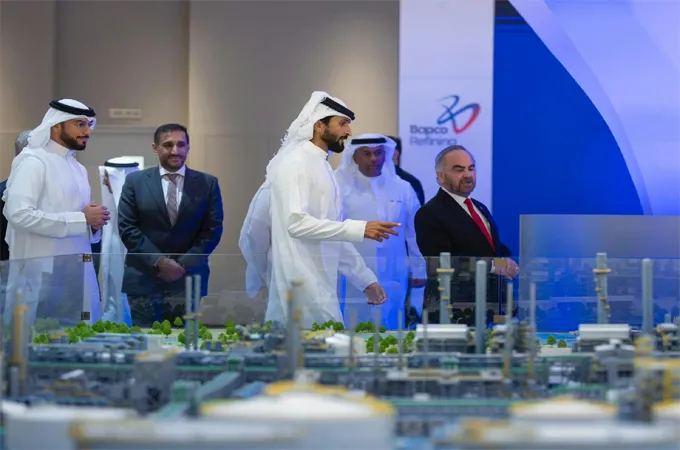
On the occasion of the first anniversary of His Majesty King Hamad bin Isa Al Khalifa's inauguration of the Bapco Modernisation Project, which was organised by Bahrain's Bapco Energies Group on December 2024, and within the framework of following-up on the progress of refinery's modern units, Shaikh Nasser bin Hamad Al Khalifa, Representative of His Majesty the King for Humanitarian Work and Youth Affairs, Chairman of the Board of Directors of Bapco Energies, paid an extensive inspection visit to the refinery site to closely examine the efficiency of operational processes and follow up on the performance of the new units.
Shaikh Nasser’s visit
aimed to assess the refinery's work and ensure the efficiency of production
operations, reported BNA.
He was briefed on the
significant operational efficiency of the refinery's operations following its
modernisation.
Production levels have
risen from 265,000 barrels per day to 380,000.
Shaikh Nasser announced
a new increase in production capacity to 405,000 barrels per day, representing
a 42 per cent increase compared to the previous capacity.
This increases the Kingdom's export capacity by up to 40 per cent of high-value oil products, exceeding the operational targets set at the beginning of the modernisation project.
As part of the Kingdom's drive to localise industries related to the energy
sector, Shaikh Nasser inaugurated the Bapco manufacturing facilities, a unit
comprising a group of advanced industrial workshops.
He reviewed the unit's
high-quality manufacturing capabilities, which enable it to produce vital spare
parts and equipment for the refinery.
The unit covers 10 per cent of
the company's annual requirements for spare parts and operational equipment.
Shaikh Nasser directed
that a feasibility study be conducted for an integrated industrial project
aimed at manufacturing the spare parts and equipment needed by the energy
facilities of Bapco Energies companies to establish a national industrial
system capable of meeting the sector's needs locally and encouraging innovation
in engineering industries to enhance Bahrain's status in this field and use the
latest and most advanced technologies, including 3D printing for the parts
manufactured in this unit.
Shaikh Nasser also
directed that a number of other complementary projects be studied with the aim
of providing economic and technical support to the modern refinery and
enhancing Bahrain's global position in innovation, sustainability and advanced
industries, to consolidate its position as an advanced industrial centre in the
energy sector.
Shaikh Nasser emphasised
that the visit aimed to closely examine the efficiency of the new refining
units one year after the historic opening of the refinery, considering the
modernisation project a milestone in the development of the refining sector and
a qualitative leap that strengthens Bahrain's position as an advanced
industrial centre in the region and the world.
Shaikh Nasser
commended the leadership's vision that supported the project since its
inception, and the exceptional legacy it represents, capable of meeting future
challenges and maximising the positive impact on the national economy.
He also emphasised the
important role of the refinery, following its modernisation, in supporting the
core operating system for the long-term sustainability of Bapco Energies,
thereby achieving Bahrain's Economic Vision 2030.
Shaikh Nasser noted
that the modernisation project completed all its construction phases and has
begun actual operation safely and reliably after a successful trial operation,
affirming that the 32 new units, compared to only 13 units before the
modernisation, have been designed to operate with minimal energy consumption
and in accordance with the highest international standards of occupational
safety and risk management, reflecting the enormous transformation brought
about by the new refinery units and demonstrating Bahrain's readiness for a new
phase of leadership in the refining and energy sector at the regional and
international levels.
Shaikh Nasser said
that the new refinery facilities include one of the largest hydrocracking units
in the region, as well as a new distillation unit and round-the-clock digital
control systems, which enhance operational efficiency and ensure the adoption
of the highest levels of modern technology.
Shaikh Nasser
commended the efforts of Bapco's board of directors and executive management
team in overseeing the modernisation project and monitoring its construction
operations from inception to completion.
He noted their remarkable success in
overcoming all challenges and their exceptional ability to control and manage
costs and expenses during implementation, which reflects the efficiency of
senior management and its commitment to the highest standards of financial
governance.
Additionally, Shaikh
Nasser expressed pride in the Bahraini youth working at the refinery, who have
proven their exceptional ability to manage and operate the latest global
technologies in refining and energy.
He noted that their
success is clear proof of the ability of national talent to manage and operate
the latest global technologies in refining and energy, reiterating that
Bahraini citizens have always been and continue to be the first choice for
employment, and that empowering national youth will remain a fundamental pillar
of the future development strategy.
Shaikh Nasser also met
with a number of Bahraini engineers and technicians working at the refinery,
who were recruited and employed prior to the start of the modernisation
project, upon his specific directives on empowering Bahraini youth and
prioritising them in this strategic development.
More than 700 Bahraini
engineers and technicians were selected to work in the new units and are now
working with high efficiency in the management and operation of the units,
laboratories and operational facilities.
This performance is the result of advanced training programmes exceeding 200,000 hours of specialised training, including international courses at the headquarters of the unit manufacturers, in addition to intensive training programmes in the Kingdom, which provided national capabilities with rare operational expertise, enabling them to handle one of the most advanced.