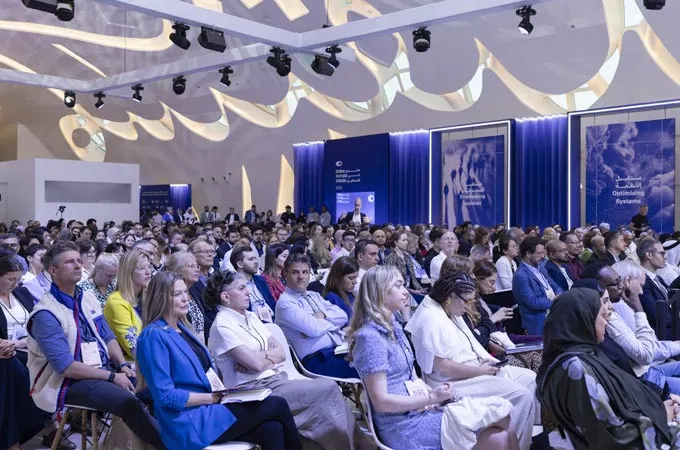
Most humans may eventually become cyborgs, the Dubai Future Forum 2025 heard on Wednesday from Professor Sir Konstantin Novoselov, Nobel Prize laureate and researcher at the National University of Singapore.
He told participants during “Beyond Medicine: What’s the Next Disruptor?” that society is increasingly “risk hungry” and that “crazy ideas can find funding”. He added: “At some time in the future, it will become normal to be implanted with chips and prosthetics. We are all set to become cyborgs.”
With exceptional future-focused insights, practical outcomes, new initiatives, and strategic announcements, the Dubai Future Forum 2025, organised by Dubai Future Foundation (DFF) at the Museum of the Future, concluded Wednesday. Over two days, the forum welcomed more than 2,500 participants, over 200 speakers, and representatives of more than 100 global institutions, reinforcing its position as the world’s largest gathering of futurists.
New species coming?
The discussion explored the future of brain–computer interfaces, with Dr Tim Sievers, Executive Co-Chairman of Blackrock Neurotech, questioning whether advanced robotics could signal the creation of “a new species”.
In “The Business of Foresight: How Do Strategies Diverge?”, members of the Foresight Inside Group, including Geraldine Wessing, Chief Political Analyst at Shell, Lauren Praverman, Global Insights Director at PepsiCo, Maria Åkerlund, Strategic Foresight Leader at Inter IKEA, and Olivier Desbiey, Group Head of Foresight at AXA, shared how they integrate external insights into corporate strategy while building internal trust and expertise.
In “From Ice to Insights: Why Should We Care About the Melting Poles?”, glaciologists, Arctic experts, and policymakers examined what extreme climate events reveal about the planet’s future, and how foresight in polar regions could drive resilience and sustainability.
A panel titled “The Art of Curating Tomorrow: How Can Spaces Enable Inclusive Futures?” explored how museums, galleries, and virtual spaces can strengthen belonging, empower diverse voices, and open pathways to more inclusive futures.
Revisiting the boundaries of medicine, “Beyond Medicine: What’s the Next Disruptor?” examined brain chips, neural interfaces, and the disruptive technologies set to redefine healthcare, raising questions about the limits society is willing to cross.
In “Relearning Imagination: Are We Actively Shaping our Future?”, government representatives, design thinkers, and changemakers discussed why imagination must become a strategic tool and how unlocking individual and collective agency can shape the future of our societies and environments.
A session titled “Look Up: What is The Future of Space Exploration?” reflected on the rapidly evolving relationship between humanity and space, highlighting why global participation is essential as space becomes a strategic frontier.
In “Teaching Futures: What Does it Take to Build Foresight Capacity Worldwide?”, global leaders in futures education shared approaches to equipping learners with the skills needed to navigate uncertainty, from academic curricula to policymaking contexts.
The panel “Existential Hope: What Does A Future Worth Building Look Like?’ explored how societies can reignite a collective vision for flourishing futures, proposing that preventing risks alone is not enough without a parallel pursuit of human progress.
The session “The Food and Water Nexus: Can We Balance Our Needs Within Planetary Limits?” examined how population demands, food systems, and planetary boundaries can be reconciled to secure long-term environmental and societal well-being.
In “Unsure AI: Can Intelligence Thrive Without Certainty?”, experts discussed how embedding uncertainty into AI systems may enhance their adaptability, teachability, and ability to understand human contexts.
A panel titled “Collaborative Foresight: How can We Create Strong, Lasting Connections?” showcased innovative ways foresight communities are strengthening collaboration across sectors to address shared challenges.
The session “Concepts of Time: How Do They Shape Our Future?” explored how societies interpret time differently, and why acknowledging these differences is vital for co-creating equitable global futures.
Discussing youth-led and intergenerational foresight, “From Inclusion to Innovation: How Are Youth Redefining Foresight?” highlighted the critical role young people play as the generation who will carry the consequences of today’s decisions.
In “The Bionic Frontier: What happens When Technology Meets Biology?”, technology and health experts examined how bionic systems, regenerative medicine, and human biological enhancement could redefine the future of health.
Concluding Day 2’s thematic programme, “Futuring for Resilient Communities: What Does it Take to Build Better?” reflected on the realities of climate disruption — from extreme weather to rising sea levels — exploring how futures thinking can sharpen community resilience and long-term planning.
Several major announcements were made at the Forum, including confirmation by His Excellency Omar Sultan Al Olama, Minister of State for Artificial Intelligence, Digital Economy and Remote Work Applications, that Dubai recorded the first-ever commercial agentic AI payment transaction outside the United States. The transaction, launched by Mastercard in partnership with Majid Al Futtaim, took place on the morning of the Forum’s opening. -TradeArabia News Service