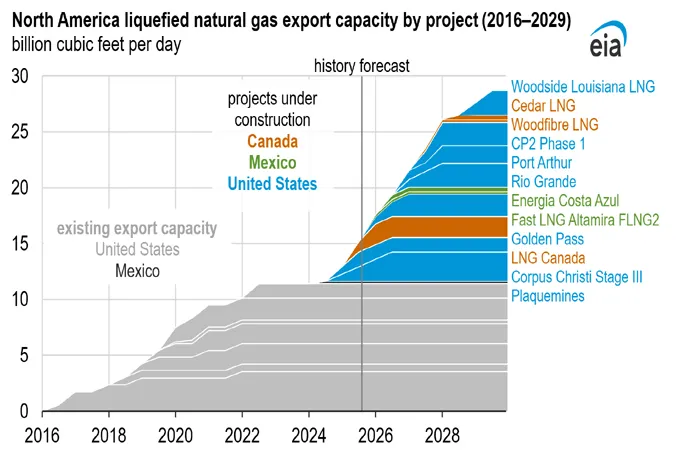
Liquefied natural gas (LNG) exporters in the US have announced plans to more than double US liquefaction capacity, adding an estimated 13.9 billion cubic feet per day (Bcf/d) between 2025 and 2029, according to US Energy Information Administration (EIA) Liquefaction Capacity File and trade press reports.
The US is already
the largest exporter in the world with 15.4 Bcf/d of capacity.
More broadly, LNG
export capacity in North America is on track to increase from 11.4 Bcf/d at the
beginning of 2024 to 28.7 Bcf/d in 2029, if projects currently under
construction begin operations as planned.
Exporters in Canada
and Mexico have announced plans to add 2.5 Bcf/d and 0.6 Bcf/d of capacity over
the same period, respectively.
North American export
capacity additions will total over 50 per cent of expected global
additions through 2029, according to the International Energy Agency.
US: The planned
liquefaction capacity additions will be concentrated around the US Gulf Coast,
already the largest hub for LNG exports in the Atlantic Basin.
To supply these
terminals, new pipeline projects will be built to transport natural
gas from production areas. However, pipeline construction delays remain a
supply risk for new terminals.
Plaquemines LNG Phase
1 shipped its first cargo in December 2024.
Plaquemines LNG Phase 2 and Corpus
Christi Stage III began shipping cargoes earlier in 2025, but they have
not yet begun commercial operation.
Five additional LNG
export projects in the US have reached final investment decision (FID)
and are currently under construction:
Canada: On July
1, LNG Canada—the nation’s first LNG export terminal—shipped its first cargo from
Train 1 after achieving first LNG production in late June.
LNG Canada, located in
British Columbia, can produce a combined 1.84 Bcf/d from two liquefaction
trains (0.9 Bcf/d per train), and the facility is anticipated to reach full
capacity in 2026.
A proposed second
phase of the project would double the export capacity to 3.68 Bcf/d and expand
the facility to four trains, according to the Canada Energy Regulator (CER).
The expansion is expected to come online after
2029.
Canada’s new LNG
capacity will be on the west coast of North America, reducing shipping
times to Asian markets by 50 per cent compared with exports from US Gulf
Coast terminals, and will source feedgas from the Montney Formation in the
western provinces of Alberta and British Columbia.
Two other projects with a combined capacity of
0.7 Bcf/d are currently under construction in Western Canada.
Woodfibre LNG, with an
export capacity of 0.3 Bcf/d, is expected to start LNG exports in 2027.
Cedar LNG—a floating
LNG project with capacity to liquefy up to 0.4 Bcf/d—reached FID in June
2024 and is expected to begin LNG exports in 2028.
Mexico: Developers
are currently constructing two LNG export projects in Mexico with a combined
capacity of 0.6 Bcf/d—the Fast LNG Altamira Floating LNG (FLNG)
production vessel (FLNG2), which has a capacity to liquefy up to 0.2 Bcf/d off
the east coast of Mexico, and Energía Costa Azul (0.4 Bcf/d export capacity) on
Mexico's west coast.
Both projects will
source feedgas from sources in the US.
Mexico’s first LNG export cargo was produced aboard Fast LNG Altamira FLNG1 in August 2024, and natural gas transported on the Sur de Texas-Tuxpan natural gas pipeline supplies this project. -OGN/TradeArabia News Service