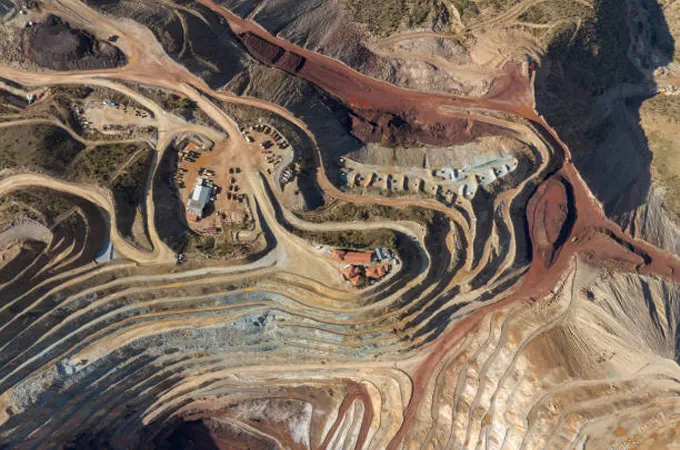
The financial system, governance and regulation of mineral exploration and mining must be reformed to ensure greater capital flows and a clean energy transition, say the authors of a new report by the UN Environment Programme-hosted International Resource Panel.
With mineral extraction rising to 50 per cent of annual global raw material extraction up from 31 per cent in 1970, financing responsible mining will be critical to a successful and fair energy transition.
Mineral extraction has increased five-fold since 1970, and the market for critical energy transition minerals – the building blocks of clean energy technologies like solar panels, wind turbines, and batteries – is expected to continue expanding rapidly.
In 2023 alone, the demand for materials such as nickel, cobalt, graphite, and rare earth elements saw increases of between 8 and 15 per cent.
In the case of lithium, demand by 2050 will be equivalent to 9 times the 2022 world production.
This report, Financing the Responsible Supply of Energy Transition Minerals for Sustainable Development, analyses demand, production, trade, and financing of key minerals, highlighting high-concentration regions such as Africa, China, and South America, and presents a series of recommendations for driving finance and investment into responsible mining.
“The demand for minerals and metals needed for the energy transition requires a mining industry that contributes to sustainable development, while respecting human rights and the environment. Through sustainable finance, responsible mining can become the default, not the exception,” said Janez Potočnik, Co-Chair of the International Resource Panel.
A capital-intensive and high-risk industry, mining relies on diverse sources of finance – public, private or a mixture of both - for each stage of a project, including the closure of mines, as well as upstream activities in the minerals and metals value chain, such as mineral-processing facilities, metallurgical plants, and metal refineries.
A survey conducted for this report among large-scale mining-related companies confirms that maintaining environmental standards is perceived to be expensive, but most companies considered that this would add less than 25 per cent to their operational costs.
However, most respondents believe that environmental, social and governance reporting will attract new investors. In this context, the large investments required by mining companies put the financial sector in a strong position to exert pressure on companies to take account of their Environmental, Social, and Governance (ESG) performance.
The report also notes that enhancing circularity in the sector could curb demand for additional energy transition minerals.
Measures such as recycling targets, government-backed financing and extended tax provisions for recycling infrastructure, incentives for eco-design, or green bonds to fund recycling facilities can reduce the need for virgin materials. Public-private partnerships, public awareness campaigns, and the creation of a global database for former and operating mining tailings facilities are also part of the recommended approaches.
Still, even with far-reaching circularity measures, the scale of investment required is significant.
According to the International Energy Agency, achieving net zero by 2050 would require investments in mining energy transition minerals of up to $450 billion by 2030 and $800 billion by 2040.
The report also recommends improvements in ESG outcomes in artisanal and small-scale mining.
It calls for increased transparency, formalising labour through locally tailored licensing procedures, capacity building, tax incentives, funding, technical support, more local participation, and access to geological and geospatial data.
An international sustainability framework for this industry could help manage environmental and social risks and improve access to formal sources of finance in the artisanal and small-scale mining sector.
Finally, the report highlights the importance of rewarding responsible mining practices, not only for companies, but also for the communities hosting these activities.
Current ESG efforts often go unnoticed or uncompensated in global markets.
To address this, the International Resource Panel recommends government-backed certification and incentive schemes, including favourable fiscal policies and improved market access.
To encourage ESG performance, the report specifically recommends: