Air traffic in the United States has returned to normal following disruptions at airports across the country caused by a technical failure in the air traffic communications and navigation systems, which led to the cancellation and suspension of flights, according to US Transportation Secretary Sean Duffy.
Speaking at a press conference today (November 14), Duffy explained that efforts to upgrade an ageing communications network operated by the Federal Aviation Administration (FAA) likely triggered a technical malfunction that disrupted air traffic and grounded thousands of flights across the United States. He noted that the issue occurred during routine maintenance work at a remote FAA facility, which involved replacing old copper cables with modern fibre-optic ones.
He said that a router undergoing replacement generated more than 1,000 connection requests every four to five seconds to other devices within the air traffic control network, disrupting communications with aircraft and affecting some radar data.
The FAA had yesterday (November 13) announced the lifting of a nationwide ground stop after a communications failure at air traffic control centers caused chaos at US airports and triggered the longest shutdown since the September 11, 2001, attacks, reported Reuters.
Duffy had last night said that US airspace reopened at 8:15 pm Eastern Time (0115 GMT), but warned that departures would resume gradually and it would take time for airlines to restore normal operations.
"It's going to be slow," Duffy told reporters at the White House.
By 11:30 p.m., nearly 10,000 flights had been canceled, including more than 2,200 each at Delta Air Lines and American Airlines, and 1,800 at United Airlines, according to Flightradar24. The plane-tracking website said some aircraft at major airports had waited more than five hours for a gate, it stated.
The four-hour nationwide grounding could disrupt airline schedules for days, aviation analysts said.
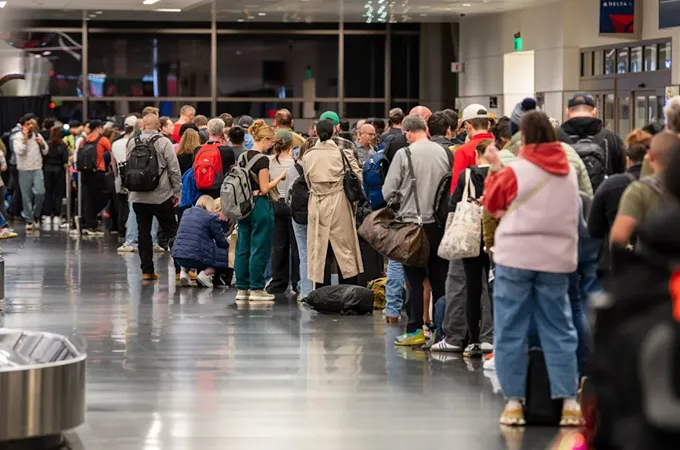
Duffy said tens of thousands of passengers were stranded at airports around the country. Duffy said he and Homeland Security Secretary Markwayne Mullin had met with President Donald Trump in the Oval Office to discuss the outage.
The failure is the latest and most dramatic sign of strain on a US air traffic control system beset by aging technology, equipment and communications problems and a shortage of several thousand controllers, it added.
Duffy said the trouble began at 3:36 p.m., when air traffic control centers experienced instability in radar and communications systems.
"Our switches, our routers actually got overloaded with data and they started to give us inconsistencies in the data from those routers and because of that we shut the system down," Duffy said, adding that at no stage did they completely lose radar or communications and they were able to safely land thousands of planes.
Duffy said the immediate problem had been fixed and that flying was safe, but warned that a broader overhaul of the aging air traffic control system was needed to prevent similar failures.
Authorities swiftly moved to temporarily suspend flights and isolate the source of the malfunction as soon as it was detected. They subsequently managed to restore the systems and resume normal air traffic operations later that same day.
Duffy added that investigations are ongoing to determine whether the malfunction resulted from an error during maintenance work or a failure in the equipment being used. He stressed that the department had ruled out the possibility of a cyberattack or an act of sabotage by a foreign state.
He confirmed that the systems had returned to operation after the affected facility was isolated, emphasizing that passenger safety remains the top priority in all decisions concerning air traffic operations.
Responding to the grounding of US flights, Data Appeal, a major provider of data to the global tourism industry, has confirmed that on Friday, there are scheduled 28,852 flights leaving from US airports representing a total of 3.54 million seats.
Of these, around 90% are domestic seats, said a spokesperson for the company.
“It’s too early to say how many of those 28,852 flights are impacted given this has happened in the mid-afternoon, so many will have already taken place, but we can safely say a good chunk of those,” remarked Carlos Cendra.
“And who knows what the knock-on effect for tomorrow will be, even if air space is opened up quickly tonight, as airlines will have their planes and crews stranded in the wrong places,” he added.