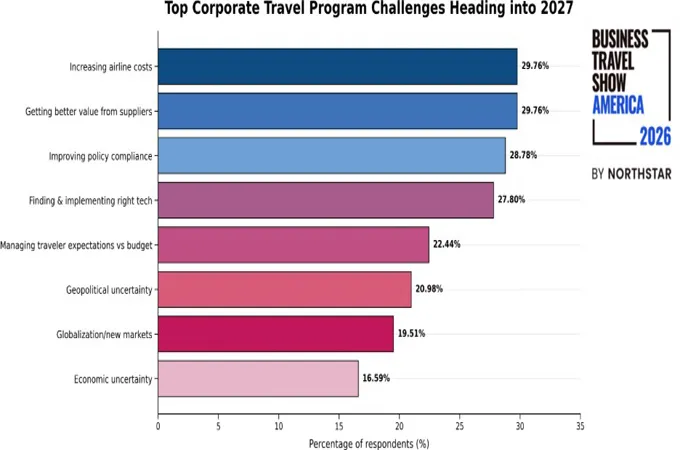
Rising airfares, securing better supplier value and improving travel policy compliance are the leading concerns for corporate travel buyers heading into 2027, according to new research released by Business Travel Show America.
The survey, involving 204 corporate travel buyers, asked
respondents to identify up to three of their biggest expected challenges in
managing corporate travel programmes next year. The findings were released as
the event opened at the Javits Center in New York, running through October 15.
Airline costs have emerged as a growing concern, with the
proportion of buyers identifying them as a major challenge doubling from 15% in
2025 to 30% this year. The increase comes amid volatile energy markets, with
Brent crude oil prices recently exceeding $100 a barrel.
Securing better value from suppliers was also cited by 30%
of respondents, while 29% identified improving policy compliance and reducing
travel spending outside approved arrangements as key priorities.
Louis Magliaro, executive vice president of the BTN Group,
said: “What's striking about these findings is, despite discussion around AI
and emerging technologies, corporate travel buyers are heading into 2027
focused on some familiar challenges: cost, supplier value and compliance.”
He added: “The solutions to these challenges are evolving
rapidly and it’s important for buyers to understand how new technologies,
stronger supplier partnerships and smarter program strategies can help them
deliver more value with the resources available and that’s where Business
Travel Show America steps in. Over the next two days, we're bringing hundreds
of buyers, suppliers and industry experts together to share practical
solutions, discover innovations and gain fresh insights, and help shape stronger
corporate travel programs for the year ahead.”
Technology and traveller experience remain priorities
Technology integration was identified as a major challenge
by 28% of respondents, reflecting pressure on travel managers to adopt
solutions that support increasingly complex programmes. Priorities include
integrating artificial intelligence tools, improving traveller experiences,
strengthening risk management and expanding data analytics capabilities.
Meanwhile, 22% of buyers cited balancing traveller
expectations with budget constraints. Employees increasingly expect
consumer-style booking experiences, greater flexibility and personalised
options, requiring travel managers to reconcile satisfaction with corporate
spending controls.
External uncertainty also continues to influence planning.
Geopolitical uncertainty was identified by 21% of respondents, while 20%
highlighted supporting business growth in new markets and regions. Economic
uncertainty was cited by 17%.
Industry event focuses on practical solutions
Business Travel Show America brings together corporate
travel and procurement professionals with more than 150 suppliers to explore
solutions to these challenges.
The two-day programme includes independent education
sessions organised by the BTN Group, buyer-only networking opportunities and
the Business Travel Innovation Faceoff, where 12 innovators will present
emerging solutions for corporate travel.
Participants can evaluate suppliers, strengthen
partnerships, benchmark travel programmes and explore technologies designed to
improve efficiency, compliance and traveller satisfaction.
The findings indicate that cost management and supplier relationships remain central to corporate travel strategies, even as technology adoption and changing employee expectations reshape the industry. -TradeArabia News Service