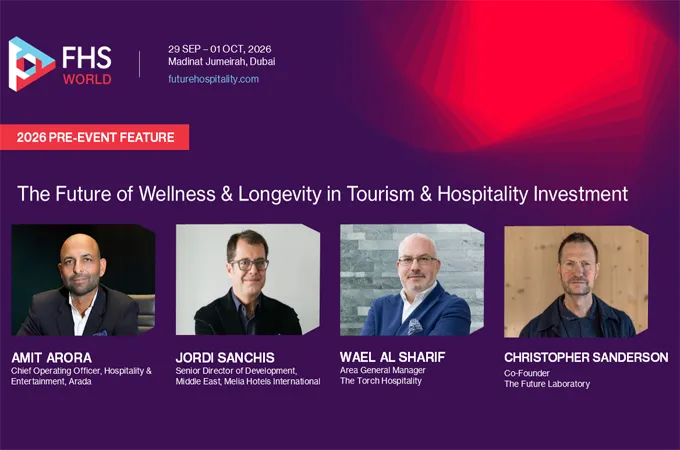
Wellness and longevity are increasingly becoming central to the global travel and hospitality sector, with investors viewing wellbeing as both a revenue opportunity and an emerging real estate asset class. Industry experts speaking ahead of Future Hospitality Summit (FHS) World 2026 said changing traveller expectations, advances in preventative healthcare and growing demand for personalised experiences were reshaping hospitality investment.
The discussion
featured Amit Arora, Chief Operating too, toward an ecosystem where wellbeing
is integrated into sleep hygiene, functional nutrition, and bio-harmonized
programming,” he says. “At Akala Hotel and Residences, Arada capitalises on
this shift by pioneering a mixed-use model that combines ultra-luxury
hospitality with preventative healthcare, Officer, Hospitality and
Entertainment, Arada; Jordi Sanchis, Senior Director of Development – Middle
East, Meliá Hotels International; Christopher Sanderson, Co-Founder, The Future
Laboratory; and Wael Al Sharif, Area General Manager, The Torch Hospitality.
Arora said wellness
had evolved beyond a supplementary hotel amenity into a core component of the
travel experience, with investors increasingly viewing it as a distinct
hospitality and real estate opportunity.
“Guest expectations
have shifted too, toward an ecosystem where wellbeing is integrated into sleep
hygiene, functional nutrition, and bio-harmonized programming,” he says. “At
Akala Hotel and Residences, Arada capitalises on this shift by pioneering a mixed-use
model that combines ultra-luxury hospitality with preventative healthcare,
precision diagnostics, and advanced therapeutics. By treating wellness as an
integrated operational thesis, owners can capture premium ADR and drive
sustained customer lifetime value.”
Sanchis said wellness
was no longer confined to traditional spa and relaxation offerings, but was
increasingly focused on helping guests maintain healthier lifestyles.
“It’s about helping
guests live better, longer and with more balance,” he says. “Longevity science
will increasingly become a credible pillar, particularly in premium and luxury
segments, but it will the financial potential of wellness-oriented hospitality.
“RLA Global and HotStats’ 2025 analysis of more than 12,000 hotels found
properties with major wellness offerings generated more than double the Total
Revenue per Available Room of hotels without such offerings in 2024 enhance
hospitality rather than replace it. From an owner’s perspective, wellness today
is both a revenue enhancer and a long-term value creator, and, in certain
destinations, is already evolving into a standalone asset class, especially
when integrated into mixed-use projects and branded residences.”
Sanderson highlighted
evidence of the financial potential of wellness-oriented hospitality. “RLA
Global and HotStats’ 2025 analysis of more than 12,000 hotels found properties
with major wellness offerings generated more than double the Total Revenue per
Available Room of hotels without such offerings in 2024. UBS separately tips
longevity for above-average equity returns this decade. Traditional luxury
chases occupancy; wellness tends to compound it,” he says.
Al Sharif similarly
described wellness as both a revenue enhancer for existing hotels and an
emerging standalone investment category. “Dedicated modern recreation
facilities command premium pricing, but integrated wellness amenities also
significantly boost the performance and valuation of traditional hotels,"
he says.
Experts said the
strongest value creation increasingly came from integrated wellness ecosystems
rather than standalone spas. Arora said mixed-use developments combining
hospitality, lifestyle programming and medical wellness could generate revenue
across multiple parts of an asset.
“Traditional spas
typically operate on localised treatment margins, whereas a holistic
destination ecosystem drives performance across the entire asset,” he says.
“For a pioneering concept like Akala, value is unlocked by pairing luxury
hospitality with medical wellness infrastructure, creating strong resonance and
multi-season touchpoints with an affluent demographic. Performance evaluation
must look beyond standard metrics like RevPAR towards success through
ecosystem-wide KPIs such as total revenue per available room (TRevPAR),
Wellness Capture Rates, and customer retention/lifetime value (LTV).”
Sanderson said
membership models could also offer significant value, with access to wellness
and longevity services becoming an important revenue stream. “The Surrenne
private members’ club at The Emory in London charges £10,000 a year plus a
£5,000 joining fee for longevity access. Yet 2025’ s RLA Global/HotStats data
show it is lean 'minor wellness' hotels, not sprawling spa-led resorts, posting
the strongest RevPAR growth. Diagnostics, not décor, are critical here. At this
early stage of the longevity curve being able to deliver on a simple longevity
framework is the metric that counts,” he says.
The experts also
discussed whether longevity represented a new stage in wellness or simply a
rebranding of existing concepts. Sanchis described longevity as a natural
evolution, while stressing that hospitality should remain accessible and
human-focused.
Al Sharif said
longevity represented a broader shift toward measurable health outcomes.
“longevity represents genuine evolution, not rebranding – and, in time, will become
mainstream. Traditional wellness offers relaxation and temporary fitness gains;
longevity provides measurable health optimisation through biometric tracking,
personalized nutrition, sleep science, and preventative healthcare. As
populations age and healthcare costs escalate, preventative longevity travel
will achieve mainstream status. It's transitioning from luxury indulgence to
health necessity.”
Traveller expectations
have also changed significantly. Industry specialists said guests increasingly
sought personalised programmes covering physical, mental and nutritional
wellbeing rather than conventional fitness centres and spa menus.
Al Sharif said
travellers now expected results-oriented programmes supported by personal data.
Arora added that affluent guests increasingly sought highly customised
experiences, including sleep optimisation, functional nutrition and recovery
treatments, while retaining the flexibility to enjoy conventional luxury
hospitality.
Despite the growing
role of technology, experts stressed that authenticity and local culture
remained important. Sanderson pointed to hospitality concepts combining
traditional practices with advanced treatments, while Sanchis said technology
should support rather than replace the emotional and cultural dimensions of
wellness.
“Technology supports
diagnostics and personalisation, but the emotional and cultural layer creates
lasting impact. In our spa and wellness approach at Paradisus resorts, for
example, we integrate local traditions, nature and rituals, ensuring that
wellbeing is deeply connected to the destination,” he says.
The sector also faces
misconceptions, including the perception that wellness primarily targets women
or leisure travellers. Al Sharif said data showed 48% male participation, with
business travellers increasingly using wellness facilities for stress
management and performance optimisation.
Arora said the
wellness market extended across the broader luxury travel demographic because
wellbeing was highly individualised. Experiences could range from advanced
longevity programmes to simple environments designed for rest and mental
recovery.
Looking ahead, Arora
said: “The future belongs to an integrated asset model where wellness is no
longer treated as an amenity, but is structurally embedded into wellness real
estate design, operational DNA, and the long-term compounding value of the destination.”
Sanchis emphasised
integrated lifestyle ecosystems combining preventative wellbeing, community,
authenticity and real estate value. Sanderson cited Global Wellness Institute
projections that wellness tourism could grow 9.1% annually through 2029, while
longevity travel could increase from $27 billion in 2024 to $44 billion by
2030.
FHS World 2026, scheduled for September 29 to October 1 at Madinat Jumeirah in Dubai, will feature a dedicated wellness track addressing longevity, health science, hospitality and real estate, healthy communities and leadership in the emerging wellness economy. -TradeArabia News Service