The Middle East’s travel and tourism sector must strengthen aviation infrastructure, improve data sharing and accelerate decision-making to prepare for a rapid post-conflict recovery, ministers and industry leaders said at Arabian Travel Market (ATM) 2026 in Dubai.
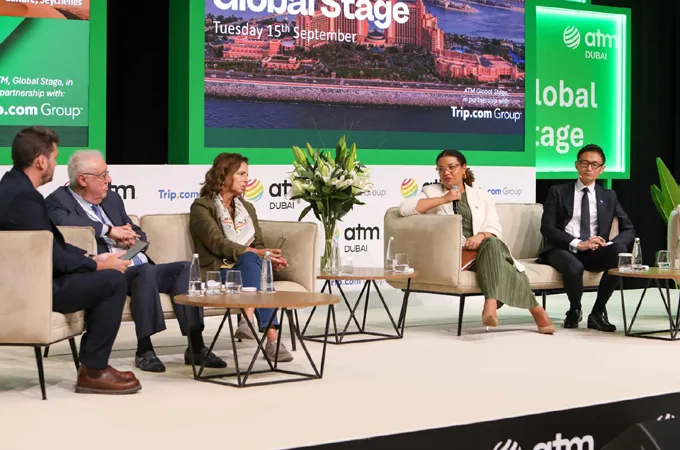
The discussion took place on the ATM Global Stage during the
33rd edition of the event, which is being held at Dubai World Trade Centre
until 17 September. Abdul Wahab Teffaha, Secretary General of the Arab Air
Carriers’ Organization (AACO); Schubert Lou, CEO of Trip.com; H.E. Laura El
Khazen Lahoud, Minister of Tourism of Lebanon; and H.E. Nicola Amanda
Bernstein, Minister for Tourism and Culture of Seychelles, discussed
post-conflict connectivity and ways to strengthen the region’s travel
infrastructure. The session was moderated by Thomas Shambler, Head of Business
at ITP Media Group.
Drawing comparisons with the travel sector’s
faster-than-expected recovery following the pandemic, Teffaha stressed the
importance of aviation connectivity to national infrastructure.
“Aviation is now part of the DNA of the human race. Aviation
connectivity is something that is no longer a luxury, and should not be treated
as a luxury by governments. It should be treated as part of the infrastructure
foundation of any country in the world.”
Bernstein highlighted the impact of regional geopolitical
tensions on Seychelles, noting that the destination relies heavily on Middle
Eastern markets and connections.
“During this period, we found that demand was still strong,
but it became about availability, frequency, connectivity, and of course,
affordability of the different route options available. About 60% of our travel
comes through the Middle East, so we were particularly vulnerable when tensions
arose here. The resilience, for us, is founded both in the strength of our
partnerships – when it comes to how we get back on our feet together – and
diversification.”
For Lebanon, Lahoud identified closer cooperation between
tourism authorities and airlines, alongside greater use of data, as priorities
for rebuilding connectivity.
“We need to have smarter tourism. We need to collaborate
more with the airlines, as we know things they don’t know and they know things
we don’t know. We need to share our data and make sure supply, demand,
efficiency – all this – is synchronised.”
Lou called for the industry to develop a coordinated
framework for responding to future disruptions, with faster decision-making
supported by infrastructure investment.
“I would say we need a playbook, outlining how we as an
industry deal with these situations, and how quickly we can respond – saying
that [when we encounter] A, B, C, we do X, Y, Z. It’s about how we can
accelerate decision-making together. Then, once we have the playbook, it’s
about infrastructure.”
Danielle Curtis, Regional Portfolio Director – UAE, RX
Global, said: “The Middle East’s travel and tourism community has had to
contend with significant challenges over the past six months, and the
resilience and determination demonstrated have been truly impressive. It is
enlightening to hear ministers and industry experts reflect on lessons learnt,
and discuss how the region can further strengthen and future-proof both its
physical and digital connectivity over the longer term.”
ATM 2026 is being held under the theme Travel 2040: Driving
New Frontiers Through Innovation and Technology, examining the role of
artificial intelligence, digital transformation, smart mobility and changing
traveller expectations in shaping tourism.
The event also introduced a refreshed brand identity,
reflecting its expansion beyond the traditional exhibition floor into a
year-round platform connecting travel and tourism communities.
On its third day, the Global Stage hosted 10 sessions
covering topics including public-private partnerships in destination
development and the impact of premiumisation on tourism.
Now in its 33rd edition, ATM continues to bring together international travel and tourism stakeholders to develop partnerships, exchange expertise and explore commercial opportunities across the sector. -TradeArabia News Service