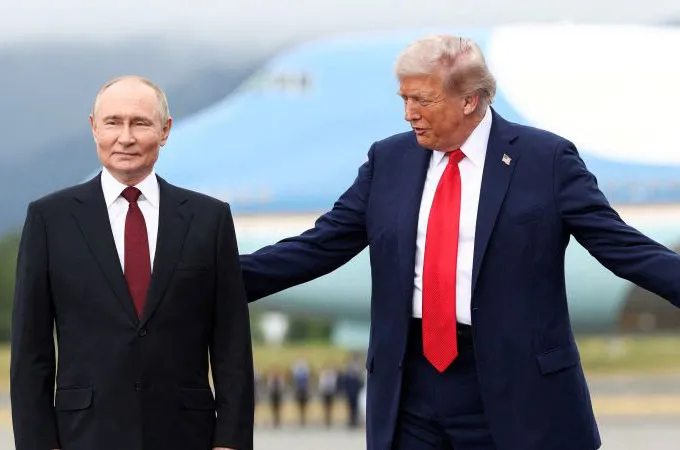
President Donald Trump has threatened military action against Oman if the US ally obstructs Washington’s efforts to negotiate with Iran over the reopening of the Strait of Hormuz, adding a new and potentially destabilising dimension to efforts to restore shipping through the strategic waterway.
Trump was quoted by Fox News reporter Trey Yingst as saying: “If Oman gets in the way, we'll bomb the s**t out of them.” The reported threat comes as Oman pursues its own negotiations with Tehran aimed at reopening the Strait, while a separate 60-day understanding between the United States and Iran has expired without a broader agreement to end the conflict.
Oman, which borders the southern side of the Strait, has maintained that it is neutral in the US-Iran war and has played a key mediating role between Washington and Tehran. The country has nevertheless come under attack during the conflict.
Trump, speaking to reporters in the Oval Office on Monday, also indicated that he was in no rush to extend the US-Iran understanding. He claimed that his administration had established a direct backchannel with Iran’s Islamic Revolutionary Guard Corps (IRGC), an assertion Tehran quickly rejected.
“There are no talks taking place between IRGC officials and the Americans,” an IRGC spokesman told the semi-official Tasnim news agency, dismissing Trump’s claim as false.
The expiry of the 60-day deadline adds further uncertainty to efforts to end the conflict, while the Strait of Hormuz remains only partially open to commercial shipping.
Iran has largely restricted traffic through the waterway since the US and Israel launched attacks on the country in February. The Strait normally carries around one-fifth of global oil and liquefied natural gas supplies, making the disruption a major concern for energy markets and international trade.
Omani and Iranian officials said earlier on Monday that they were close to finalising an arrangement to reopen the waterway. Tehran has previously linked a full reopening to compensation from Washington for what it describes as US violations of the two sides’ understanding.
Shipping traffic remains dramatically below normal levels. MarineTraffic data showed at least three commercial vessels passing through the Strait during the latest 24-hour period — two tankers entering the Persian Gulf and one vessel sailing out towards the Gulf of Oman. Before the war, around 110 ships a day typically transited the waterway.
Traffic is also depressed through the Bab al-Mandeb Strait farther west, another key maritime gateway linking the Red Sea with the Gulf of Aden. At least 37 commercial vessels crossed the strait during the same period, including 13 cargo ships and six tankers entering the Red Sea and 13 cargo ships and five tankers leaving for the Gulf of Aden.
The United States said its forces were continuing to intervene in commercial shipping movements. In a statement issued by the Department of Defense, Washington said that as of August 17, US Central Command forces had “redirected 64 commercial vessels, disabled 3, and boarded 2 to ensure compliance.”
Trump has also insisted that preventing Iran from acquiring a nuclear weapon remains the central objective of the US military campaign, pushing back against suggestions that keeping oil prices and energy supplies stable has become an equally important consideration.
The latest developments come as the military and diplomatic costs of the conflict continue to mount. Trump on Monday also rejected reports of declining supplies and low morale aboard the USS Abraham Lincoln, calling CNN reporting about shortages aboard the aircraft carrier “fake news.”
The worsening uncertainty around the Strait of Hormuz is likely to keep pressure on global shipping and energy markets, while Trump’s threat against Oman raises questions over the future of the mediation efforts that have so far provided one of the few channels for negotiations between Iran and the United States.