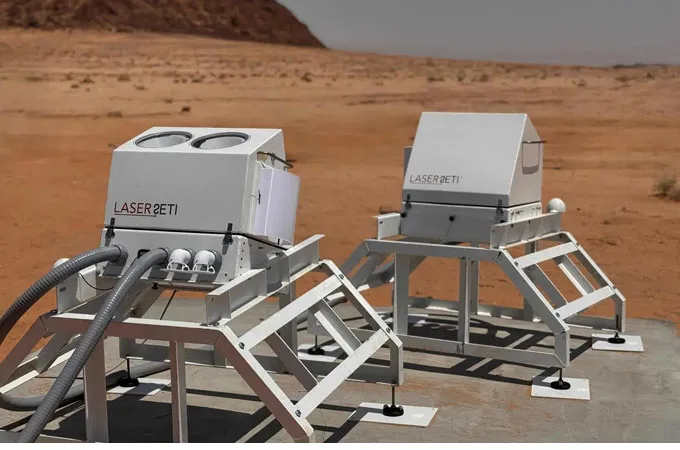
The Royal Commission for AlUla (RCU) has announced the successful installation and commissioning of two stations belonging to the global LaserSETI project at AlUla Manara.
The milestone strengthens Saudi Arabia’s presence within international scientific observation networks by leveraging AlUla’s natural assets and expanding research partnerships, in line with AlUla’s vision and the objectives of Saudi Vision 2030, a Saudi Press Agency (SPA) report said.
LaserSETI is an international astronomical observation network that uses specialised stations to continuously monitor the night sky for transient optical phenomena.
These are distinctive, rare flashes or changes in light that may be associated with cosmic events or unusual astronomical objects, as well as potential laser signals that require further scientific investigation and analysis.
Observational data
The technology generates observational data that can be compared across multiple locations, enabling researchers to study phenomena that may be difficult to observe from a single site.
The deployment of this technology at AlUla Manara draws on the quality of AlUla’s dark skies and its geographical location, adding a new observation area to the global LaserSETI network.
With the two stations operational, AlUla has become the project's first and only site in Asia and its fifth operational observatory worldwide, joining existing sites in California, Hawaii, Arizona and Puerto Rico. AlUla’s participation extends the network’s geographical coverage into a previously unrepresented region, creating further opportunities to collect and compare observation data across different sites.
Initial commissioning phase
Both stations are now fully operational, having successfully completed their initial commissioning phase on August 19, 2026. They continuously collect astronomical observation data, which is contributed to the global LaserSETI network for analysis and comparison with observations from other sites.
AlUla Manara is also working with the project team to customise data outputs and extract relevant observations to support scientific studies and future research into transient optical phenomena.
The milestone builds on the cooperation agreement announced by RCU and the SETI Institute on August 8, 2024, which included support for the development of AlUla Manara Observatory and the installation of LaserSETI observation equipment. The commissioning of the two stations demonstrates the partnership’s progression from agreement and planning to operational delivery, and highlights the contribution of international scientific partnerships to developing astronomical research and observation capabilities in AlUla.
The next phase will focus on analysing the data collected by the system and developing further opportunities for scientific research and international partnerships. These efforts will also help demonstrate the suitability of AlUla’s dark skies for astronomical observation and strengthen AlUla Manara’s wider astronomy programme.—TradeArabia News Service