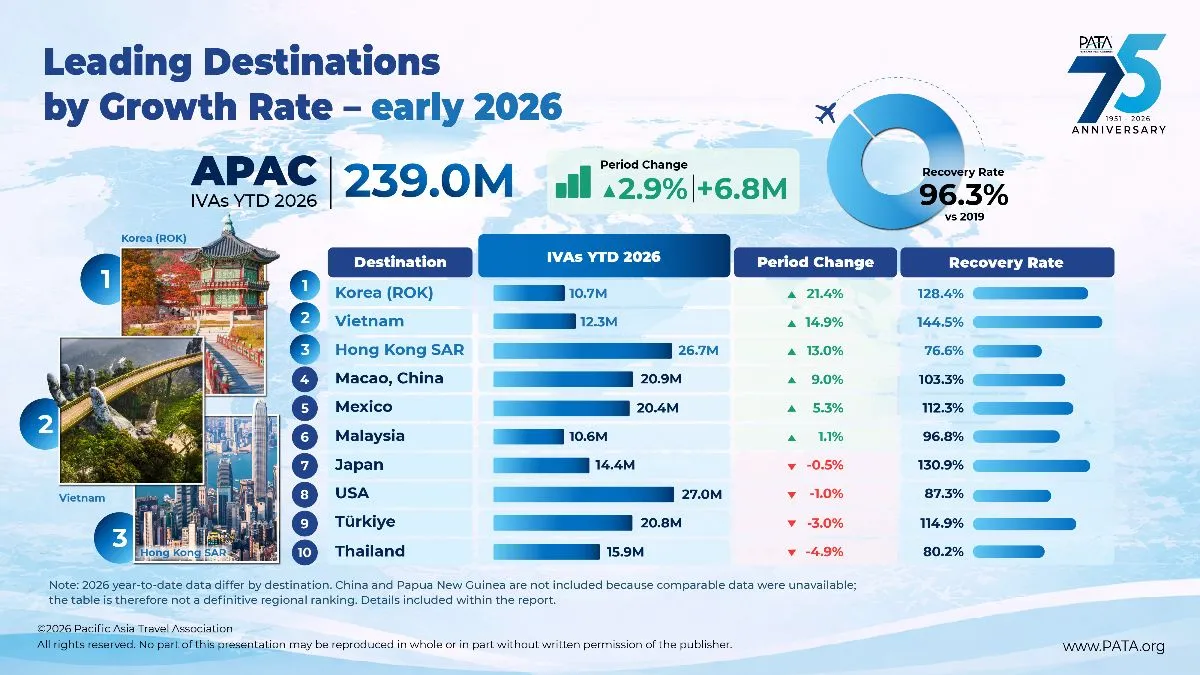
The Pacific Asia Travel Association (PATA) has released its Annual Tourism Monitor 2026, reporting that international visitor arrivals across Asia Pacific are approaching full recovery, although growth is moderating and performance varies across destinations.
International visitor arrivals (IVAs) across 44 destinations
reached 239.0 million in the early months of 2026, up 2.9% from the same
reporting periods in 2025 and equivalent to 96.3% of the corresponding 2019
level.
In 2025, the region recorded 700.2 million arrivals across
46 destinations, recovering to 99.3% of its 2019 total.
Asia accounted for 523.1 million visitors, representing
74.7% of arrivals, while the Pacific reached 89.4% of its 2019 level and the
Americas recovered to 94.2%.
The report highlights contrasting destination performances.
The US recorded the highest arrival volume among the
destinations covered, followed by Hong Kong SAR, Macao, China, Türkiye and
Mexico.
Thailand and Japan also remained major destinations, while
Vietnam and Korea (ROK) posted strong growth.
Korea (ROK) welcomed 10.7 million international visitors, an
increase of 21.4% year-on-year and 128.4% of its 2019 level. Vietnam recorded
12.3 million arrivals, up 14.9% year-on-year and reaching 144.5% of its
pre-pandemic volume.
By contrast, the US recorded 27.0 million arrivals, down
1.0% year-on-year, while Thailand received 15.9 million, a decline of 4.9%.
In 2025, arrivals also weakened in several major markets,
including the USA, Thailand, India and Cambodia.
“The recovery of tourism across Asia Pacific is an important
achievement for our industry, but recovery does not mean that the environment
has become predictable,” said PATA CEO Noor Ahmad Hamid. “We are operating in a
world where disruption has become a constant - from geopolitical conflicts and
natural disasters to economic pressures and changes in travel policies. Our
ability to adapt, work together, and respond to changing traveller needs will
be increasingly important.”
As the region moves beyond the post-pandemic rebound, the
focus is shifting towards sustainable and resilient growth. Visa policies, air
connectivity and transport links remain critical to destination
competitiveness, while rising travel costs and complex travel procedures could
influence demand.
PATA also emphasised diversification, noting that
destinations attracting visitors from a broader range of source markets and
encouraging longer stays may be better equipped to manage fluctuations.
Managing visitor flows and promoting travel beyond peak
periods and major gateways will also become increasingly important for
destinations exceeding pre-pandemic arrival levels.
“Tourism has shown remarkable resilience over the past
several years,” added Mr. Hamid. “The next phase will require us to think
differently about growth. Success will not simply be measured by how many
visitors we receive, but also by the value tourism creates for destinations,
businesses, communities, and travellers.”
The PATA Annual Tourism Monitor 2026 examines international arrival trends and the challenges shaping the region’s transition from pandemic recovery to its next phase of tourism growth. -TradeArabia News Service