Resilience begins with how policies are designed, how infrastructure is built and how partnerships are forged whilst ensuring that food, water, and energy systems can adapt to change and sustain communities.
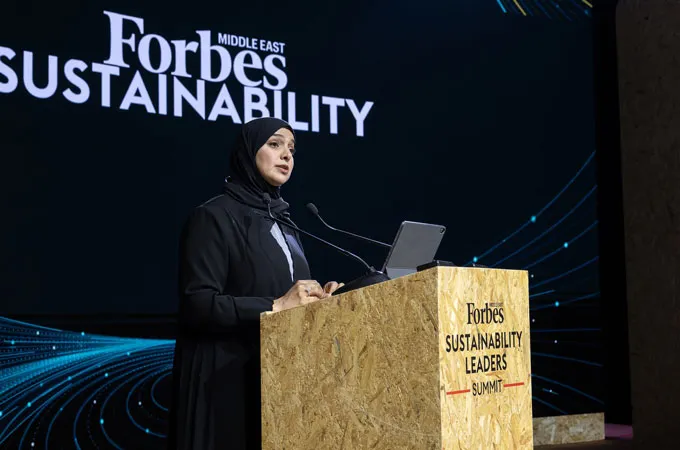
This is according to Dr Amna bint Abdullah Al Dahak, UAE Minister of Climate Change and Environment, who opened the fourth edition of the Forbes Middle East Sustainability Leaders Summit, which kicked off at Adnec Centre Abu Dhabi under the theme “Resilience for a Sustainable Future”.
Dr Al Dahak said: “In the UAE, this vision is anchored in the enduring legacy of our Founding Father, the late Sheikh Zayed bin Sultan Al Nahyan, who championed resource conservation. We are carrying forward his legacy through science, innovation, and strategic investment to strengthen food security, secure water resilience, accelerate the clean energy transition, and drive towards Net Zero by 2050. We firmly believe that economic diversification and emissions reduction reinforce one another, laying the foundation for lasting prosperity for generations to come.”
Practical partnerships
She added: “This summit provides an opportunity to turn shared priorities into practical partnerships among governments, businesses, investors and academic institutions, and to make resource conservation and resilience central to investment decisions and growth plans. Our conversation with students today reflects the importance of engaging young people in shaping their future and equipping them with the knowledge, skills and opportunities to deliver sustainable solutions. It is our responsibility to build systems that endure and prepare future generations to improve them. Our impact will be measured by what we protect today, and by what we empower our children to protect and build upon tomorrow.”
The summit brings together more than 3,000 participants, including leaders from government, business, investment and academia, as well as experts from the region and around the world, an Emirates News Agency (WAM) report said.
Over two days, the summit is examining the key challenges and opportunities linked to strengthening economic and institutional resilience, energy security, sustainable investment and infrastructure development, as well as the role of innovation and future leaders in building economies and societies that are better able to adapt to global change.
Leadership conversation
The Minister opened the summit with a leadership conversation featuring a group of students from UAE schools, addressing the key issues and challenges facing younger generations and the role of youth in shaping the future.
During the conversation, the students raised questions on climate change, food and water security, artificial intelligence, technological transformation and the responsibilities of leadership, as well as how decisions made today can build a more resilient and sustainable future for generations to come.
Khuloud Al Omian, CEO and Editor-in-Chief of Forbes Middle East, said: “Resilience has become a cornerstone of sustainable growth and prosperity amid the rapid transformations taking place around the world. From Abu Dhabi, the summit provides a platform for dialogue and knowledge exchange among leaders from government, business, investment and academia, strengthening collaboration, building capabilities and developing practical solutions that enhance the readiness of economies and institutions for the future while creating sustainable value for generations to come.”
The summit brings together leading policymakers, business leaders, investors, academics and experts from the region and around the world to discuss ways to strengthen resilience, develop practical solutions that support sustainable growth, and explore cross-sector collaboration to address economic, environmental and technological challenges.—TradeArabia News Service