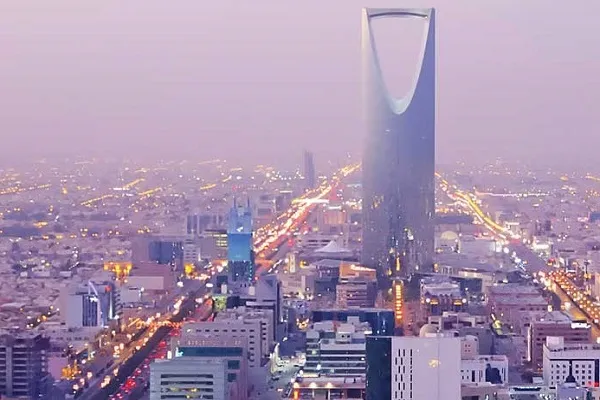
Saudi Arabia’s structural shift toward non-oil revenue is strengthening the kingdom’s long-term economic resilience, while rapid growth in its digital economy is supporting efforts to diversify beyond hydrocarbons, according to top ratings agency S&P Global Ratings.
The transformation, however, will require substantial financing that the banking sector alone may not be able to provide, S&P said. Saudi banks will need to expand their use of structured finance and attract more domestic and international capital to help fund the kingdom’s economic expansion.
“Disciplined capital allocation and new financing channels will determine the pace and sustainability” of the transformation, the ratings agency said.
Saudi Arabia recorded a fiscal deficit of 160 billion riyals ($42.7 billion) in the first half of 2026, up 71% from 93 billion riyals a year earlier, largely due to higher capital expenditure.
S&P expects the kingdom’s fiscal deficit to reach 5.8% of gross domestic product this year, matching the 2025 level, before narrowing to an average of 3.4% of GDP between 2027 and 2029.
The agency said disruptions related to the war in the Middle East were likely to persist to varying degrees through 2027, with regional oil exports remaining below pre-war levels.
Saudi authorities are also recalibrating the pace of projects under the Vision 2030 reform programme, a move S&P said should help contain the fiscal deficit and the accumulation of government debt through 2029.
A further escalation of the conflict that pushed government debt accumulation significantly above S&P’s projections could put downward pressure on Saudi Arabia’s credit rating, it said.
The kingdom nevertheless retains a strong external position, supported by a large asset base, including holdings of the Public Investment Fund and foreign exchange reserves.
Foreign exchange reserves stood at $494 billion, equivalent to 48.7% of GDP, at the end of June 2026, up from about $437 billion, or 45.6% of GDP, at the end of 2024, S&P said.
Digital economy
S&P said the expansion of the digital economy was becoming a key pillar of Saudi Arabia’s diversification strategy, supported by the kingdom’s location between Asia, Africa and Europe and its growing terrestrial and subsea communications infrastructure.
Saudi Arabia is seeking to establish itself as a regional data hub, with fibre routes and subsea cables connecting the kingdom to major markets.
The 1,100-km Vision Cable, for example, connects Jeddah, Yanbu, Duba and Haql. But the concentration of cable routes along the Red Sea and Arabian Gulf leaves the kingdom exposed to outages, making network diversification and resilience increasingly important, S&P said.
Demand for local data-centre infrastructure is being driven by data residency requirements, government digitisation, corporate adoption of cloud computing and incentives for local and international operators to invest in Saudi Arabia.
Data from 451 Research, part of S&P Global, showed that operational IT capacity in the kingdom stood at about 222 megawatts in the first quarter of 2025. The research firm forecasts annual growth of about 29% between 2024 and 2030, although the pace will depend on how many announced projects are ultimately completed.
The expansion of cloud computing and artificial intelligence will require significant investment in servers, power infrastructure, cooling systems and network capacity.
Consultancy Alvarez & Marsal estimates that Saudi Arabia could reach 1 gigawatt of active data-centre capacity by 2030 under its base-case scenario, requiring $7 billion-$9 billion in project capital and $3.5 billion-$7 billion in debt.
Under a more aggressive scenario, capacity could reach 2.5-3 gigawatts by 2030, requiring $28 billion-$42 billion in capital, including $14 billion-$32 billion in debt, Alvarez & Marsal estimates.
S&P said this scenario could include HUMAIN’s 1.9-gigawatt target if roughly half of Saudi Arabia’s announced project pipeline is delivered.
Banks seek new funding channels
Saudi banks are increasingly looking beyond traditional deposits to finance loan growth.
Government and related-entity deposits accounted for 33% of total system deposits in June 2026, compared with about 20% at the end of 2018. Even so, S&P said public-sector inflows were insufficient to support expanding loan portfolios.
The banking sector’s loan-to-deposit ratio reached 104% at the end of June, and S&P expects banks to increase their reliance on external funding.
Saudi banks continue to issue senior unsecured bonds, subordinated debt and Additional Tier 1 instruments, while also exploring structured finance and other funding tools.
Saudi Arabia’s growing use of international capital markets reflects the development of its financing system over the past decade. S&P estimates that the government raised a cumulative $148 billion through international sovereign issuance between 2017 and 2025, while Saudi companies raised $83.2 billion through international markets.
Private credit is another potential source of funding. Although it currently accounts for a relatively small share of total financing, S&P expects its role to increase as investors seek opportunities in the expanding market.