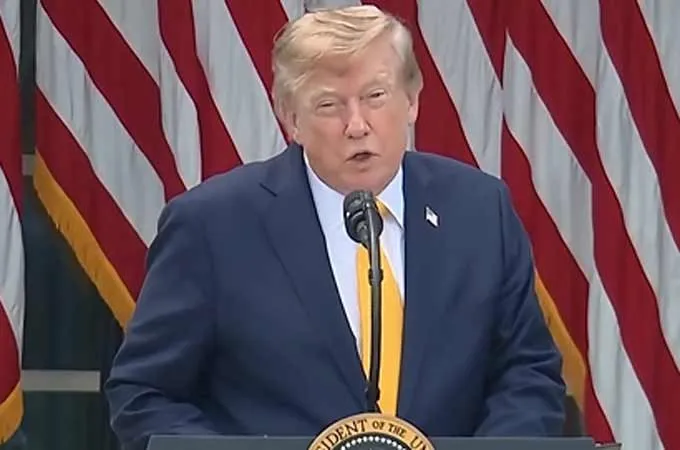
US President Donald Trump has formally submitted a proposed civil nuclear cooperation agreement with Saudi Arabia to Congress, setting in motion a 90-day review period for a pact that would give US companies a major role in developing the kingdom’s nuclear power programme.
The agreement, signed in July by US Energy Secretary Chris Wright and Saudi Energy Minister Prince Abdulaziz bin Salman, provides the legal framework for decades of US-Saudi nuclear cooperation and could open the door to contracts worth tens of billions of dollars for American companies.
But the agreement is politically sensitive on both sides. Trump has said the pact will not move forward unless Saudi Arabia joins the US-brokered Abraham Accords and normalises relations with Israel, while questions remain over the extent to which the agreement would allow the kingdom to develop domestic uranium-enrichment capabilities.
The Trump administration's submission to Congress begins the statutory review required under Section 123 of the US Atomic Energy Act. Congress has 90 days of continuous session to review the agreement. If lawmakers do not block it during that period, the agreement can enter into force.
The administration has described the pact, formally known as a Section 123 agreement, as a major expansion of peaceful nuclear cooperation that will benefit US industry while helping Saudi Arabia meet its growing energy needs.
A major US nuclear opportunity
The agreement would allow US companies to supply civilian nuclear technology and equipment for Saudi Arabia’s planned nuclear programme, including the potential construction of advanced AP1000 reactors developed by Westinghouse.
The reactors could form the centrepiece of a multibillion-dollar Saudi nuclear power programme, creating a potentially significant market for US reactor technology, engineering, construction and nuclear services.
For Riyadh, nuclear power is part of its broader effort to diversify its energy mix and reduce the amount of crude oil and natural gas consumed domestically for electricity generation, allowing more hydrocarbons to be directed toward exports and higher-value uses.
Saudi Arabia has been pursuing nuclear power for years as part of its Vision 2030 economic diversification strategy. The kingdom has also sought to develop a domestic nuclear fuel cycle, including the ability to use its own uranium resources.
The US Energy Department said the agreement, together with a bilateral safeguards agreement, establishes the foundation for a “decades-long, multi-billion-dollar partnership.”