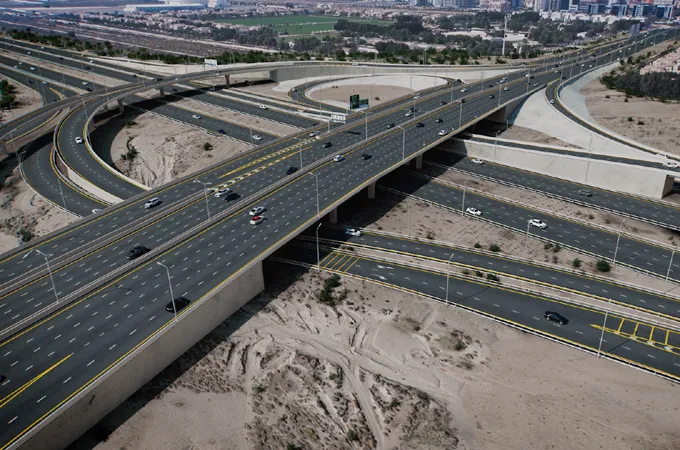
Dubai’s Roads and Transport Authority (RTA) has completed all bridge works under Al Qudra Road Key Intersections Development Project, opening three bridges and two loop ramps spanning 2,660m at the intersection of Al Qudra Road and Sheikh Zayed bin Hamdan Al Nahyan Street.
Al Qudra Road extends from its intersection with Sheikh Mohammed bin Zayed Road, through Sheikh Zayed bin Hamdan Al Nahyan Street, to Emirates Road.
The newly opened bridges and ramps enables free-flowing traffic without disruption in all directions, saving seven minutes of the time previously spent waiting.
They also increase the intersection’s capacity by 150%, from 7,800 to 19,400 vehicles per hour, improving traffic flow along one of Dubai’s key road corridors.
The opening marks the completion of all bridge works under Al Qudra Road Development Project, which includes enhancing several key intersections and constructing bridges stretching 4,750m, in addition to improving and expanding 11.6km of Al Qudra Road.
The improvements help increase the road’s capacity by 33%, from 12,000 to 16,000 vehicles per hour in both directions, and reduce journey time by 70%, from 10 minutes to three. They further ease travel for the more than 400,000 residents and visitors in the areas served by the project.
Completed newly bridges
The completed works at the intersection of Al Qudra Road and Sheikh Zayed bin Hamdan Al Nahyan Street comprise three bridges and two loop ramps.
*The first bridge, 750-m-long with two lanes, serves traffic from Al Qudra Road to Sheikh Zayed bin Hamdan Al Nahyan Street towards Jebel Ali.
*The second, 900m long with two lanes, serves traffic from Al Qudra Road to Sheikh Zayed bin Hamdan Al Nahyan Street towards the city centre and Dubai International Airport.
*The third bridge, 500-m-long with a single lane, serves traffic from the surrounding residential areas towards Al Qudra City.
According to RTA, the works also include two loop ramps, each with two lanes.
*The first, 230-m-long, serves traffic from Sheikh Zayed bin Hamdan Al Nahyan Street to Al Qudra Road towards Al Qudra City.
*The second, 280-m-long, serves traffic from Sheikh Zayed bin Hamdan Al Nahyan Street to Al Qudra Road towards Umm Suqeim.
In addition, three kilometres of service roads have been built on both sides of Sheikh Zayed bin Hamdan Al Nahyan Street to strengthen connectivity with surrounding development projects.
The new bridges and ramps follow the opening of the two main bridges at the same intersection, 1,400 metres long with eight lanes in both directions, which helped improve traffic flow along Al Qudra Road.
Integrated plan to develop major road corridors
Mattar Al Tayer, Director General, Chairman of the Board of Executive Directors, Roads and Transport Authority, affirmed that the completion of all works under the Al Qudra Road Key Intersections Development Project represents a distinctive addition to Dubai’s road network.
The achievement also reflects RTA’s commitment to translating the wise leadership’s directives into action by continuing to develop integrated, sustainable infrastructure that keeps pace with rapid urban and population growth and enhances the efficiency of the mobility system and quality of life.
The project forms part of RTA’s integrated plan to develop Dubai’s key road corridors, improve their efficiency and capacity, and strengthen connectivity between residential and development areas and centres of economic activity.
He stressed that the project’s completion contributes to tangible improvement in traffic flow along Al Qudra Road through integrated traffic solutions that shorten journey times, enhance road safety and facilitate access to the areas served by the project.
Supporting Urban Development
Al Tayer said: “Road network development projects are of strategic importance in supporting Dubai’s urban and economic growth by providing advanced infrastructure capable of accommodating future expansion and enhancing the attractiveness of residential, development and investment areas.”
He explained that Al Qudra Road Development Project serves key areas with more than 400,000 residents and visitors, helps strengthen connectivity between Sheikh Mohammed bin Zayed Road, Sheikh Zayed bin Hamdan Al Nahyan Street and Emirates Road, and facilitates access to several residential communities and major development projects.
He affirmed that RTA continues to deliver road development projects in line with a proactive vision that takes account of future growth requirements and aligns with the objectives of the Dubai 2040 Urban Master Plan, reinforcing Dubai’s competitiveness and global standing and providing a safe, seamless and sustainable mobility system that supports the emirate’s comprehensive development.