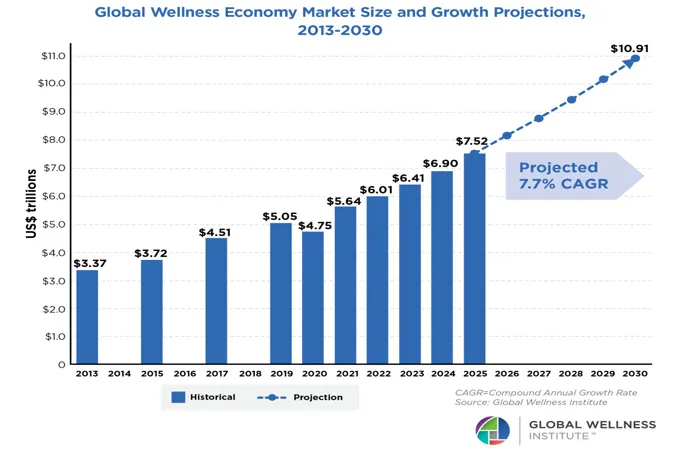
The global wellness economy grew by 8.9% between 2024 and 2025, reaching a record $7.5 trillion, as demand for wellness-related products, services and experiences accelerated across markets, according to the Global Wellness Institute’s (GWI) Global Wellness Economy Monitor 2026.
The latest report
projects the market will reach $8.2 trillion by the end of 2026 and approach
$11 trillion by 2030, with an annual growth rate of 7.7% over the forecast
period. This expansion is expected to outpace global GDP growth by
approximately 50%.
Worldwide spending on
wellness is now 2.2 times higher than in 2013, when GWI first began measuring
the sector. The wellness economy also accounts for an increasing share of
global economic activity, rising from 4.3% of global GDP in 2013 to 6.36% in
2025. Its contribution is forecast to reach 7.21% by 2030.
The report highlights
wellness real estate and mental wellness as the fastest-growing sectors since
2019, reflecting increasing demand for healthier living environments,
preventive health solutions and services addressing stress, sleep and mental
health.
Wellness real estate
has expanded to 3.5 times its 2019 size, making it the fifth-largest wellness
market, up from seventh place three years ago. It recorded year-on-year growth
of 23.2% between 2024 and 2025, the strongest performance among all wellness
sectors.
Mental wellness has
nearly doubled in size since 2019, with annual growth of approximately 12%. Its
strongest-performing subsectors include cannabis, which expanded by 23%
annually, meditation and mindfulness at 14%, and sleep at 13%.
Looking ahead,
wellness real estate is expected to remain the fastest-growing sector through
2030, with projected annual growth of 15.3%. It is forecast to become the
world's second-largest wellness market, behind personal care and beauty, more
than doubling in size from current levels.
Mental wellness is
projected to grow by 12.6% annually through 2030, making it the
second-fastest-growing sector.
“While it may seem
like we’ve reached ‘peak wellness,’ the reality is that the wellness economy
will continue to explode over the next five years, because this growth is not
simply a consumer trend,” said Katherine Johnston, GWI senior research fellow.
“Powerful structural forces across every region of the world will accelerate
demand in the coming years: rapidly aging populations, over-burdened healthcare
systems and rising rates of chronic disease, stress and mental health
challenges. These pressures make prevention, healthspan and healthy living
environments more critical than ever.”
Regional markets
and tourism recovery
All regional wellness
markets recorded substantial growth compared with 2019, with Europe, the Middle
East and North Africa (MENA), and Asia reporting the strongest year-on-year
gains.
Europe led regional
growth at 12.3% between 2024 and 2025, followed by MENA at 11.3% and Asia at
9.7%.
Despite this
expansion, per capita wellness spending remains uneven. North America leads at
$6,419, followed by Europe at $2,149. Spending stands at $635 in Latin America
and the Caribbean, $527 in Asia-Pacific and $440 in MENA.
Tourism-related
wellness sectors are also experiencing a strong recovery following the
pandemic. Spas recorded 12.8% growth between 2024 and 2025, wellness tourism
expanded by 11.4%, and thermal and mineral springs grew by 10.4%.
All global regions
achieved record wellness tourism revenues and trip volumes in 2025. While the
US accounts for 36% of worldwide wellness tourism expenditure, MENA recorded
the strongest regional growth at 21.5%, followed by Sub-Saharan Africa at 18.1%
and Asia at 15.6%.
The recovery is
expected to continue through 2030, with annual growth forecast at 8% for spas,
7.1% for wellness tourism and 9.8% for thermal and mineral springs. The latter
is benefiting from growing interest in social bathing and the development of
new destinations.
Other sectors and
emerging opportunities
Four wellness markets
are classified as mature and steady-growth sectors: personal care and beauty;
physical activity; healthy eating, nutrition and weight loss; and traditional
and complementary medicine. Each recorded annual growth of approximately 5% between
2019 and 2025.
Traditional and
complementary medicine is nevertheless expected to accelerate, with projected
annual growth of 9.1% through 2030, supported by increasing interest in
Ayurveda, traditional Chinese medicine, herbal remedies and longevity-related
treatments.
Personalised medicine
is another significant growth area. The subsector, valued at $364 billion,
expanded by 7.7% over the past year and is forecast to grow by 9.3% annually as
demand increases for preventive diagnostics, longevity programmes and healthspan
solutions.
GWI also highlighted
mindful movement as the fastest-growing segment within physical activity. Now
valued at $56 billion, the subsector has benefited from rising interest in
Pilates and other movement-based wellness activities.
Workplace wellness was
the only stagnant sector, recording annual growth of just 1.3%. GWI attributes
this performance partly to changing employer approaches to employee wellbeing,
with businesses increasingly adopting broader strategies beyond conventional
workplace wellness programmes. The expansion of remote and gig work has also
left more employees without access to such benefits.
Seven sectors
forecast to exceed $1 trillion
The report identifies
a significant expansion in the number of trillion-dollar wellness markets by
2030. While three sectors currently exceed the $1 trillion threshold, seven are
expected to reach that level within the next four years.
These include personal
care and beauty, wellness real estate, physical activity, healthy eating,
nutrition and weight loss, wellness tourism, public health, prevention and
personalised medicine, and traditional and complementary medicine.
The findings are
presented in GWI’s 160-page Global Wellness Economy Monitor 2026, which
provides updated market valuations, historical growth trends, regional
comparisons and forecasts across all 11 wellness sectors.
The report points to an increasingly important role for wellness in the global economy, with ageing populations, healthcare pressures and rising demand for preventive health and longevity solutions expected to support continued expansion through the end of the decade. -TradeArabia News Service