Travel technology start-ups must demonstrate clear differentiation, solve specific customer problems and prepare for lengthy enterprise sales cycles as artificial intelligence reshapes the industry, according to speakers at the Travel Tech Association’s second annual Start-Up Summit.
Held on October 14 in Arlington, Virginia, the
event brought together founders, investors and industry executives from
companies including Amazon, Hilton, Skift, Serko and Oppenheimer & Co.
Discussions focused on emerging opportunities in AI, enterprise partnerships,
investment trends and the future of travel technology.
Eight start-ups pitched their businesses to a
panel of six judges. CleverFi, which enables travellers to connect to Wi-Fi
automatically and securely by extending their home networks to accommodation
and other destinations, won both the judges’ and audience votes, receiving
$10,000.
AI makes differentiation more important
During the opening panel, moderated by Li
Reilly, fractional general counsel to Travel Tech, investors and industry
executives discussed the challenges facing start-ups in an increasingly
competitive AI market.
Gilad Berenstein, founder of Brook Bay Capital,
said access to similar AI tools was making it harder for companies to establish
lasting competitive advantages. He noted that many start-up pitches were
becoming difficult to distinguish from one another.
Berenstein also urged travel businesses to
optimise their online content for AI assistants, explaining that incomplete
descriptions could prevent products from appearing in AI-generated
recommendations. Hotels offering adjoining rooms or family suites, for example,
risk missing potential bookings if these features are not clearly described
online.
Leslie Adler, vice president of business
development and innovation at Hilton, advised founders to communicate their
value propositions clearly and tailor solutions to individual customers’ needs.
Johnny Thorsen, vice president of strategic
business development at Serko, recommended identifying one to three unique
selling points that customers could not easily replicate or source elsewhere.
He also stressed the importance of demonstrating a product’s value during a
single meeting.
Thorsen highlighted opportunities arising from
changes in travel distribution, noting that airlines that have spent 13 years
adopting the New Distribution Capability (NDC) standard are reassessing their
strategies as AI agents and the Model Context Protocol (MCP) reshape travel
sales.
He said suppliers were willing to invest in
these technologies but often lacked the in-house expertise needed to implement
them, creating opportunities for start-ups. Speakers also identified potential
for smaller and mid-sized acquisitions as established travel companies seek to
acquire AI capabilities rather than develop them internally.
Enterprise partnerships require patience
In a fireside discussion, Hillary Dallas, head
of global travel and events at Amazon, spoke with Steve Reynolds, CEO of
CorpTravelTech, about securing enterprise customers and converting pilot
projects into long-term partnerships.
Dallas said Amazon evaluates technology based
on its ability to improve the traveller experience, reduce costs or mitigate
risks.
She cited Amazon’s partnership with travel
booking platform Spotnana, which began with an initial meeting in December
2021. Security and legal reviews took approximately 12 months, before the
platform launched across 45 countries in February 2026. Amazon has since
achieved 97% online booking adoption.
Reynolds noted that lengthy procurement and
contracting processes can create significant financial pressure for start-ups
that cannot sustain operations for a year without revenue.
Dallas said concerns that large companies would
simply copy start-up innovations were often overstated, as internal engineering
resources require advance planning and budgeting.
She predicted AI agents would increasingly
handle routine tasks, including travel policy queries, allowing human agents to
focus on complex itinerary changes and crisis support. She also anticipated
personalised AI travel assistants, adaptive travel policies and closer
integration between business and leisure travel profiles.
Agentic AI and trust to shape the industry's
future
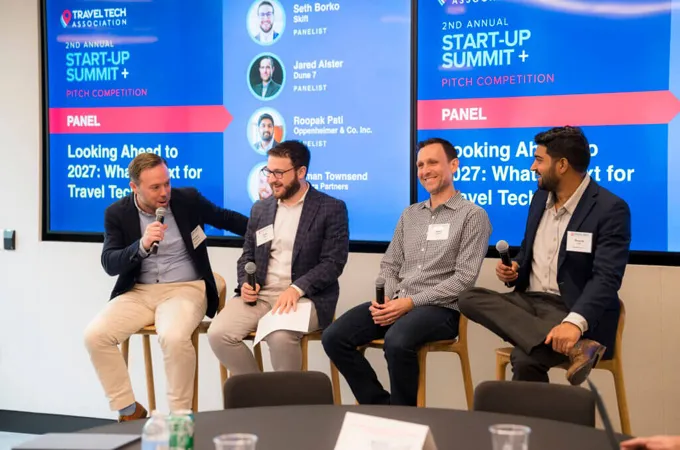
A closing panel examining trends for 2027
featured Jared Alster, chief strategy officer and co-founder of Dune7; Seth
Borko, head of research at Skift; and Roopak Pati, managing director and head
of global travel technology investment banking at Oppenheimer & Co. The
discussion was moderated by Roman Townsend, managing director of Belvera
Partners.
Panellists said the industry was
underestimating the potential impact of agentic AI, predicting that the
technology would become widespread across travel. They identified trust as a
decisive factor in determining how quickly businesses and consumers adopt
AI-driven services.
Laura Chadwick, president and CEO of Travel
Tech, highlighted the value of bringing founders together with buyers and
investors.
“We’re incredibly grateful to the industry leaders, investors, and experts who gave their time and shared their insights with the founders who joined us,” said Laura Chadwick, President and CEO of Travel Tech. “It was especially valuable to hear directly from companies like Amazon, Hilton, and Serko about how they evaluate new technologies and partnerships, and from investors about where they see opportunities emerging. Bringing these different perspectives together is exactly what we hoped to accomplish with the Start-Up Summit, and we’re excited to keep building these connections across the travel technology ecosystem.” -TradeArabia News Service